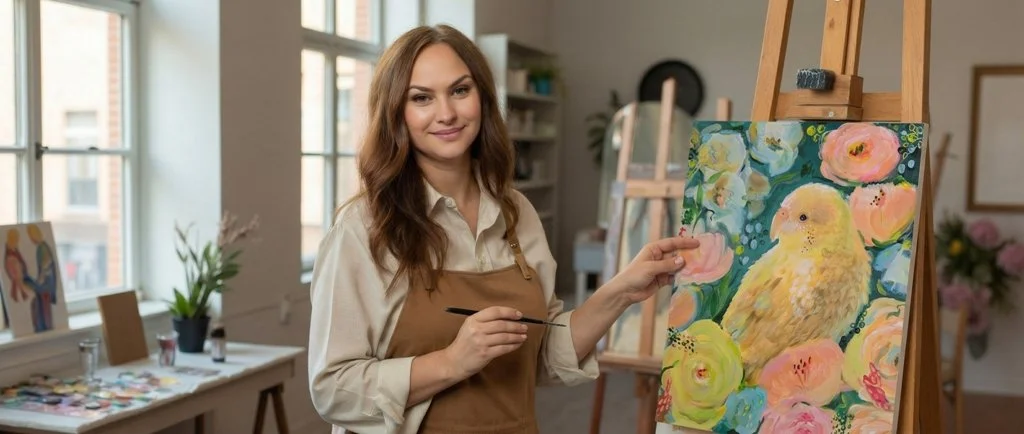
Ukrainian oil painter Mari Bloom on war, displacement, and painting as survival
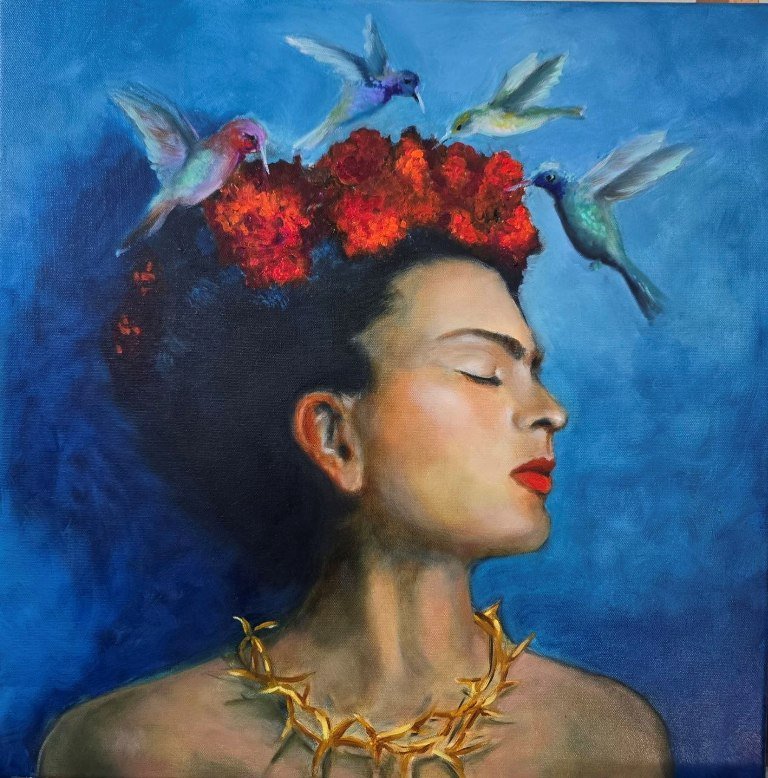
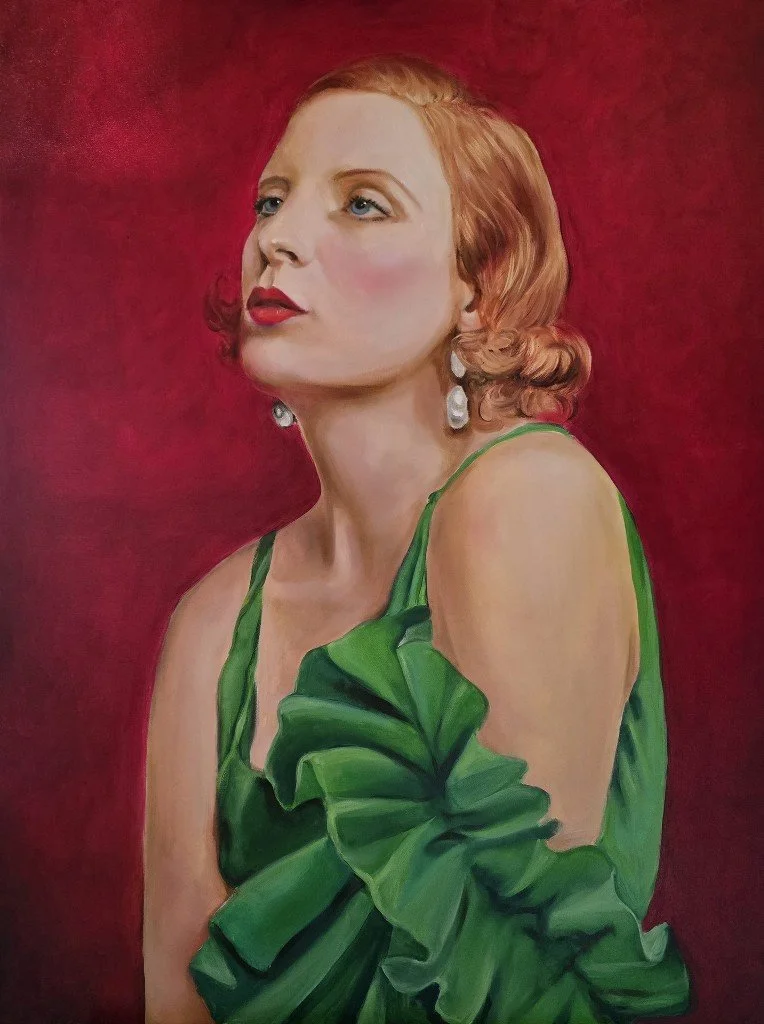
Editor's Note: Mari Bloom reached out to FC after reading our artist features. Her story…from Soviet Ukraine to the Spanish holiday that became an exile, to opening her own studio in Florida, is one of the most remarkable we've received. What follows is our Q&A with the artist, conducted over email.
Enjoy. -Mike
You were on holiday in Spain when Russia invaded. What were those four days actually like, and what did getting through them teach you?
My friend Yana and I were on holiday in Spain. Everything was lovely, relaxing — we had no idea how completely our lives were about to change. On the morning of February 24, 2022, we woke to phone calls and hundreds of text messages screaming from our screens: War. War, war! Russia has attacked Ukraine! The unthinkable had happened.
Our home cities were being bombed. Relatives weren't answering their phones. We cried. Then came an email from the airline: there was no return flight, all travel to Ukraine was cancelled. Then we discovered, in horror, that our bank cards were frozen — millions of Ukrainians were trying to withdraw money at once, and the system had collapsed.
Yana asked me, "How much cash do you have?" We checked — twenty dollars between the two of us. Our accommodation was paid until the end of the week, but where would we go after that? In a foreign country, with no family or friends nearby. Yana was crying: "Where will we stay, what will we do?" I tried to joke: "We can pick a train station or a church."
In the end, social media saved us. I wrote to everyone I knew. We asked for help with shelter, and a kind Dutch family with a big heart took us in. We survived there as best we could, fighting a terrible depression, thinking of our loved ones back home. Fear moved in and stayed. People kept asking, "How can we help you?" And I thought: buy me paints, please.
Those four days split my life into before and after. Life is so fragile, and the world can be cruel. The greatest wealth is people with open hearts. I am grateful to everyone who took part in my fate and helped me survive.
When you packed that one suitcase for Tampa, you filled it with paints and brushes instead of clothes. Was that conscious, or instinctive?
My friend Tatiana, who had emigrated and married in America eight years earlier, reached out to me: "Come, we can help with the paperwork." I agreed. On June 22, I found myself at Tampa Airport with a large suitcase — not many personal belongings inside, but everything else was paints, brushes, pastels, sketchbooks, and canvases. My real treasure.
When a situation restricts you and forces you to choose, people choose what is most precious to them. For me, that is my paints and the ability to make art regardless of country or circumstance. Painting is a therapy for survival.
You grew up in Soviet Ukraine, where everything was grey and closed. Your mother had one book on her shelf — The Hermitage. What did you see in those pages as a child, and how did it shape what you do now?
I was born in Ukraine, in the Soviet era. My childhood memories of that time are a contrast between the outer reality and the inner world I discovered for myself. The outer world was often grey: people mostly lived modestly, dressed alike, and everything was in short supply, from food to furniture. But inside me there always lived an interest in beauty, in detail — a love probably nurtured by my mother.
In our home there was a large art book: The Hermitage. Its glossy pages became my window into another world. I could spend hours studying the reproductions of the old masters: Raphael, Leonardo, my beloved Caravaggio, Degas, Matisse, Monet, and Rubens with his provocative half-nude figures — a shock to my child's imagination. My mother adored museums, and my whole childhood was spent traveling to them. That love is still alive in me today. There is a particular magic and beauty in works of art that captivates me. That is how my love of painting was born — and I think it is for life.
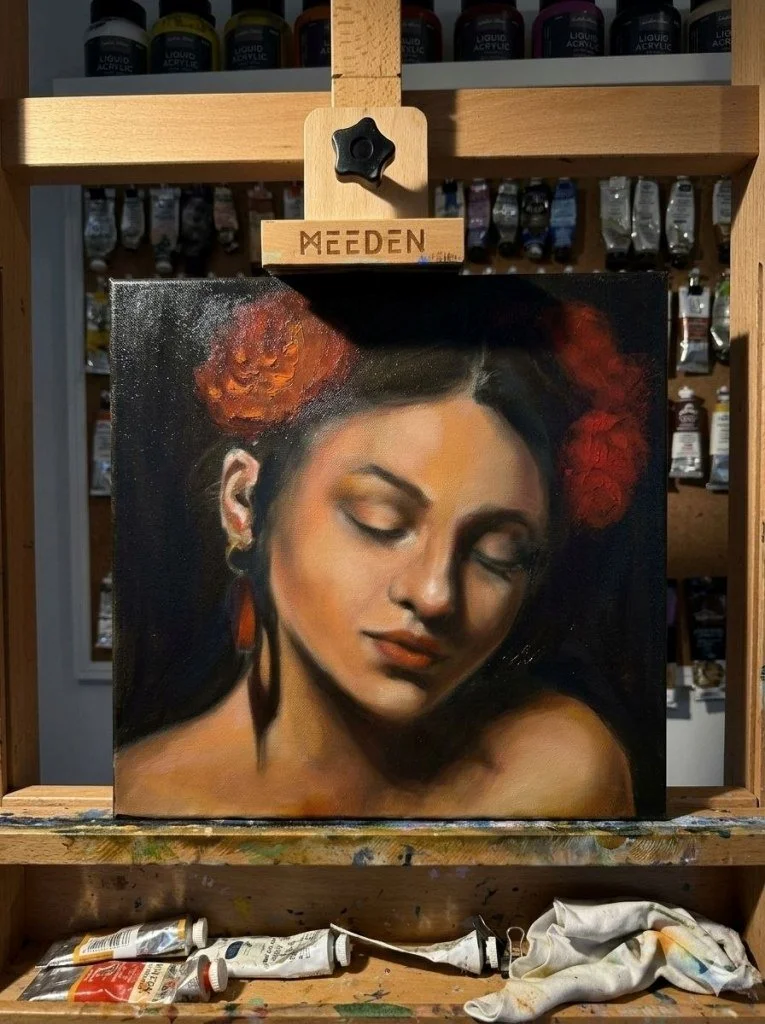
You've said "beauty is not decoration — for someone who grew up without it, beauty is an argument." What are you arguing for, or against, when you paint?
"Beauty is not decoration, it is an argument" reflects my philosophy of art as a powerful, transformative force rather than a mere decorative element. For an artist forced to leave her home because of war, and confronted with displacement, true beauty is a manifesto of survival and inner strength.
It is a force of resistance. Amid destruction and chaos, creating beauty becomes an act of resistance — it argues for the right of life, order, and harmony to exist in spite of everything. Decoration is passive; it only masks or entertains. An argument is active. It makes the viewer stop, enter into a dialogue, and rethink reality. The world tried to give me grey. I answered with color.
Tell us about the Between the Wars series and the connection to Tamara de Lempicka. What do you see in her that feels personal?
Between the Wars is a deeply personal, autobiographical story about the loss of home, forced flight, and trauma I lived through myself. These paintings capture the moment my familiar reality split into before and after. The state of being "between the wars" is not just a stretch of time — it is my inner sense of a person caught between a past life consumed by war and a new, foreign reality. It is an attempt to put myself back together, mentally and physically, in a new place.
For me this series became a way of self-healing. To paint in that period meant to process my fear and uncertainty into images. The women in these portraits carry a hidden pain, yet they possess enormous inner strength and resilience — the very qualities I search for in myself, so as not to break, so as to adapt in exile.
The women in your paintings look directly at the viewer and don't look away. Where do those faces come from?
I don't paint from life or make models pose for hours. All these faces are composite psychological images, born of my memory and my experiences. There is a great deal of myself in them.
Living in these features are my childhood memories, when I spent hours studying my mother's book of Hermitage reproductions, absorbing the anatomy and light of Da Vinci, Rembrandt, and Caravaggio. My directing background is at work here too: I am a theatre director by training, and the canvas is my stage. I direct every turn of the head, every gaze of my heroines, building their character and their drama, trying to convey what I feel.
And in the Between the Wars series, these faces became an archetype — a composite image of the Ukrainian woman who moves through historical catastrophe with her head held high. Their vivid color is not an attempt to look pretty. It is their argument, and mine, in favor of life.
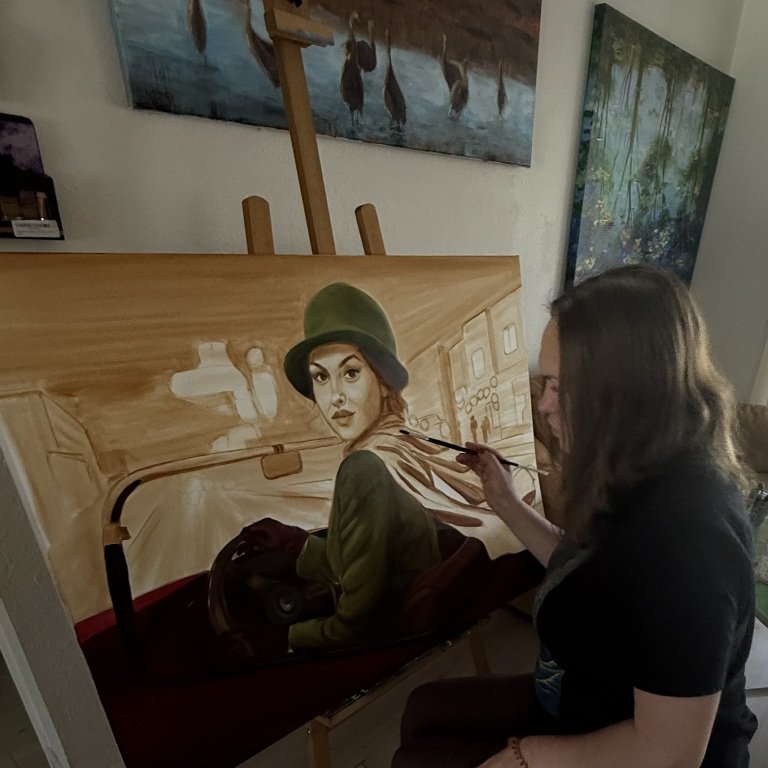
You opened The Fun Pelican Art Studio two years after arriving with nothing. What did it take, and what did it feel like on opening day?
Opening my studio, The Fun Pelican, inside the Artmosphere Gallery in St. Petersburg was not just the launch of a business. It was the moment of my true rebirth and my victory over circumstance. When war destroyed our thriving Paint Bar studio in Zaporizhzhia in 2022, it felt as though a huge part of my soul had been taken from me. Arriving in America, I knew that to feel alive again, I had to reclaim that space of shared creativity.
For a few years I worked on contract for Painting With a Twist in Trinity, Florida — an important step in adapting to America. It was very hard: two jobs, and an endless search for a space of my own. And in April 2024, my dream found a home again. I found Artmosphere Art Gallery & Studios — a living art cluster in the heart of St. Pete. The moment I walked in, I felt the powerful energy of independent artists, exhibition halls, and freedom. I knew I wanted to be part of this community.
The Fun Pelican was created for everyone. I often see how people are afraid of a blank canvas — they say they have no talent, or they've never held a brush. My task, as a director and an artist, is to remove that fear. I taught both adults and children, gently guiding them through the basics of oil, acrylic, or charcoal. It is an incredible joy to watch someone who came in tired or closed off leave with their own painting and shining eyes.
Today I feel that St. Petersburg has embraced me. My work is exhibited in the gallery, local art lovers buy it. I can share light and color again. And that, perhaps, is my strongest argument that art can overcome any destruction.
You paint florals, seascapes, portraits, and commissions alongside the personal Between the Wars work. How do you move between those modes?
This story began unexpectedly. One day a client came to me and commissioned several portraits in the Art Deco style. I'll be honest: until that moment I knew almost nothing about Tamara de Lempicka. It became not just a remarkable introduction to a new aesthetic, but a challenge — I had never painted in such large formats before.
The commission absorbed me so completely that I dove into the artist's biography. And what I learned struck me: how alike human fates are. Eras changed, generations passed, and yet people still lose absolutely everything to war. I never once thought that in my own lifetime I would have to live through a war myself, and feel firsthand what she once went through.
Every custom commission is a real challenge for me and, of course, priceless new experience. In every such challenge I see only the positive — an enormous stimulus for personal growth, and one more step forward.
Your work has been selected for the Seattle Art Fair and the international Emotions 2026 exhibition. How does it feel to have work that came out of personal survival showing in international venues?
I am very grateful to myself for my determination — my stubbornness, even. Do you know the story of Baron Munchausen? His most famous feat is when he and his horse got stuck in a swamp and he pulled himself out by his own hair. In the physical world it's impossible. But psychologically it is a brilliant image — a man who flatly refused to live in a grey, dull, cruel everyday reality, and colored the world around him with his imagination.
That is what I do. On the hard days, when the news from long-suffering Ukraine drives me mad, I pull myself out of that state and tell myself: go and paint. It is my salvation. And I think my paintings selected for exhibitions are the proof of it. I am deeply grateful to all the curators. It is a wonderful motivation to keep living and working.
What does painting give you that nothing else does?
When the world around you collapses, when there is war, and you have to leave everything and go to another country, you lose all control over your life. It is always a loss of your familiar social status and a barrier in communication. Nothing depends on you anymore. But when you sit down in front of a blank canvas, you are the only one who sets the rules of the game.
When depression closes in, or homesickness, or fear of the future, the brush becomes my only instrument of self-therapy. Painting gives me a universal international language. I don't need to find the right English idioms to tell a collector in Seattle what is on my heart. The color, the light, and the expression in my heroines' eyes speak for themselves. It is a way to be heard and understood on the deepest, most human level. Painting is a victory over chaos, and a way to put myself back together.
About Mari Bloom
Maryna Tsoneva, who signs her canvases as Mari Bloom, is a Ukrainian oil painter and educator based in Florida. Born in Ukraine in 1972, she trained as a theatre director at the Kharkiv State Academy of Culture. She is the founder of Paint Bar Art Studio (Ukraine), The Fun Pelican Art Studio, and Mari Bloom Studio (Florida). Her work has been selected for the Seattle Art Fair 2026 (TERAVARNA Gallery) and the international Emotions 2026 exhibition (Gallerium), and she is an International Member of the Portrait Society of America. Her paintings are held in private collections in Ukraine and the United States.
Website: MariBloomFineArt.com