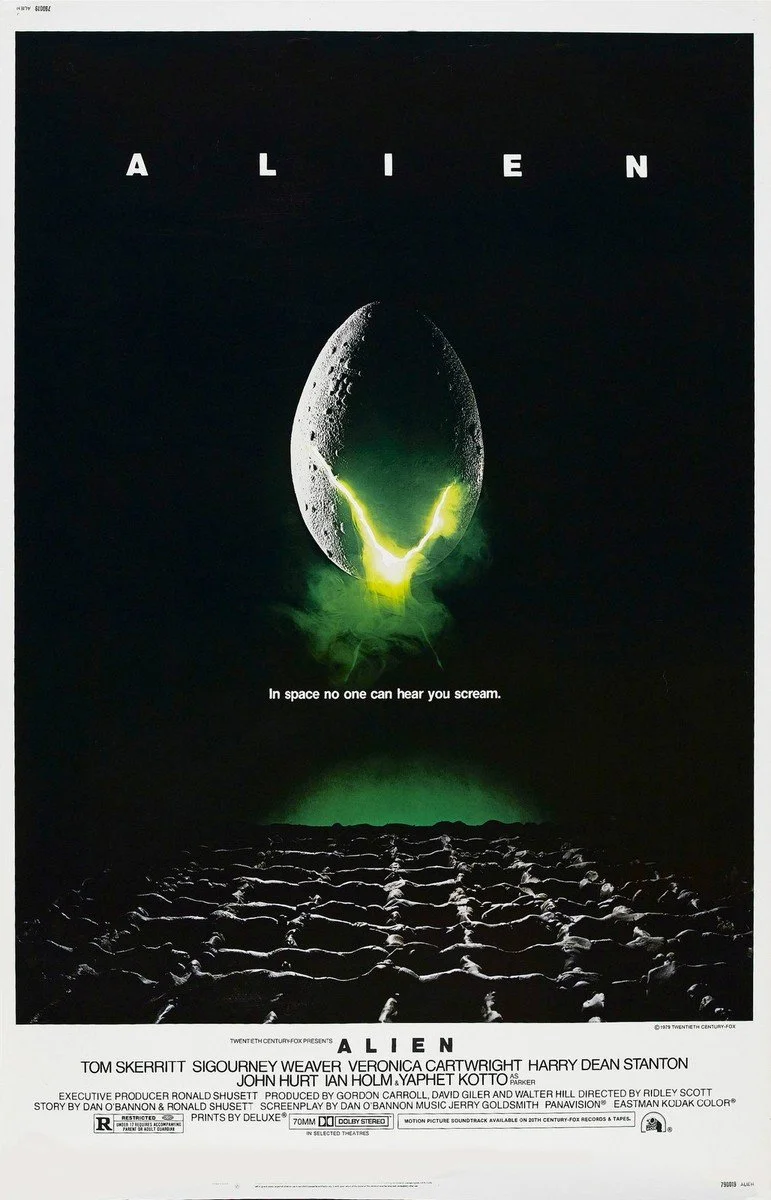
You've seen the movies. Here's what you probably don't know about where they came from.
The Alien franchise is my favorite franchise. All of it. Every film, yes even the ones you didn't like, even the ones I probably shouldn't admit to liking. Alien was the first glance of a horror movie that I got when I was around 7 years old. It grabbed my attention and is why I love horror today.
But this isn't just another Alien article. The films have been covered endlessly over the interwebs, I’m sure. What gets discussed less is the origin of the thing at the center of it all: the creature itself, and the deeply strange, deeply human story of the artist who created it.
This is partly about the franchise. Mostly it's about H.R. Giger.
Before Alien, Space Was Clean
It's worth remembering what science fiction looked like before 1979. Think Star Trek and 2001: A Space Odyssey. Space was noble, polite, aspirational and inhabited by people in clean uniforms who spoke in measured tones about the future of humanity.
Alien gave us truckers in space. The Nostromo was grimy and leaking. The crew complained about bonus pay and bad food. They weren't explorers or military officers, they were contract workers getting screwed over by a corporation that had already decided their lives were worth less than the thing they'd been sent to retrieve.
The Weyland-Yutani Corporation is arguably the real villain of the entire Alien series. The Xenomorph is terrifying. But it's doing what biology designed it to do. The company made a choice…and looking back, it’s equally as terrifying.
That grounded cynicism, the idea that even in the distant future we'll still be exploited by heartless corporations, is part of what made Alien land differently than anything that came before it. The horror (and science fiction) felt closer to home and more relatable.
The Xenomorph Was Born From a Nightmare. Literally.
H.R. Giger suffered from chronic night terrors for most of his life. He used art as a form of therapy, a way to exorcise the visions that haunted him in the dark. He kept a sketchbook beside his bed so he could capture whatever was there when he woke up before it disappeared.
The Alien is, in the most literal sense possible, a painted nightmare…and that’s exactly how it looks.
Giger was born Hans Ruedi Giger on February 5, 1940, in Chur, a small Swiss town. His father was a pharmacist and young Giger grew up surrounded by glass bottles and strange medical instruments. When he was five years old, his father brought home a real human skull from a medical supplier and gave it to him as a gift. Giger tied a string to it and dragged it around the neighborhood like a puppy. The origin story practically writes itself.
Switzerland was neutral during the war but the fear of invasion was constant throughout his childhood. His parents kept the lamps covered with dark bluish cloth so Allied bombers wouldn't spot their house. Giger later said he grew up absorbing the collective dread of the adults around him without understanding what was causing it. That creeping, invisible, unexplained terror became the foundation of everything he made.
His style, which he called biomechanical, fused human bodies with machines in ways that felt simultaneously alien and deeply familiar. Not robots. Not humans. Something in the space between, something that had no name because nothing like it had existed before.
The Muse
In 1966, Giger met a Swiss stage actress named Li Tobler in Zurich. She was studying drama, he was a young designer barely making ends meet, and they moved in together almost immediately, sharing a series of rundown apartments in the city's bohemian circles.
Li became his absolute muse. Her face appears in dozens of his paintings from that period, sometimes clearly recognizable, sometimes fused into the biomechanical forms that were becoming his signature. She was the human element in his inhuman art.
Their relationship was intense and complicated. Li struggled with severe depression throughout their years together. Giger later said she had "an enormous vitality and a great appetite for life" but also that she had told him she wanted her life to be "short and intense." He took care of her through hospitalizations and disappearances, but was powerless against the depression that gradually consumed her.
In May 1975, at 27 years old, Li took her own life at their home in Oerlikon.
Giger was devastated. His work after her death took on an even darker tone, the biomechanical forms becoming more claustrophobic, more suffocating, more infused with the specific weight of grief…which certainly is present in the DNA of the franchise.
How the Alien Almost Didn't Happen
In the early 1970s, Chilean filmmaker Alejandro Jodorowsky was attempting to make a massive, wildly ambitious adaptation of Frank Herbert's Dune. He assembled a dream team that included Giger, writer Dan O'Bannon, and Salvador Dali. The project collapsed spectacularly. It remains one of cinema's most fascinating disasters, and there's an excellent documentary about it if you want to go down that particular rabbit hole.
But O'Bannon was so struck by Giger's art during the Dune project that when he sat down to write what would become Alien, he wrote it specifically with Giger's aesthetic in mind. The monster didn't exist yet, but O'Bannon already knew what it could look like.
Director Ridley Scott chose Giger's 1976 painting Necronom IV as the basis for the alien creature. Fox executives hated it immediately. They thought Giger's work was too disturbing, too grotesque, too much for audiences (so what’s the problem?), Scott fought for him and won.
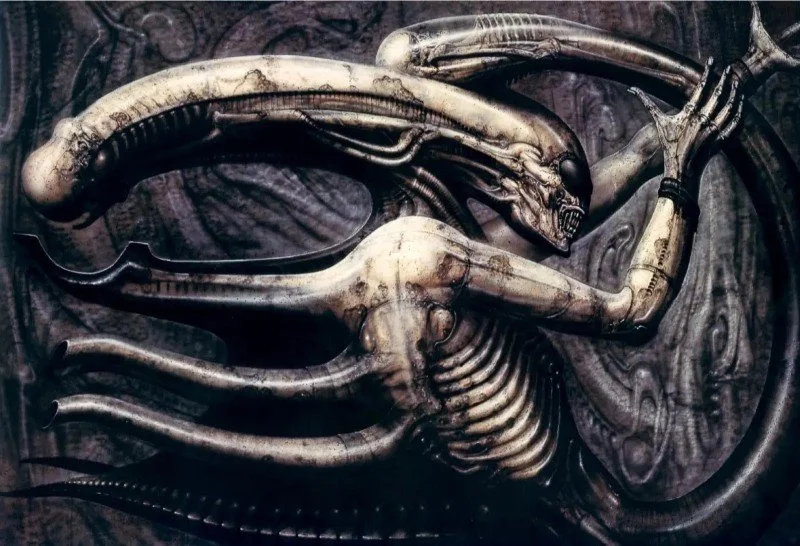
Necronom IV (1976) by Hans Ruedi Giger
Then Giger did something that turned out to be the key design decision in the entire franchise. If you look at Necronom IV, the creature has eyes. When designing the movie version, Giger deliberately removed them. His reasoning: a monster is infinitely more terrifying if you have no idea whether it's looking at you. Giger’s Alien was born.
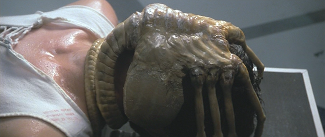
The “facehugger” was the first thing Giger designed, and his original concept was enormous: massive, with eyes, and a spring-like coiled tail to help it jump. After feedback he scaled it down and modeled it after a pair of skeletal human hands. The result was something that looked like it had no business existing.
The Chestbuster
No article about Alien is complete without the “chestburster”. It remains one of the most shocking moments in cinema history, and the story of how it was filmed is almost as good as the scene itself.
Ridley Scott deliberately kept the cast in the dark about what was actually going to happen. The script described it as simply "the thing emerges." That was it. Scott knew that if actors were just pretending to be horrified, you'd see the acting. He wanted something rawer than that.
On the day of filming, the set was shrouded in plastic and smelled of formaldehyde. John Hurt was fitted with a false chest packed with real animal organs sourced from a local butcher. Blood pumps were hidden under the table. A hydraulic ram was rigged to push the puppet through at the right moment. The crew were all wearing raincoats. The cast, as Sigourney Weaver later noted, probably should have found that suspicious.
When Scott called action and the chestburster tore through, the cast's reactions were completely genuine. Veronica Cartwright, who plays Lambert, was actually hit in the face by a spray of blood that wasn't supposed to reach her. Her reaction of stumbling backward in horror is real. The whole scene is real, because Scott engineered it that way.
At the premiere, the audience reportedly broke into wild applause after the scene. Then went completely silent. Associate producer Ivor Powell remembered people running to the bathroom, some fighting for seats further back, and the Fox studio head's wife reportedly still traumatized by it years later.
Stanley Kubrick reportedly called Ridley Scott afterward to ask how the practical effects were done. When Kubrick wants to know your secrets, you've done something right (genius, actually).
The Oscar, The Sequel, and The Letter
Alien won the Academy Award for Best Visual Effects in 1980. Giger's contribution was central. He was, briefly, a recognized figure in mainstream cinema.
Then James Cameron took over to make Aliens. He completely froze Giger out. Didn't call him. Didn't consult him. Made the sequel without him.
Cameron later wrote Giger an apology letter, which is the kind of thing that happens when you've had time to reflect on something you know was wrong. He admitted he was intimidated by Giger's psycho-sexual aesthetic and knew that if Giger was involved, his art would overpower the film. Cameron wanted to put his own stamp on it. The decision was creatively defensible. The execution, just not calling, was not.
Alien 3 helped launch director David Fincher’s career (it was his 1st feature) and brought Giger back. Producer Gordon Carroll hired him to design the new creature. Giger produced the sleek, fast, animalistic Dog Alien, intentionally stripping away the large biomechanical pipes from its back to create something that moved differently. Then the studio handed the physical build to a special effects company called ADI, who changed his designs. Giger was furious. He was left out of the theatrical credits entirely and had to fight to be recognized for work he'd actually done.
Alien Resurrection didn't involve him at all, but he reportedly liked the film. History repeated itself anyway: his name was again left off the credits initially, requiring yet another fight before Fox corrected it.
Ridley Scott brought him home for Prometheus in 2012. When Scott returned to the franchise, he went straight back to Giger. Giger provided new concept sketches and designed the alien murals inside the Engineer temple. There is footage of Scott visiting Giger's studio to show him the new designs and get his blessing. It's a genuinely moving thing to watch and the production design in the film was amazing.
It was his last direct contribution to the series. Giger died on May 12, 2014, after a fall at his home in Zurich. He was 74.
One last franchise detail that's too good not to mention… there's a footnote that has become one of cinema's great pieces of accidental mythology: the entire Alien vs. Predator crossover, which spawned comics, video games, and eventually films, started as a background gag. The special effects crew working on Predator 2 in 1990 put a Xenomorph skull in the background of the Predator ship as an inside joke. Fans saw it and lost their minds. That single prop practically spawned an entire industry…props to the props department.
The Credit Wars Continue
Since his death, his wife Carmen Maria Scheifele Giger has managed the H.R. Giger Museum in Switzerland (it’s on my bucket list) and oversees his estate with considerable care. The estate has consistently ensured that "Original Alien Design by H.R. Giger" appears in the credits of every project that uses his work.
The fight isn't over. Alien Romulus in 2024 fully credited him and leaned heavily into his original aesthetic, which fans responded to enthusiastically. But eagle-eyed viewers noticed that early credits for the Alien: Earth television series appeared to drop his name, sparking immediate fan backlash and speculation that the creature design had been tweaked just enough to sidestep paying his estate.
The drama, like the franchise itself, continues.
The Horror
The Xenomorph doesn't have motivation in any way we can access. It doesn't want revenge. It's not evil in any human sense. It's biology operating at maximum efficiency with no regard for anything else. There's no reasoning with it, no appealing to it, no moment of connection. It is utterly, completely other…and it’s horrifying.
That quality came from Giger. The creature that lived in his nightmares was never going to be something familiar with a horror mask on. It was going to be something that had never existed before, pulled from a part of the imagination that most people don't visit and for good reason.
He gave us a monster that is still, 46 years later, the most convincing argument cinema has ever made that there might be things out there we are completely unprepared for.
He made unique art to survive his own unique mind. The world is richer and more terrifying for it. Amen.
About The Author
Mike Meyerson is the founder of FEELING CREATIVE?, and has been a horror nut ever since Alien and The Exorcist gave him nightmares as a boy. Currently located in NY’s Hudson Valley Region, is always looking to build the network, find a new cool trail to hike and a new horror movie to watch.
Read Mike’s other articles - HERE.