From prehistoric clay to Hokusai's waves, Japanese art has never really been about showing off.
Growing up, there was a painting on the wall of our living room that I never fully understood but couldn't stop looking at. A striking kabuki-style figure, white-haired and otherworldly, rendered in bold graphic lines with gold foil detail, by a Japanese artist named Hisashi Otsuka. The piece was called Lion of Winter. Nobody in the house could have told you much about Japanese art history. But something about it attracted everyone’s attention.
There's a reason Japanese art keeps showing up everywhere, on gallery walls, in tattoo studios, on tote bags, in the Instagram feeds of people who don't even know where it came from. It has something most art doesn't: even though the art often has a feeling of “less is more”, it often contains so many layers of depth, it feels like the art can just keep going indefinitely…off the page, canvas or body (as with a tattoo).
That's not an accident. It's a philosophy that runs through thousands of years of Japanese creative culture, from the earliest pottery ever made to the digital installations filling warehouses in Tokyo today.
It Started With Clay
Japanese art history begins in the Jōmon period, roughly 10,500 BCE, which makes it one of the oldest continuous artistic traditions in the world. The word "Jōmon" means cord-marked, a reference to the patterns pressed into wet clay using twisted rope before firing. What's remarkable is that these weren't purely functional objects. The decoration was deliberate. People living in prehistoric Japan were making aesthetic choices, pressing patterns into clay not because they had to but because it looked right and those patterns started telling stories.
That instinct toward beauty in everyday objects never really left Japanese art. It just evolved.
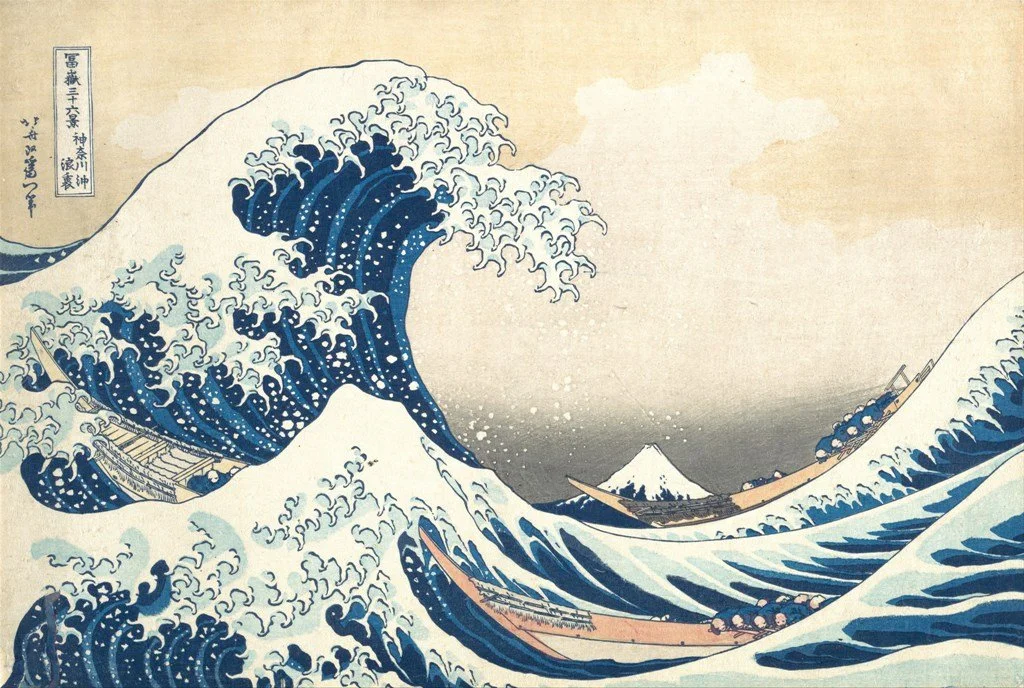
Katsushika Hokusai - The Great Wave off Kanagawa / aka: Tsunami (1831)
The Wave Everyone Knows
Fast forward to the 1830s and Katsushika Hokusai, who produced what became the most recognized piece of Japanese art in the Western world: The Great Wave off Kanagawa. Part of his series Thirty-Six Views of Mount Fuji, the print shows an enormous wave mid-curl, with tiny boats beneath it and Mount Fuji small and serene in the background.
It's a woodblock print. Ink on paper, produced in multiples, originally sold cheaply to ordinary people. Not a painting for a palace. The fact that it's now one of the most reproduced images in art history says something interesting about what actually lasts.
Hokusai was in his seventies when he made it. He'd spent decades producing work, reinventing himself repeatedly under different names, and he reportedly said that nothing he made before age seventy was worth much. He died at 89, reportedly saying he wished he'd had five more years to become a true artist. The gap between taste and ability, it turns out, isn't a modern problem.
What Makes It Japanese
There's a through-line in Japanese aesthetics that goes by several names depending on the context: wabi-sabi (the beauty of imperfection and impermanence), ma (the significance of negative space and pause), mono no aware (the bittersweet awareness that things don't last). These aren't just design principles. They're ways of seeing.
Western art has historically leaned toward fullness: fill the canvas, make it dramatic, show everything. Japanese art often does the opposite. An ink painting of a single bird on a branch with half the scroll empty. A ceramic bowl with an intentional crack filled with gold. A woodblock print where the mountain is the smallest thing in the frame.
That sensibility quietly rewired Western art when it arrived in Europe in the late 19th century. Monet's water gardens, Van Gogh's bold outlines and flat color fields, Toulouse-Lautrec's poster compositions: all of them were directly influenced by Japanese woodblock prints. The movement even had a name: Japonisme.

Vincent van Gogh - Brug in de regen-naar Hiroshige (1887)
Then Everything Changed, and Stayed the Same
Contemporary Japanese art looks nothing like Hokusai and everything like him at the same time. Yayoi Kusama's infinity mirror rooms fill entire museum buildings with obsessive pattern and repetition, a very Japanese sense of the infinite expressed through very modern materials. Takashi Murakami's Superflat movement deliberately collapsed the boundary between fine art and commercial culture, between manga and painting, between old and new. TeamLab's immersive digital installations dissolve the line between viewer and artwork entirely.
Different materials, same questions: What is the relationship between the individual and something much larger? What do you leave in and what do you leave out? How do you make someone feel something without explaining it to them?
Why It Still Matters
Japanese art endures partly because it was never really about status or spectacle. The tea ceremony aesthetic, the garden design, the woodblock print sold at market: these were arts made for daily life, for attention, for the practice of noticing things.
That's a useful idea regardless of where you're from. The creative traditions that last tend to be the ones that treat ordinary moments as worth caring about.
If you're drawn to Japanese aesthetics, whether in art, design, photography, or the general philosophy of less being more, you're responding to something that has been refined over a very long time by people who thought carefully about exactly that.
About The Author:
Mike Meyerson is the founder of FEELING CREATIVE?, and has worked in the video/marketing/advertising industries for over 25 years. Currently located in NY’s Hudson Valley Region, is always looking to build the network, find a new cool trail to hike and a new artist to follow, and yes…”Lion in Winter” still hangs on his parents’ wall.
Read Mike’s other articles - HERE.