
Cats, Geometry and a Little Imagination
Artist Spotlight: Marina Imar
I am Marina Imar, an artist working in painting and graphic art.
In my work, I use geometric shapes, broken lines, and simplified structures, transforming familiar images into a slightly different visual world.
Back in 2018, I decided to try applying my geometric language to the image of a cat.
At first, I created a small sketch using colored pencils. I liked the result — the cat turned out bright, slightly unusual, and very alive. I decided to continue the idea and created my first painting on canvas.
At that time, I had no idea that this idea would become the beginning of a large series. I simply liked the image I had created and wanted to continue. One sketch followed another, and then new artworks began to appear.
This was how the “Avant-Garde Cats” series gradually began to take shape.
Over time, cats became an important part of my artistic practice. The series grew, and the cats developed different personalities, appearances, and situations. Eventually, the paintings found their viewers and traveled to different countries. Today, my cats live in private collections, including faraway Australia.
My cats are one of my favorite series. In general, all of my work combines avant-garde ideas and geometry.
But geometry is not just an artistic style for me. It is also a way of seeing the familiar world differently. I like taking familiar objects, animals, or everyday situations and transforming them into systems of simple forms while preserving their character, mood, and recognizability.
For me, geometry is not a strict or static structure. On the contrary, it gives me the freedom to play with form, color, space, and movement. I am interested in finding a degree of simplification at which an image becomes almost abstract, yet remains alive and understandable to the viewer.
When I work with cats, this becomes especially interesting. They can be expressed through relatively simple forms, but at the same time it is important to preserve the individuality of each character — its pose, movement, mood, and personality.
Cats are fascinating characters in general. They are very interesting to observe: they can simply sit, carefully watch something, or interact with each other — and each of these ordinary situations already contains a little story.
That is why I enjoy depicting cats. I do not want to simply create a beautiful geometric shape in the form of a cat. It is important to me that behind the simple forms there is a character.
And, answering your question in advance: yes, I have cats too. I think this is one of the reasons why I enjoy observing them so much and turning their behavior into images, paintings, and digital art.
The idea of creating a digital project came to me at the beginning of 2026, so it is a very recent development. By that time, I already had experience working with cats in painting and graphic art, but I wanted to explore a new direction.
The world is changing, and artists are increasingly using modern technologies as well. For me, this became a reason not simply to transfer my existing cats from painting into a digital format, but to create an independent artistic project.
The transition to digital art was not a rejection of painting for me, but a new stage in the development of an existing artistic language. Geometry, color, and the work with the character of an image remained important, but the digital environment gave me new ways of working with these elements.
I became interested in experimenting with composition, scale, combinations of forms, and color solutions, testing different possibilities more quickly and seeing how the same artistic decision could be perceived completely differently depending on its surroundings.
What became especially important to me was that digital art makes it possible to develop not only individual images, but also an entire series united by a common visual language.
It is very interesting to see how the original idea of the “Avant-Garde Cats” can develop. My love of geometry, bright colors, and distinctive forms has remained, but the project itself has become broader: new situations, interactions between cats, and elements of Japanese visual culture have appeared.
That is why, for me, Geometric Cat Art is not simply a collection of images of cats. It is an ongoing artistic project that grew out of my painting and found a new space for development in digital art.
The idea of combining the avant-garde geometry of my cats with Japanese style became a natural continuation of the series. My cats have always seemed slightly Japanese to me — perhaps because they already had something of the visual simplicity and expressiveness that I feel close to. And I have always loved Japanese culture.
I like the Japanese sense of minimalism and the combination of decorative elements with restraint. At the same time, even a simple everyday object can become expressive through composition, details, and the way empty space is used.
I wanted to create my own, slightly imaginary artistic fairy tale about Japan — a space where my geometric cats find themselves in a world that combines everyday situations with Japanese visual motifs.
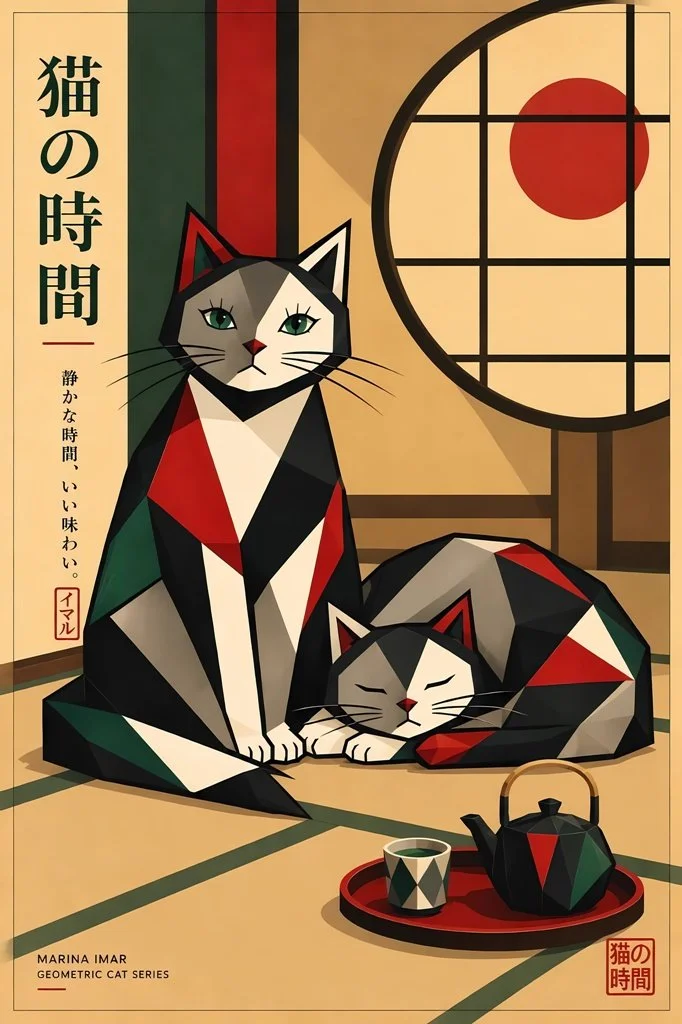
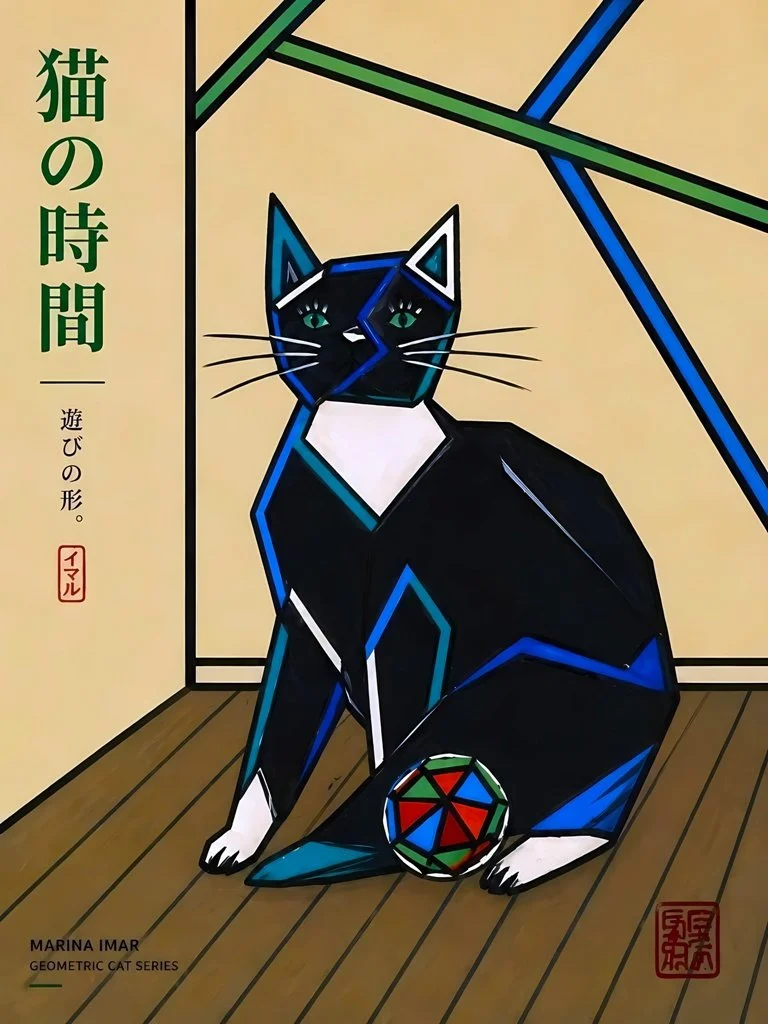
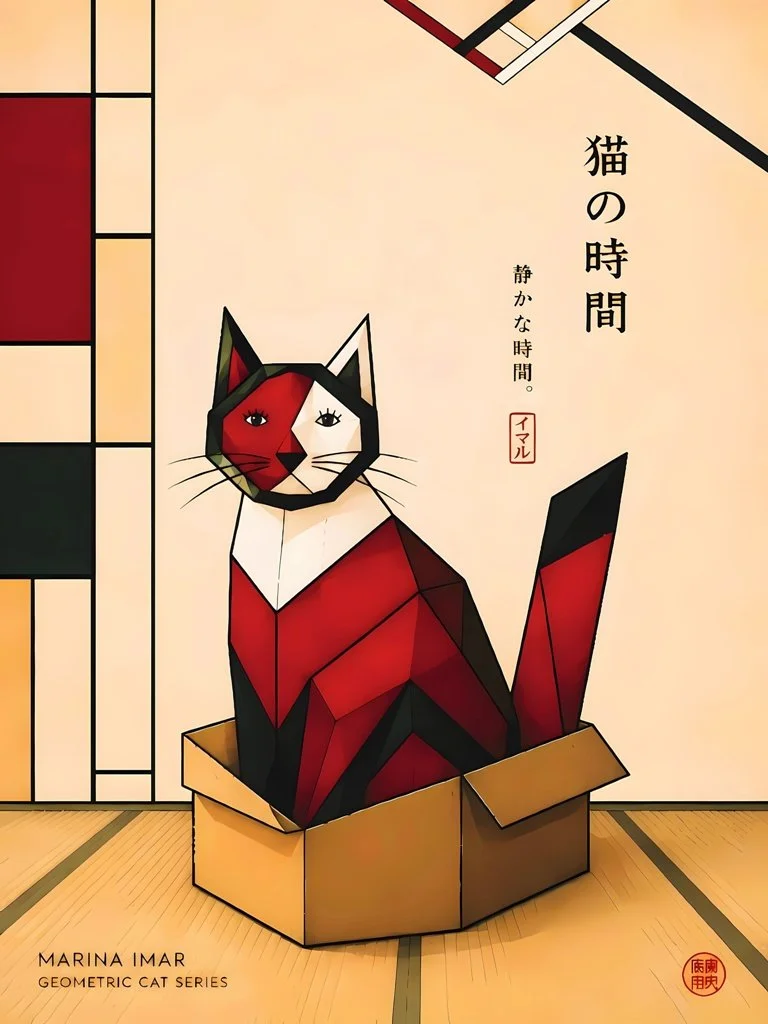
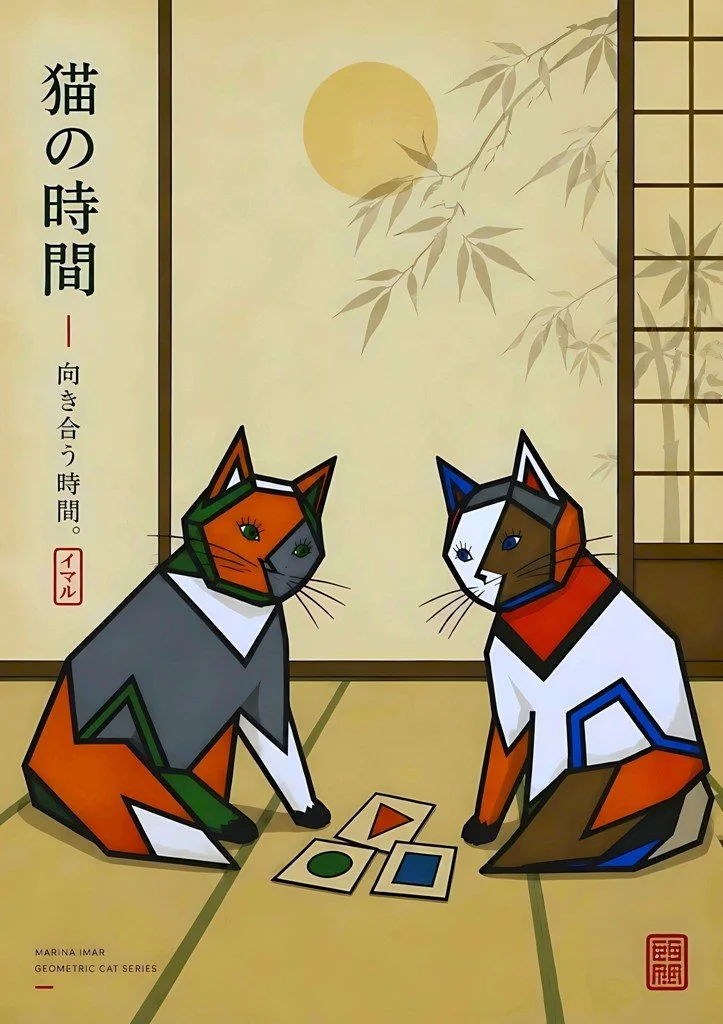
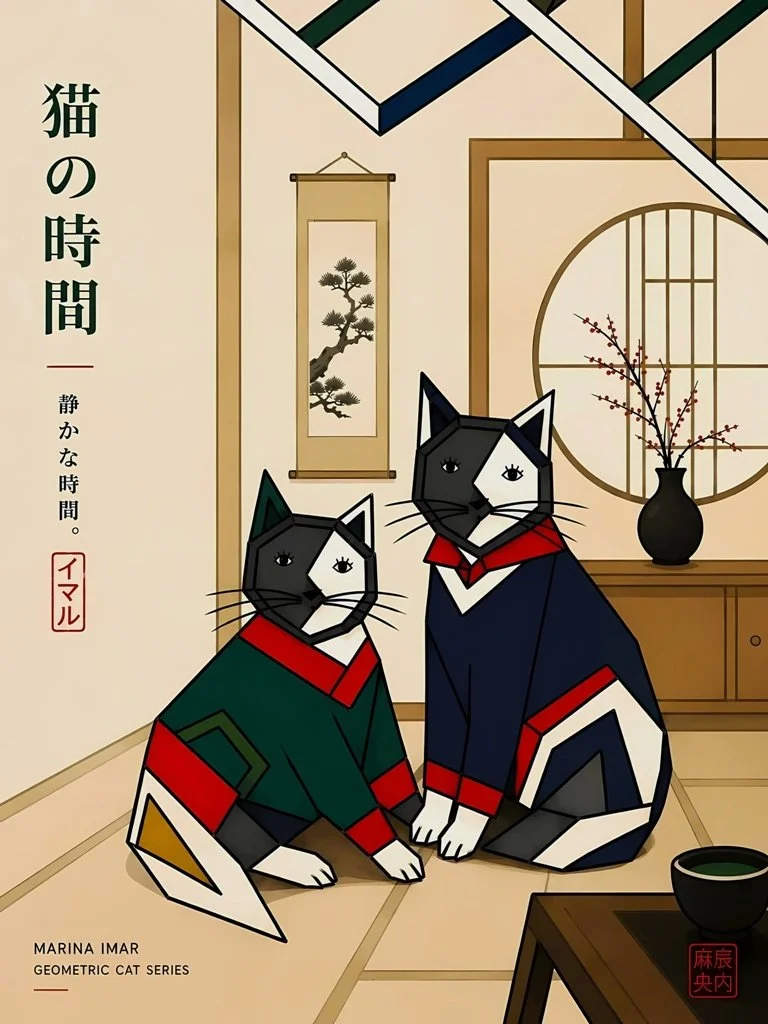
This is how the project “A Cat’s Time” — 猫の時間 (Neko no jikan) came about.
For me, this became a new stage in the development of my existing characters. They received a different environment, new stories, and a different mood, while keeping their personalities and the geometric language with which everything began.
The project includes cats wearing kimono, cats having tea, a cat curled up inside a box, scenes of play, and other little stories from the lives of cats.
From the outside, it may seem that working in digital art is easier than working on canvas or paper, but it is not.
The most difficult thing for me when working in digital art was preserving the originality of the project.
The digital environment offers an enormous number of possibilities, and precisely because of that, it is easy to lose your own visual language among the countless images and styles that already exist. It was important to me not simply to use digital tools to create beautiful and visually striking pictures, but to preserve what makes my cats my own, original characters.
I wanted my geometric forms, distinctive lines, approach to color, and composition to remain recognizable in every new work. At the same time, the project needed to develop rather than become an endless repetition of the same image.
For me, this became a constant search for balance: how to develop the project, experiment, and try new things without losing its own identity.
Today, Geometric Cat Art — “A Cat’s Time” — 猫の時間 — continues to develop as my ongoing authorial project.
At the same time, the project itself is gradually changing. In the beginning, my cats were very minimalist — consisting almost entirely of simple forms and a small number of details. Over time, however, their images have become more complex.
Today, my works are moving increasingly toward avant-garde painting. It is becoming important not only to depict the character itself, but also to work with color, composition, the interaction of geometric forms, and the space around the character. I can allow myself more details, more complex color combinations, and a freer composition while still preserving the recognizable geometric language of the project.
I am curious to see where this development will lead. I do not want to define the project’s final boundaries in advance. For me, it is important that Geometric Cat Art continues to change, preserving its individuality while opening up new possibilities for me as an artist.
Biography
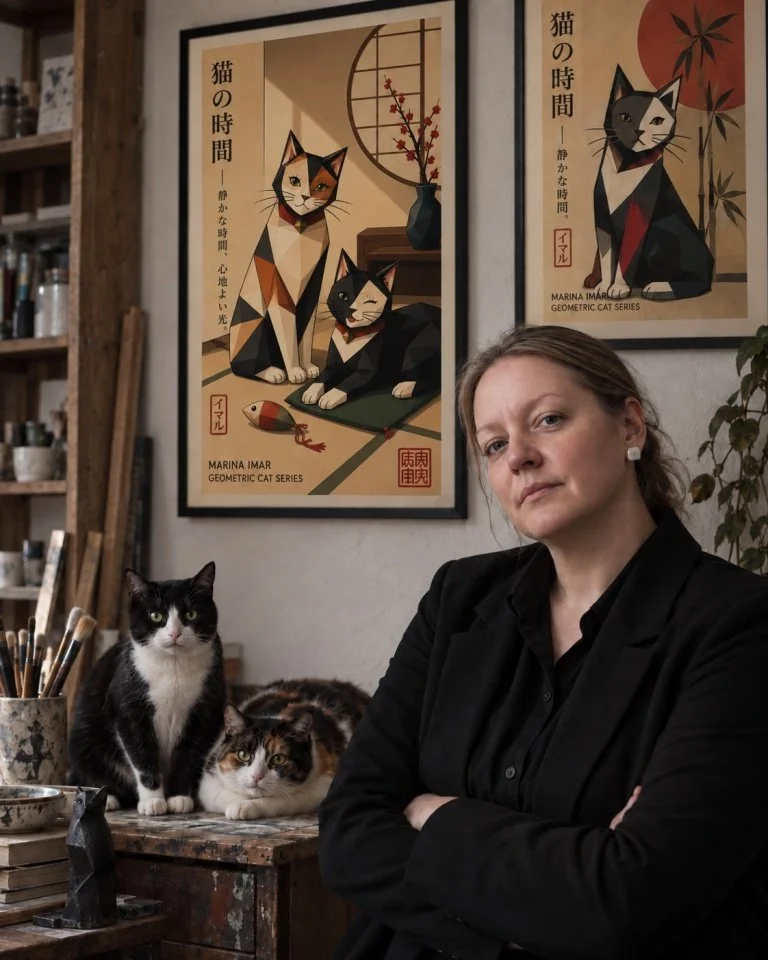
Marina Imar is a contemporary artist working within the fields of avant-garde art, conceptual art, and visual irony. At the core of her artistic language is the deconstruction of familiar images and their transformation into expressive geometric structures. In her work, she explores rhythm, color, form, and tension within the composition, combining painterly freedom with the clarity of geometric construction.
In her artistic practice, Imar works with acrylics and markers, creating dynamic works on canvas and cardboard. Her art explores a variety of subjects — from reinterpretations of Japanese traditions and samurai imagery to animals and urban scenes, which she transforms into independent visual narratives.
Her professional career includes exhibitions with creative organizations such as the Union of Artists of St. Petersburg, the Union of Artists of Belarus, and the Union of Designers of Moscow. Imar has participated in more than 50 exhibitions and has received international awards, including an ART Czech Republic diploma. Today, her works are held in private collections in different countries and across different continents.
Since 2026, Imar has been developing digital art through her authorial project Geometric Cat Art, continuing to explore the possibilities of geometry, color, and avant-garde art.
Visit Imarart.com
Follow on Instagram / Facebook
See more on Artmajeur
