
Why "Wish You Were Here" Is Rock's Greatest Song
By Phil Allard
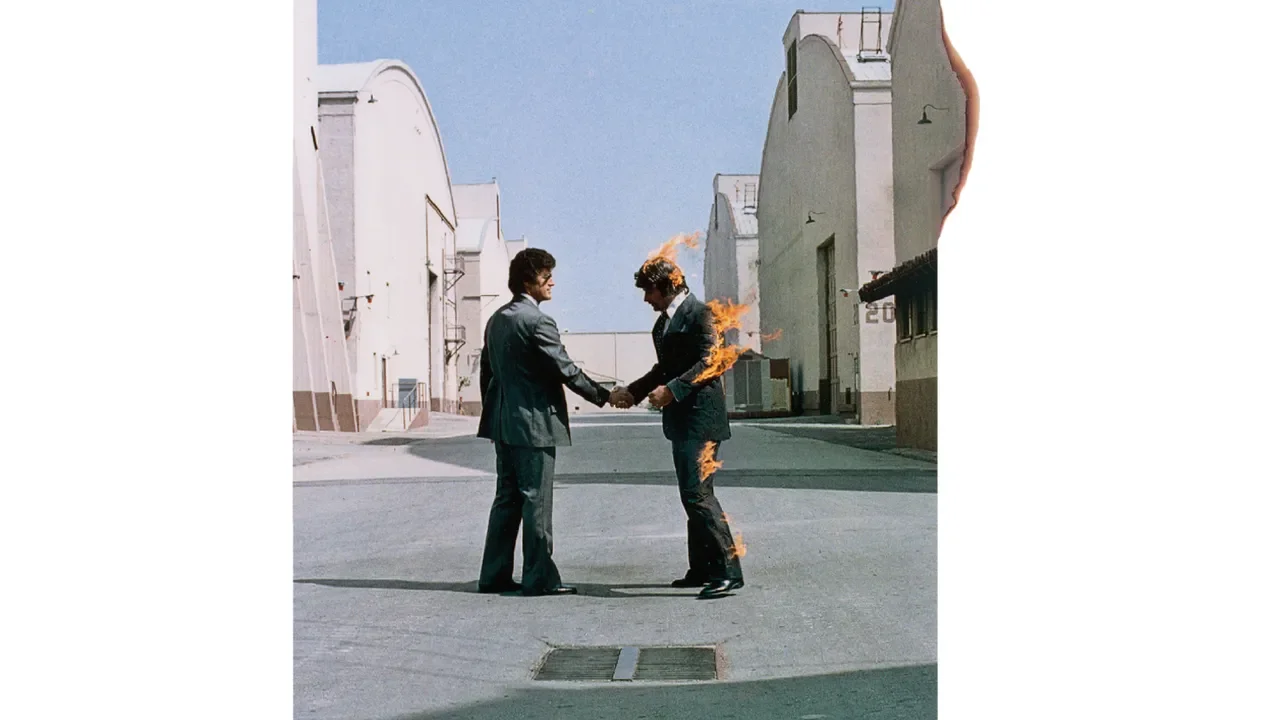
Some songs are impressive. "Wish You Were Here" is something rarer: a song that aches. Released in 1975 as the emotional core of Pink Floyd's album of the same name, it earns its claim to greatness not through spectacle but through restraint, through everything it declines to say outright.
The lyrics never resolve into simple sentiment. Instead, they work by way of unanswerable questions and stark contrasts: heaven against hell, a walk on part against a leading role, a cage against freedom, offered without commentary, so the listener has to sit with the gap between them. That gap is the whole point. The song isn't really about the person it addresses; it's about the impossibility of ever fully knowing another person, orbeing known yourself.
Roger Waters wrote it in large part for Syd Barrett, and that history matters more than a footnote. Barrett had been Pink Floyd's founder and original creative engine, the one who named the band and wrote its earliest songs, before a collapse tied to mental illness pushed him out only a few years into their career. By 1975 he had become something like a ghost the band could not stop circling. He was still alive, but the person they had known was, in every functional sense, gone. That is a strange and particular kind of grief, mourning someone who has not died, who might still be reachable in theory, and yet is not reachable at all. It is grief without the clean edges of a funeral.
The song's origins were almost offhand. By most accounts David Gilmour worked out the opening twelve string figure on his own, and Waters has described the song as one that came together strangely fast, written in something like an hour. He and Gilmour rarely wrote together by that point in their partnership, so the collaboration itself was unusual, a brief truce between two men who would spend much of the following decade at odds. Waters wrote the words after the music was largely settled, and Gilmour ended up singing them, which gives the recording an odd double distance: one man's grief sung in another man's voice.
Waters himself has resisted a purely biographical reading of the song. He has suggested the lyrics reach past Barrett alone into something more existential, a meditation on absence and disengagement that speaks to anyone who has gone through the motions of a life without feeling present in it. That reading fits the album as a whole. Waters once summed up the band's complicated relationship to Barrett bluntly, saying the group could not have existed without him but also could not have continued with him, a line that captures both the debt and the guilt at the heart of the record. The surprise still lands, though, when you learn that Barrett himself wandered unannounced into Abbey Road studios in June of 1975, while the band was mixing "Shine On You Crazy Diamond," the album's other Barrett elegy. He had gained so much weight and shaved his head and eyebrows that some of his old bandmates did not recognize him for several minutes. They were, quite literally, in the middle of mourning a man who then walked through the door.
There is a vagueness to it that recalls Dylan, the way a Dylan lyric can gesture at a feeling without ever naming it directly, leaving the listener to fill in what is missing. But where Dylan often piles up image after image until the meaning multiplies and refracts, Waters strips the language down to almost nothing. Few words. Plain contrasts. No wordplay to hide behind. It is a simpler kind of vagueness, one that trusts silence and space more than metaphor. You can hear echoes of that same restraint elsewhere in the band's own catalog, and in artists working adjacent to them at the time, Nick Drake's hushed, unresolved sadness, Leonard Cohen's plainspoken ache, even the wide open spaces Neil Young left in his quieter songs. All of them understood that the less a song insists, the more room it leaves for the listener to arrive at their own meaning. Even musicologists who have studied the track closely have pointed out that its verses avoid the strong chord resolutions listeners expect, drifting from one chord to the next without the usual sense of tension and release, which is part of why the song feels unmoored in a way that mirrors its subject.
That restraint also fit its moment in a way that feels almost inevitable in hindsight. By 1975 the optimism of the previous decade had curdled. The counterculture's belief that the world could be remade through music and protest had run up against Vietnam, Watergate, economic stagnation, and the slow realization that a generation's idealism had not delivered the world it promised. The youth of the late sixties who had marched and dropped out and believed were now older, and many of the friends, heroes, and versions of themselves they had lost along the way were not coming back. Barrett's decline was one specific casualty, but it stood in for something larger, the sense that brilliance and innocence had been consumed by the decade rather than rewarded by it. "Wish You Were Here" caught that mood exactly. It is not a protest song and it is not a eulogy. It sits in the space of quiet disillusionment between the two, which is likely why it resonated so widely with a generation that had grown suspicious of anthems and grand statements.
Musically, the song mirrors that same patience. It opens almost by accident, a radio signal drifting into static, then an acoustic guitar figure, lo fi and intimate, like someone playing to themselves in an empty room. David Gilmour's voice enters unhurried, almost conversational. There is no rush toward payoff. The arrangement builds so gradually that you do not notice the crescendo happening until you are already inside it, the electric guitar layering in, the band swelling underneath, until the song reaches a fullness that feels earned rather than built for effect. That is the emotional cadence at work. The song does not perform its sadness, it accumulates it, the way real longing tends to build quietly before it becomes undeniable.
I have a personal reason for feeling strongly about all this. My college friend Betty Lozinski, wrote her master's thesis in part on this very song, on exactly how much it leaves unsaid and why that absence is the mechanism, not a flaw. Her argument, as I remember it, was that the song works because it refuses to fill in its own blanks, which forces every listener to supply their own missing person, their own version of what might have been. That is why the song has stayed personal to so many different people across five decades. It is not really about Syd Barrett to most of the people who love it. It becomes about whoever the listener has lost, or almost had, or let drift away without meaning to.
That is also why the song has outlasted its era. It does not rely on hooks or spectacles to make its case. It relies on the distance between what is said and what is felt, the same instinct that makes the best fiction trust implication over statement. "Wish You Were Here" never tells you how to feel. It just leaves the door open and lets you walk through it yourself.
Author’s Bio:
Phil Allard has a B.A. in English Literature from Central Connecticut State University, where he also taught English Composition and did graduate work in Irish Literature. His M.A. is in Oral Traditions in World Cultures from the Graduate Institute.
Phil is a full-time High School English Teacher for the Georgia Cyber Academy.
Before embarking on his teaching career, Phil worked as an online columnist for WCBS News Radio 880 in New York City, covering the NY Yankees. He also worked as freelance boxing scriptwriter and researcher for ESPN’s Ringside series. During that time, he was also a writer of historical position papers for Issues and Controversies Online, specializing in 19th century American politics. He has published two non-fiction books that can be accessed on InfoBasePublishing.com.
In earlier days he worked as a copywriter for the Taunton Press, publishers of Fine Woodworking and Fine Homebuilding magazines.
Phil lives in Western North Carolina, where the fireflies drift in the soft random air.
Read Phil’s articles: HERE
Please follow Phil on: LinkedIn / Instagram / X
Phil’s debut novel, Returning from Silence, is now available on Amazon.
