
I Pitched My Novel to Over a Hundred Literary Agents. Here's What I Built From the Experience.

I spent a while pitching my debut novel to literary agents with dreams of publishing. It was not a process that I enjoyed, and it led me to create a tool to help authors get their books traditionally published.
Getting a book published isn’t an easy feat, regardless of whether you go the traditional publishing route or self-publish. If you already know the difference, you can skip this paragraph, but for those who don’t know, traditional publishing entails reaching out to literary agents to gauge interest in your book. If an agent likes your book and thinks that it’s marketable, they’ll agree to represent you and prepare to pitch the book to publishers (it’s completely variable what this prep entails, but it often involves collaborative editing). Once the book is deemed “ready,” your agent attempts to sell your book to publishers and get you a publishing deal. The benefits are obvious if you’re able to traditionally publish: your writing is supported developmentally and financially, it’s easier to get the work in front of more eyes, and you’re provided with professional resources like design and editing before the book ends up on the shelf of a bookstore. You can also self-publish, which means that you either do everything yourself, or find people to help you turn the book into a sellable product (usually you pay for this help). Self-publishing’s benefits are strong, too: you get much more creative control, you have the potential to learn a lot, and it can be very personally rewarding. There are reasons that many people aim for traditional publishing, though: writers like writing, and often care less for things like marketing, graphic design, book formatting, and other essential pre-publication needs. Plus, self-publishing can be expensive, whereas traditional publishing shouldn’t cost you any money once a literary agent agrees to represent you. Those are a couple of the reasons I went for traditional publishing, anyway.
My querying experience spanned months and felt like a rollercoaster. Reaching out to agents was exhilarating at first. I wrote and edited my book entirely independently, so pushing it out of the nest and see if it’d fly was a thrill. I knew it was a waiting game, so I patiently continued combing through a long list of top literary agents, clicking through agency websites to see which active agents would accept submissions in my genre, trimming my manuscript down to each agent’s preferred excerpt size, summarizing, comparing, and talking up my book, defining where it’d fit into the modern book market, answering hundreds of questions, and submitting through various channels. Sounds fun, right? The process was made even more delightful by the fact that every website related to querying literary agents seemed to have been built in the early 2000s and never since improved. The list of literary agents I was working from wouldn’t even allow me to copy the agents’ names from the site to search them online, so I typed them up one by one, noting the details of each submission.
I tried to keep the process of querying routine so that I could get through it without too much fatigue. I queried three agents a day, five days a week for a while. It seems like it’d be a quick process once you do it several times, but even with strong templates, solid organization, and a will of iron, it was difficult to hit that number every week. When I’d contacted a certain amount of agents without much interest, I completely revamped my approach and wrote a new letter selling my book in a completely different way. I cast out query after query with renewed zeal, but that zeal only extended so far.
By the time I’d pitched Through Inconvenient Action to over a hundred literary agents, I was so exhausted of the process that I decided it’d be better to just publish the thing myself, so I could focus on the passion that’d allowed me to complete a book in the first place: writing. If you can believe it, the process of querying literary agents is not a universally loved one, which is of course why self-publishing exists.
However, putting myself through the process of querying agents wasn’t a complete wash (though it took me a while to see things that way). The work had left me with some useful industry knowledge, and a custom, detailed database of active agents accepting books in my genre. I’d spent so much time staring at my little tracker file, thinking that there must be a better way. Eventually I saw what was right in front of me and began thinking about how to turn my literary agent data into something useful, something that’d help me if I ever tried to get traditionally published again (a likely event, since I was already more than halfway through my second book).
That data became WestQuery. It’s a literary agent database and submission tracking system for authors. I built it to be everything those arduous literary querying tools weren’t: modern, sleek, simple, and smart. At first, WestQuery was a database exclusively populated with agents that I queried this year (2026) who accepted thriller and suspense book submissions (my debut’s genre). Once I started working on the tool, I saw potential for more, so I added active literary agents accepting other genres.
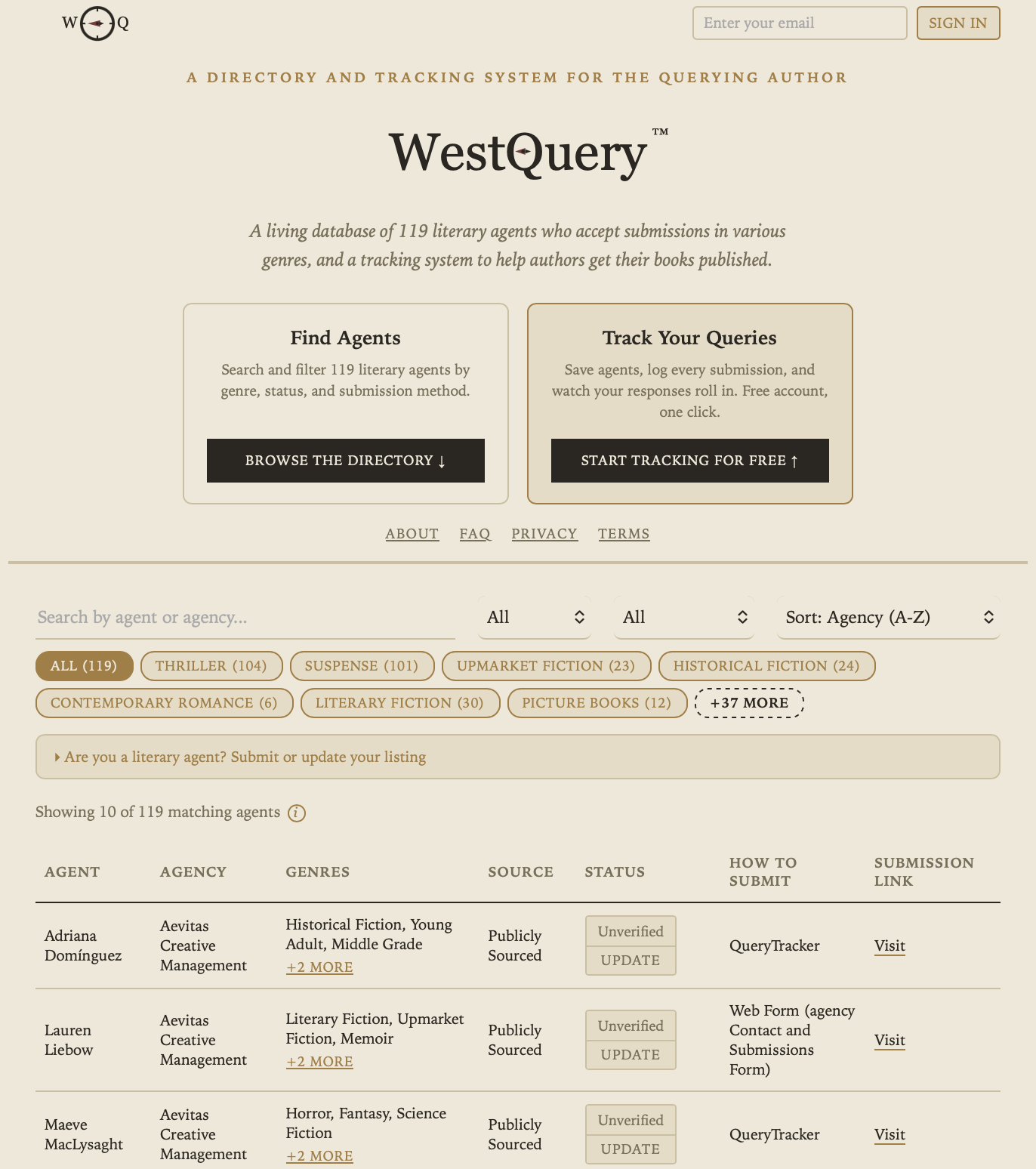
You can use WestQuery to navigate getting your book traditionally published: sift through an intuitive and accurate list of agents with direct links to their agency sites, then create a free account and save agents that you’ve contacted/want to contact + track their responses to your submissions. It’s exactly what I wish I had when I was trying to get Through Inconvenient Action published, and I’ll definitely be using it when I take my second novel to market.
Thanks for reading! My name is Ben Cibula and I’m an independent writer and creator. I’m from the Pacific Northwest of the United States, and my time in that region informed the setting and tone of my debut novel. If you’re interested in my other work, you can find it all at BenCibula.com
Read Ben’s other article: What I Learned From My First Book Signing
