
By: ceci
The first time I looked closely at a thangka, I did not try to decode the iconography. I noticed the hand behind it. Mineral color sat on the surface with a slight grit, not the flat sheen of acrylic. A gold line traced a sleeve with a steadiness that felt earned. The cloth held a quiet tension, stretched and prepared long before any figure appeared. My eye slowed because the materials asked it to. That slowing was the beginning of the essay I keep writing, in the studio and on the page: form itself as a path.
What a thangka is (for readers new to the form)
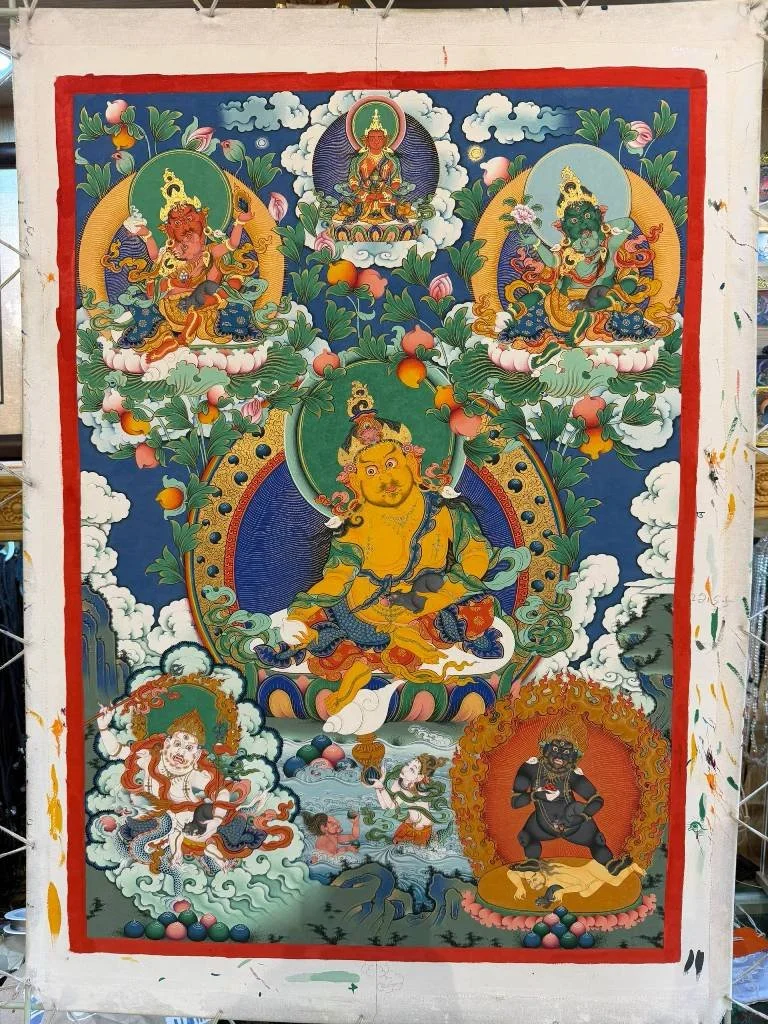
If the word is new to you, start here. A thangka (also spelled tangka) is a Tibetan and Himalayan Buddhist scroll painting: mineral pigments—colors ground from stone and earth—on prepared cloth, often finished with a silk brocade mount. Unlike a Western framed canvas that stays on the wall, a thangka is made to be hung for looking and rolled for storage or travel. Common subjects include a Buddha, a bodhisattva (an enlightened being who helps others), a teacher, a mandala (a geometric sacred diagram), or a narrative scene.
In shrine rooms, temples, and homes, thangkas have long served as supports for devotion, teaching, and—where a practitioner has proper authorization—visualization. That is traditional religious use, not a health claim and not something this essay confers. What also sets a thangka apart from ordinary decorative painting is a shared system of proportion and iconography: faces, bodies, and seats are measured so the image stays readable within a living tradition, not only as personal style.
For a first look, begin with the whole. Find the central figure, then the space above and below (often teachers or lineage above; protectors, donors, or offerings below). Only after that, move in to mineral grit in the blue, a gold edge, or a single hand gesture. You do not need every symbol named to look with care.
Thangka making, as I have come to understand it from the outside of a living workshop tradition and from close looking at finished work, is contemplative craft. The finished scroll can be beautiful, but beauty is not the only point. The sequence of making—stretching cloth, laying ground, measuring proportion, grinding pigment, drawing gold—trains attention. Each stage refuses hurry. For a maker, the painting is not only an object to complete; it is a long practice of staying with one mark at a time. That is the thesis I want to hold here, from an artist’s standpoint rather than a shop window: the form trains the mind that makes it.
Canvas and ground: setting a slow rhythm
Before line or color, there is cloth. Traditional thangka painting begins with a textile support that must be stretched, sized, and given a ground. The cloth is pulled taut on a frame; glue and chalk or other preparatory layers are worked until the surface will take fine drawing without buckling. This is not glamorous work. It is repetitive, physical, and exacting. A poorly prepared ground shows later as crack, bloom, or a line that will not hold.
I have come to read preparation as practice. The rhythm of stretching and smoothing sets the pace for everything that follows. You cannot skip ahead to the face of a deity if the cloth still moves under the brush. Setting the ground is a way of saying: this will take the time it takes. In a culture of fast images, that insistence on readiness is already a contemplative act. The studio becomes quieter because the materials will not cooperate with impatience.
Line and proportion: constraint as creative freedom
Once the ground is ready, underdrawing begins. Measurement traditions in Himalayan painting are often described from the outside as rigid grids—canonical proportions for body, face, and ornament. Lived from the inside of making, those constraints feel different. They are a shared language, not a photocopy machine. The underdrawing holds the figure in relationship: how the head sits above the heart, how the lotus seat carries weight, how negative space around a form keeps the composition breathing.
Constraint, here, is creative freedom of a particular kind. Without proportion, the hand invents endlessly and the image loses its center. With proportion, invention moves into quality of line, warmth of color, the small decisions of edge and shadow. Copy-work is the fear of outsiders who have only seen finished scrolls in museums. In the studio, the grid is a conversation partner. It asks the painter to stay honest to a tradition while still leaving room for a living hand. That balance—between received measure and present attention—is itself a training.
Pigment and gold: light and layer in the making
Traditional pigments begin as stone and earth. Lapis, malachite, and other minerals are ground, washed, and bound until they become paint. The pestle makes a sound you learn to hear: when particles are still coarse, when they are fine enough. There is no infinite undo. Each layer has weight. Mistakes are corrected by patience, by another thin pass, not by deleting a digital layer. The painting remembers the hand.
Gold is rarely loud decoration on a careful thangka. It is often the edge that holds a form: the outline of a lotus petal, the thread of a robe, the thin light around a face. Drawing that line asks for a steady breath. If the wrist tightens, the line breaks. Many painters treat gold work as a kind of sitting with the eyes open—one continuous attention, one continuous mark. From an artist’s view, this is where contemplative making becomes sensory rather than abstract. Light is built in layers. Color is mineral fact. The studio smells faintly of glue and stone. You are not “applying mindfulness” to craft; the craft is already asking for it.
Portable and miniature forms: when scale changes the making
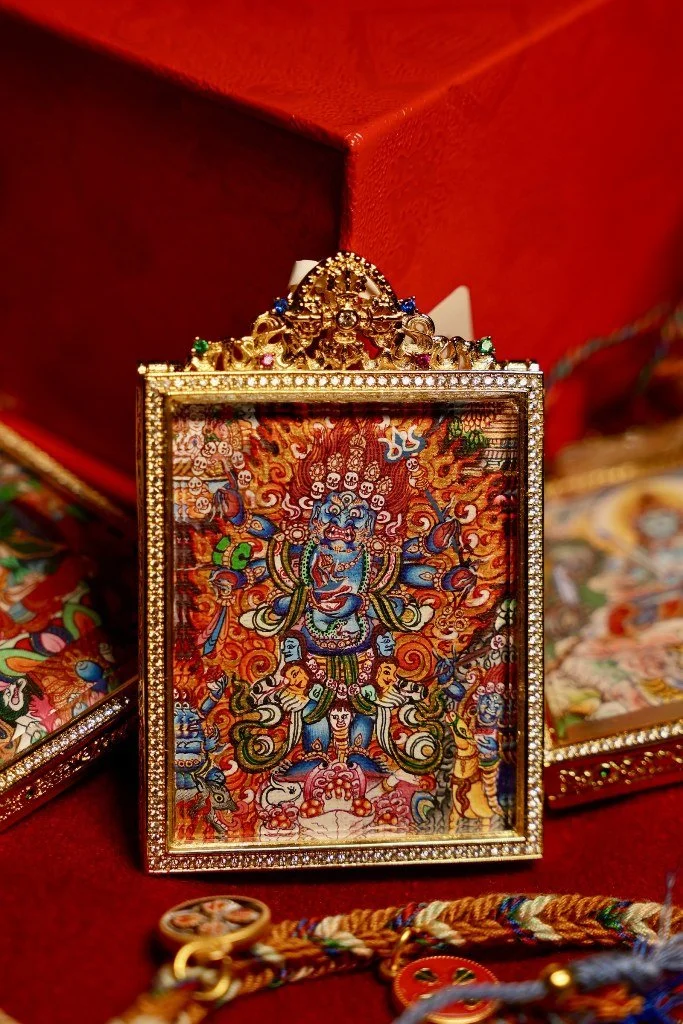
Not every sacred image stays on a temple wall as a hanging scroll. Miniature paintings and other portable small images travel with people—worn close, kept in a small case, brought into ordinary rooms. I am interested in these forms as a craft narrative, not as a product line. Scale changes both making and viewing.
At a few centimeters, every stroke must read. Detail becomes meaning; ornament cannot be piled on for its own sake. The maker works closer to the surface, often with finer tools, and the questions sharpen: What must remain when almost everything is reduced? Which line still carries the figure’s calm? For the viewer, the relationship changes too. You hold the image nearer. You look for shorter spans of time, but more often. Presence is compressed into a field the size of a palm. That compression is a design problem and an attention problem at once—and solving it is still about form as path, not about marketing a smaller SKU.
The viewer’s practice: slow looking as echo
If the maker’s pace is set by cloth, measure, pigment, and gold, the viewer can meet that pace without ever grinding a stone. Slow looking is the editorial mirror of contemplative making. Sit with a thangka—or a careful reproduction—and resist the urge to name every symbol at once. Notice mineral grit in the blue. Follow one gold edge until your breath matches its length. Let the composition hold you the way a well-prepared ground holds a line.
This is opinion from an artist’s desk, not a therapeutic claim. I do not argue that looking cures or blesses. I argue that looking, done without hurry, inherits something of the studio: a willingness to stay. In a magazine devoted to creative life, that inheritance matters. We are surrounded by images made to be scrolled past. A thangka was made to be stayed with. Meeting it on those terms is a small act of cultural and personal attention—respectful of religious meaning, open to anyone willing to look.
Form as path
I return to where I began. The first close look was not a quiz about iconography. It was hand and eye slowed by materials. Canvas and ground set rhythm. Line and proportion offered freedom inside measure. Pigment and gold made attention sensory. Scale, large or portable, asked what must remain. Viewing, done slowly, echoed making.
Form as path means the making itself trains the maker, and the looking can train the one who stands before the finished work. That is the studio window I wanted to open here—not a shop window, but a clear view of process, from one creative practitioner to others who care how things are made.
Author bio
cesi writes about Tibetan art and contemplative craft from an artist’s standpoint, with a focus on thangka painting, mineral pigment, and how sacred images are made and looked at. Work and notes appear at Buddha Trace: BuddhaTrace.com
