
Estalos and Georgia: Monteiro Jr.’s Corporeal-Existential Cinema
EDITOR’S NOTE
Clinton is back, this time with Francisco Monteiro Jr., a Brazilian filmmaker from the state of Piauí who has been quietly building one of the most distinctive bodies of work in independent short film. His last two shorts…Estalos and Georgia, won him Best Director at the Ibero-American Film Festival two years running. Clinton dug into the craft behind both films and got Francisco talking about process, risk, and what it means to make cinema in a place most of the world has never heard of.
Enjoy. -Mike
How do Estalos and Georgia reflect your personal artistic evolution between 2023 and the present moment?
Estalos and Georgia came from very distinct moments and very distinct feelings as well. The screenplay for Estalos had spent a decade kept in a drawer without us being able to produce it because there were no funds for it. We had made a short documentary called Estado da Arte, which basically was an interview with theater director Adriano Abreu. And from that work, I came away very reflective about both the directions my personal life was taking and, in fact, the production universe we had in Piauí. I remember I really wanted to step away from audiovisual production for a bit and dedicate myself to something else—something that would give me better peace of mind and a more stable financial return. I confess that even today that temptation crosses my mind.
So, when the project for Estalos was approved in the first local audiovisual grant in 2017, I found myself wobbling in that vibe. Anyway, even with the delay in the transfer of funds, the casting changes, and the chaos of the covid pandemic, we threw ourselves into this project with everything we had, with everything we knew, intending to build a short that would truly be an experience.
I really wanted to make a film, even as a short, that brought into its language, into its conception, all the basic elements of cinema in a pulsating, narrative way. Not just telling its story, but having a proper approach, exploring cinematic language in a very assertive and very particular way to what was being done locally. And I believe it worked out brilliantly. Estalos managed, in its own way, on its journey, to break through some bubbles and is today the most-awarded short film from Piauí in film festivals. But I am restless. I wanted the next short to take a little more risk, not be so neat, to have a raw, artisanal quality. I wanted it to be a vomit of ideas and anxieties that I carried. And out of that, Georgia was born. Sort of to mess up any expectations people might have had of me.
What was the spark or original image that inspired the creation of Estalos?
I think the spark for creation had several origins. Initially, I was questioning the strength of dialogue in screenwriting quite a bit. I felt that dialogue, in general, dragged the narrative down when we put obvious or stupid lines in the characters' mouths. I really wanted to make a film that didn't depend on spoken lines.
One day, while working as a press officer at the Monsenhor Chaves Foundation, a colleague of mine started cracking his body. He cracked his neck, his hands, his fingers, his chin, and even his nose. I had to stop and ask about that, and he really did crack his nose. From that point on, we started talking about creating a character with this trait. I found that fascinating, very curious, and unsettling. And, for me, a creative spark needs to unsettle me. I put these two issues together: the desire to make a dialogue-free short and the figure of this colleague cracking right in front of me. We created a treatment together, I took the idea home, and during a trip to the coast, I wrote the screenplay.
The first version was called "The Man Who Cracked" [a play on the title of the Coen brothers' film The Man Who Wasn't There]. When I showed the text to him, the shock was immediate, as he expected it to be a comedy. I replied that there was no way a character like that could turn into a comedy; it had to be a social, existentialist, and heavy drama. It was from those two sparks that the story was born.
What inspired the existential theme of an actor in conflict with his own character in Georgia?
We all wear characters and are in conflict with them all the time. Putting an actor to personify this was just an instinctive indulgence I took in Georgia. I didn't want to rationalize the thing. I wanted it to be the total antithesis of Estalos. No resources, no plot, shot quickly and finished with urgency. I was about to leave for a long stint away from Piauí and wanted Georgia to be, in a way, my farewell.
For all that purification of language, all that conceptualization to give way to intuition, to the risk of making something without so much planning. The risk of making something that could go wrong. Maybe I'm creatively self-destructive, who knows. But Georgia gave me the opportunity to get rid of things that had accompanied me for a long time. Feelings in their verbal forms. If my critique of expository dialogue previously led me to make Estalos, now it would be radically the opposite. I would make a short totally grounded in the way the character, or even the actor, vomits out these dialogues.
How was your work with the actors of Estalos to capture the subtle emotional shifts demanded by this story?
I think the most interesting part of working with the actors on the short was the role reversal. Let me explain: Felipe Zahir, the protagonist of Estalos, wasn't an actor; he was a street dancer, whereas Serena Morais wasn't a ballerina, she was an actress. So, when you invert these roles and put a dancer to act and an actress to dance, you have to handle things with a different kind of flexibility than usual, which was very stimulating as a director. Working the bodies of these actors in a way they weren't used to, working with the minimum, creating a film that was minimalist in emotions, yet in an extremely visceral way.
I think Felipe delivered all that urgency and bodily anxiety that his character brings, which makes a very marked counterpoint to the lightness, delicacy, and subtlety of Serena's performance. The counterpoint between this heavy, burdened, and troubled body and the lightness and delicacy of the counterpart (who in this case is the ballerina) is the game that drives the entire subtext of the short. It's what moves everything behind the images, everything that isn't said by the characterizations, in the way we guide these performances in front of the frame.
In the case of Georgia, how was it dealing with the main actor to navigate a performance that blurs fiction and identity?
Like I was saying, I didn't want to rationalize the process. I wanted to test myself under sudden pressure. To discover the short I was making while making it, including with the crew. So, the first thing we did was not rehearse. Marcel (the protagonist of Georgia) is an actor who comes from the theater. Not rehearsing, to him, is almost sacrilege.
How to enter a character without preparing? How to embody the director's vision if there's no conversation beforehand about it? What the hell kind of movie was this, anyway? What would it be like? What would it be about? I didn't know. I believe the crew didn't know either. That's the fun, that's the risk. When you make a project with no budget, the freedom you have allows for certain boldness. Again, running the risk of failing. That's what I was looking for there. In addition to not allowing rehearsals or any kind of preparation, apart from a location scout, there was no script reading either. Nor did I allow Marcel to memorize the text.
He only read it once, and today I think he shouldn't have read it at all. If I was going to test myself under sudden pressure, everyone would be tested too. And then during the process, I started discovering that I didn't want to know about this character, I didn't want to know exactly what he was saying. I wanted to perceive where the actor was there, where this persona he was projecting with the text was. What moments those gaps became visible in front of the camera.
And making him run, making him get tired, sort of catalyzed all of that. The body left the actor exposed. And with the exposed actor, it was much easier for the character, the supposed character, to be contaminated by him. And that's precisely what I was intuitively looking for. On the other hand, there are things that were pre-arranged seconds before the take began.
So, not everything is a cognitive failure of an actor without cartesian mastery of the material, and not everything is a matter of mise-en-scène. There is a gray area between these two things that interested me a lot. When I watch the film, it intrigues me to think where Marcel is, where the character is, and, above all, at what moment these two entities bifurcate or drift completely apart. I like playing this guessing game with those instants. Georgia is not a narrative film, in the comfortable sense of the term. It's a thesis film. Almost an experimental essay that doesn't quite go so far as to call itself one – and solely for the fact that the scenes on the bridge, before and after, contextualize a little story of self-abandonment.
In Estalos, what fundamental stylistic choices or camera language did you use to intensify tension or intimacy?
Estalos never really had a literary screenplay. I skipped that step deliberately when writing it, going straight to the decupage. I wrote Estalos based on the shot breakdown: I visualized each framing, what it showed, what it wanted to say within that context, and noted down that sequence right away. This allowed me, from an early stage, even on paper, to see the film, to see how it could look, and to realize how each frame did or didn't say something, moving or stalling the narrative. Once again, without the need to resort to expository dialogue. The few lines it has were improvised during filming.
It was very much about having a visual writing style, a strong textual decupage from the beginning, and thinking about this as language, about how I wanted to trap this character inside the frame. If you pay attention, when we are with the protagonist, the frame does not move: it is hard, static, rigid. When the ballerina enters the scene, the frame moves, becoming light in an almost strange way. It is in this clash, in this dialectic of the still frame versus the moving frame, that the entire intention of the short's language is built. Little by little, we lead the protagonist to try to get rid of this frame that binds him, of this static image that imprisons him.
Everything flows in this direction. When we talk about tension and intimacy, the difference between the two is very subtle. All the time the characters are very close to the camera. There is intimacy there, but it's a tensioned, hard intimacy, which gives an existential weight to each close-up, to each detail, to each wide shot, to each establishing shot, and to every movement possible within the language we chose.
What visual techniques were used to reflect inner turbulence in Georgia?
First, the most obvious one: handheld camera. When it comes to – as you put it – inner or outer turbulence, bringing the viewer inside the action, generating immediate empathy, a handheld camera is an impulse that almost never disappoints. In the case of Georgia, we anchor the moment the character lives, the journey he makes, with a handheld camera very close to his face.
Speaking of a journey, it is no coincidence that the film begins and ends with the character – at this point, we have the character and not the actor – standing on a bridge. But then we have this radical break in static tone within the dramatic core, so to speak, of Georgia, which is when character and actor take turns in this circular run of emotional purgation. The static camera and the wide shot in black and white enhance all the strangeness of the situation: an empty warehouse where this shirtless subject exhausts himself physically and loses his breath because of the laps he runs between one reading and another.
Readings that usually come out crooked, wrong. My initial idea was that this entire sequence would be a single wide shot lasting 20 minutes, without a single cut. And it was filmed that way. We repeated the shot about two and a half times until I realized the actor couldn't deliver anymore. In total, he had run and spoken for an hour, basically.
Besides being completely out of shape, which of course wasn't ideal, I soon found out that Marcel had undergone heart surgery some time ago. Without knowing it, I could have sent my actor straight to the hospital. Fortunately, that didn't happen. What happened was that the uncut wide shot, lasting exactly 20 minutes, wasn't telling me anything in terms of language. It just looked like a director torturing an actor in a not-very-kind way.
That was when I realized how much Marcel's apnea drew attention in an almost suffocating way. They were the cue for us – myself and co-editor Matheus Vilarindo – to chop up the long shot, motivating the cuts based on Marcel's breath. Or would it be the character's breath? Truth be told, it was the apneas, the shortness of breath (which earned me a good scolding from my doctor brother), that conceived the linguistic form of Georgia.
Estalos hints at sudden noises or instantaneous perceptions. How does this thematic motif shape the narrative rhythm and character relationships in your film?
Precisely because we don't have dialogue, I needed sound to be more than a mere thematic motif: it had to be the engine of the narrative. Everything was designed so that the cracks pushed the story and shaped the language I was looking for. I wanted the entire short to crack. When you think of a dialogue-free film, driven by diegetic or non-diegetic sound, the entire configuration of the work revolves around that. Each crack had a function, a personality, and a dramatic power.
This constructed the narrative in such a way that the entire editing was based on them. This was my quest as a director, screenwriter, and editor; this was, in fact, the first film whose first cut I edited alone. The second layer is the characters, focusing on how the protagonist's cracks isolate him and cause his loneliness, reflecting a story of self-acceptance and prejudice. When he's walking down the street, the cracks annoy people, push them away, and make him a target for bullying. But when he acts as a human statue and re-signifies these sounds for the sake of art, we get a different reaction from the public. A genuine shock of admiration occurs, that shock when we see a work of art being made and exhibited right before us.
How do you approach narrative rhythm and tension in psychologically oriented films?
Rhythm is one of the elements I worry about the most. I worry about rhythm as early as writing the screenplay. I truly believe that a good screenplay carries the rhythmic intention of the images in the arrangement of its sentences. The rhythmic impression of the work as a whole. Like a rough cut, really. I write the screenplay like an edit. I edit while writing. Or I write while editing. And this is a writing process that gets completed when we are in post-production. It starts in the text and ends in the timeline.
For me, everything, the entire process, is a single act of writing. And rhythm is that tangible structure I'm always looking at when I set out to write a project. And the logic doesn't change due to whether or not we have a more psychological leaning. Or a more intimate one. Because they are images. Even if it's the character's subjectivity, built upon their sensations, which brings out their inner world, we need to tell that through images. Tension, whatever it may be, must stem from the character, to then be somatized in the body of the film, in the arrangement of the images.
What role do sound design and soundscape play in conveying the hidden layers of Estalos?
The sound design of the short was probably the most time-consuming part of the whole process. We did it with Iago Guimarães in his studio, and it took months for us to produce each noise, each crack, each sound effect, and each sound ambiance. Practically 80% of the film's direct sound had to be reconstructed in the studio so that we could have control over the character's point of view. Remembering that we are seeing reality through the eyes of the protagonist, the sound also comes through his ears.
All of this was thought out, deliberated, and planned to have this subjective provocation. And I wanted each crack to have a personality, for each noise to truly be a narrative element. That everything around him – not just his body's joints, but also the bed, the gate, the night, everyday cracks, people on the street, the car engine... that all of this told a story, that the short's soundscape was at the service of the character's dramaturgy. It was really cool to be able to work on this detail by detail: thinking, rethinking, building, rebuilding, using different techniques to compose the cracks, making these cracks lead us into the soundtrack and vice versa.
All this sonic packaging, which is extremely important for experiencing the film, was thought out and imagined together with Iago, with Quaresma (who composed the score), with the wonderful production of Regina França, and with the people who were there trying to give their all to birth this short the way we really wanted it to be birthed. Even if it demanded way too much time for a short film.
How has the feedback received at festivals shaped your perspective on these two works?
I wouldn't go so far as to say it changed my perspective on Estalos and Georgia. The films are the same, before and after the festivals. And, for now, I'm glad to have made them each in its own time, each in its own way. They are shorts that dialogue with each other just as much as they distance themselves.
I like that. However, I know how important festivals are, both to validate the work that we as a team did, and to present these works to an audience. Films that aren't seen are sad. For me, festivals are windows, opportunities for the work that started inside my head to reverberate to people I will never get to meet. I think that is the most fascinating thing about festivals.
As an independent creator at Doroteu Filmes, how do you navigate the balance between artistic vision and practical limitations?
I'm not a big fan of the term "independent," especially when we talk about cinema. Because the way we use this term in Brazil makes it sound like something lesser. I think everyone makes cinema, with a lot or a little budget. And you need to adapt to the budget you have. Everything will revolve around how you manage that budget creatively, so that the film isn't limited by it, but rather gains in terms of language. It's always a clash between what we want to do and what we can do, but I think that's the fun part of it.
This encourages the team even more to have ideas, to come up with original proposals and out-of-the-box thinking. Not having all the resources in the world, not having all the time in the world, or not having everything there in a practical way involves a logical problem-solving reasoning that is very exciting.
I think the director's great job is precisely that: solving problems in favor of your creative vision, in favor of what you are aiming for. This clash remains imprinted on the final result, for better or for worse. It stays there as a record of how the film happened and how it will serve itself throughout its posthumous journey.
What do you hope global audiences will reflect upon after watching Estalos and Georgia?
I might even run the risk – look at me doing it again – of sounding pretentious, but I would love for global audiences who discover my films to realize that there is a production being made consciously, even in an obscure place, in a far-flung place like the state of Piauí, in Brazil. And for people to be able to discover what we've been doing here. Not just my work. There is a lot of good stuff being produced around these parts, productions that think about and practice language, that try to break boundaries, propose ideas, and dialogue beyond what is being shown. I wanted people to discover that, yes, cinema is being made in Piauí. Above all, I'd want them to get to know it better.
What direction do you intend to take next with your production company, Doroteu Filmes?
We have another fiction short, called Fractal, which was shot last year in São Paulo and is expected to be released next year. This short sort of closes a trilogy with the two we've just discussed. Totally different languages and themes, yet with elements that intersect. Actor, body, and character are very present in Fractal, my first queer narrative. In addition, there are projects for feature-film funding calls. There's one in the pipeline, waiting for a grant call to open, which is the viable way to make films in Brazil. Crossing fingers that the political situation in the country doesn't drive me away from cinema so I can validate myself as a person. That would be existentially frustrating.
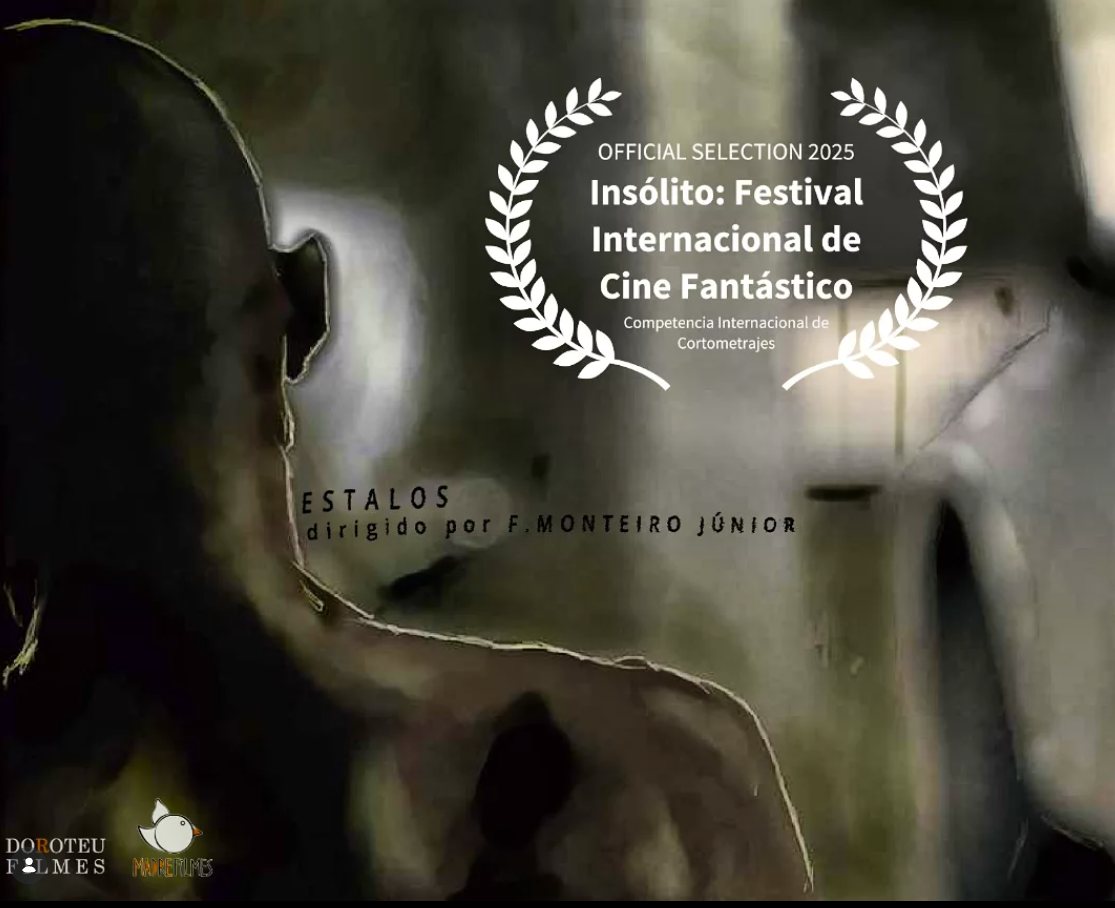
Estalos (2023, 22 min)
Follows Eliseu (Felipe Zahir), a lonely man who cracks his joints and works as a human statue trying to give new meaning to life through art until his path crosses with that of a ballerina (Serena Morais). Funded by the Secult/PI Grant, the work combines the fable of The Nutcracker, a score by José Quaresma, and award-winning sound design by Iago Guimarães to build a hyper-realistic allegory about made-invisible bodies. The film boasts a victorious trajectory across dozens of festivals in Brazil and abroad, with 15 awards and screenings in Peru, the USA, and England, standing out for wins such as Best Film and Best Director at FIACINE, as well as 7 awards at the 18th Encontro Nacional de Cinema dos Sertões (including Best Fiction, Direction, Screenplay, and Actor).
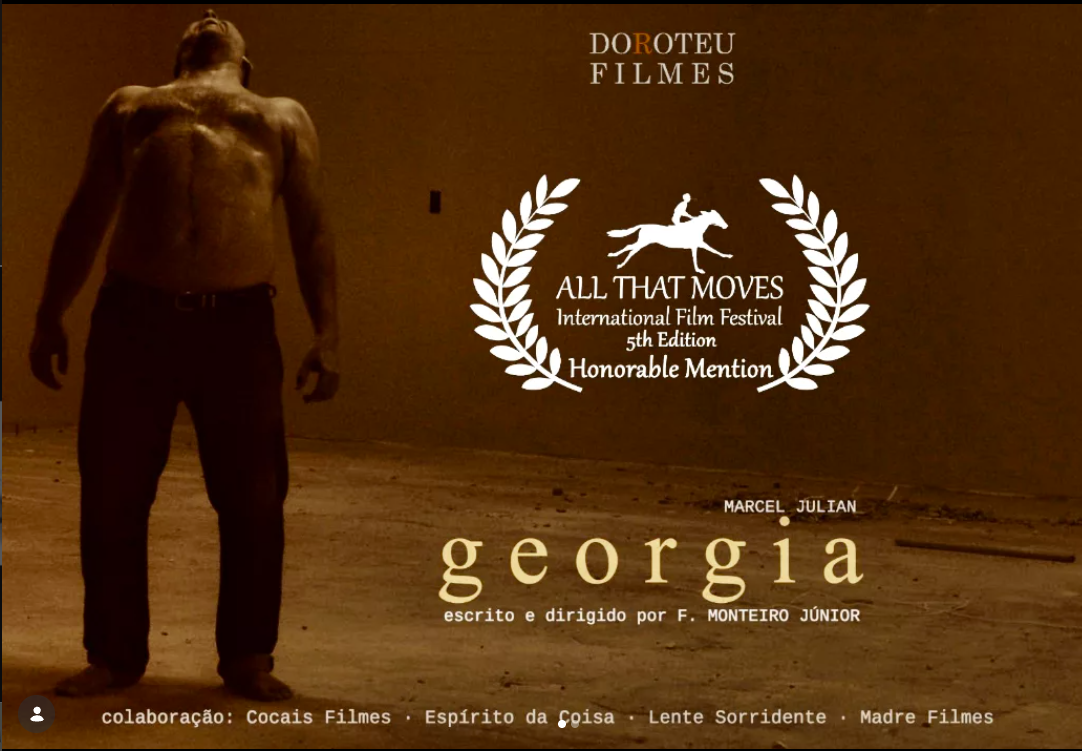
Georgia (2025, 20 min)
Dives into the existential horror of an actor in a solitary ritual to purge a character whose lines he cannot memorize. With visceral language, the work challenges the boundaries between performer, performance, and persona under the provocative premise that "acting has been prohibited." The film has been consolidating its presence in the national and international festival circuit, including screenings at FIACINE, where it made history by winning all awards in the Fiction Brazil Competition (Best Film, Direction, Screenplay, and Performance), in addition to the Best Actor award at the 19th Encontro Nacional de Cinema dos Sertões and an Honorable Mention at All that Moves.
Francisco Monteiro Jr.
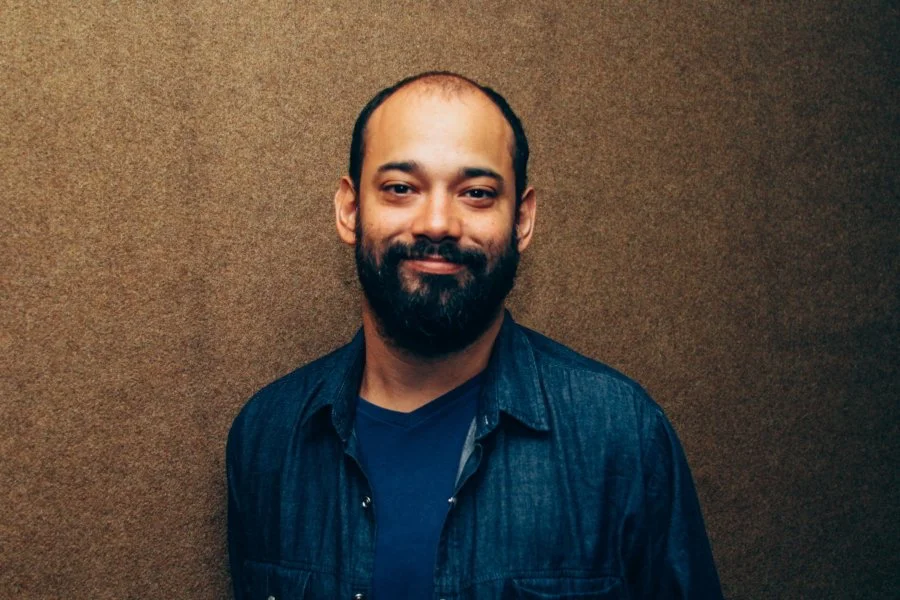
A Brazilian filmmaker and writer, he is the founder of Doroteu Filmes, overcoming the limitations of dyskinetic cerebral palsy to reflect on, teach, and make cinema. With a background in Psychology and Journalism and a Master's degree in Literature, he debuted in literature in his teens with As Sete Vidas do Gato (1998), followed by award-winning works such as O Confidente (2003) and prominent Amazon e-books in 2026. He has built a multi-award-winning cinematic trajectory that includes Qualquer Hora Dessas (2012), Estalos (2023), and Georgia (2025). Recognized as Best Director for two consecutive years at the Ibero-American Film Festival (FIACINE) and serving as Regional Sub-director for Brazilian Association of Screenwriters, he combines his dedication to directing, screenwriting, and the completion of the project Fractal (2027) with an intense involvement in audiovisual education and film criticism.
Interviewer Bio:
Clinton R. Siegle is an award-winning independent filmmaker, writer, and interviewer whose work has screened at 146 international film festivals and earned 14 awards. His films explore the boundary between the real and the surreal, often examining time, perception, and the human experience. Beyond filmmaking, Siegle is a cultural interviewer and archivist, documenting long-form conversations with artists, creators, and thinkers. As a writer and essayist, his work—spanning fiction, cultural commentary, and experimental storytelling—has reached over 8.49 million views worldwide. Through film, writing, and dialogue, he bridges history and myth, science and speculation, inviting audiences to question the world they inhabit.
Check out Clinton’s other articles: HERE
