
Original Horror Fiction: A Four-Part Ghost Story for Halloween Season
Editor’s Note: Happy Halloween! This is it, we wrap up our four part short horror story, by Clay Boone…with Part 4 of “Misery Loves Company”. If you haven’t read the previous parts, go here first: PART ONE / PART TWO / PART THREE
Enjoy, -Mike.
I remember a childhood image of my grandmother from when I was eight. Sitting in her tacky plaid recliner thrown in front of a staticky old ’70s TV watching Billy Graham as she talked down at eight-year-old me:
“God speaks to us in mysterious ways in our darkest times, so you better listen because your generation has some of the darkest a-commin!”
God. I had distanced myself from that part of the family a long time ago. I remember as a kid not being able to sleep at grandma’s because of all her talk of demons and hell. It was terrifying to me back then! Made me think a portal was going to open up and I was going to be snatched away by the devil’s minions if I ate too many of her caramel candies. I remember she took me to a Benny Hinn service and I watched a woman, supposedly, have a demon cast out of her. She spoke in multiple pitches and shook and snarled as he announced:
“Be free from Satan’s shackles!”
He then smacked her onto the ground with a Bible to the forehead. Of course it took time and education to realize it was all bullshit and how filthy rich televangelists were. Now it’s embarrassing to even talk about, the fact I was so fooled by it all.
I hadn't thought about any of that shit in years. But the psychiatrist could explain Tod. He could explain the face in the window and the apple, maybe even the apple in my bathroom sink. What he couldn't explain was an envelope of photographs in my glovebox that a clerk at CVS had looked at too.
Now here I was, thirty-something years old, wondering if my grandmother might've known something I didn't. That was a depressing thought. I didn't know any priests. Everything I knew about Catholics came from The Exorcist.
Still, it was somewhere to start.
It took a lot of humility to set foot inside that old Catholic church.
It was the closest one to Wentworth, only a few minutes away, and I couldn't help noticing it was built from the same red brick as half the academy. Apparently Lexington had bought that shit in bulk.
I went near closing time on purpose. If I started sounding too crazy, I wanted as few witnesses as possible.
The place was quiet enough that my shoes sounded too loud against the floor. Candles burned near one wall, and the air smelled faintly of old wood and incense.
I found the confessional and sat down.
For a while, nothing happened.
Then a small panel slid open beside me.
“What do you wish to confess, my child?”
A soft voice came through the screen.
Shit. Just like The Godfather.
That was about the extent of my knowledge of confession.
“Father, I didn't actually come here to confess.”
Except maybe confess my insanity.
There was a short pause.
“All right.”
“I came here because I need some answers.”
“What sort of answers?”
I rubbed my hands together.
“I think I'm being haunted.”
There.
I'd said it.
Way to sound sane, dickhead.
The priest shifted on the other side.
“Haunted?”
“I work at Wentworth Military Academy.”
Another pause.
“Wentworth.”
“You know it?”
“Yes.”
So I gave him all of it: the apple, the face in Hickman's window, the Ouija board, Albert and the dark room. Then Tod.
"He's been dead for five years."
The priest didn't say anything.
"I know how that sounds."
Silence.
I shrugged. "You wanted honesty."
The panel slid shut, and for a second I thought I'd finally crossed the line that gets you thrown out of a church. Then I heard him stand.
"Come around."
He was younger than I'd expected, mid-thirties maybe, tall and skinny, with round glasses and a hairline in full retreat. He held out his hand. "Father Steven Rooney."
His hand was warm. I remember noticing that. His eyes dropped to our hands for a moment. I figured it was a priest thing.
His office was behind the sanctuary, small and chilly enough that his breath showed when he talked. I remember thinking a church that old couldn't afford heat. One wall was all books, most of them by guys I'd heard of in college and pretended to have read then too, and on the bottom shelf something in Latin with a cracked leather cover that looked older than the parish.
"I'm going to disappoint you," he said.
"Wouldn't be the first person this week."
He smiled. "I can't tell you that you've seen a ghost."
"Then what can you tell me?"
"That seeing the face of a dead man doesn't necessarily mean the dead man is what you're seeing."
That shut me up. "You're saying it isn't Tod."
"I'm saying you don't know that it is."
"He knew things Tod should've known."
"That proves something knew them."
I didn't like how well that fit.
"Have you seen a doctor?" he asked.
"A psychiatrist. And I paid for an MRI."
"Good," Rooney said, and sounded like he meant it.
After that he asked questions a doctor might have asked, only sideways. When had I first seen the face? At my interview. Had I pointed it out, or had someone pointed it out to me? I'd pointed. Had I looked at it longer than I had to?
"It's a face in a window. Everybody looks."
Rooney nodded like that was an answer.
I thought about all the nights on rounds I'd stood under that window like a man waiting for a bus. I didn't say so.
"Have you spoken to it?"
"To a window?"
"To anything."
I thought about Hickman's front door and my flashlight. "I may have threatened it with a demerit."
Rooney almost smiled. "Of course you did."
"Is that bad?"
"It's not good."
"Any time you can't account for? Hours, an evening?"
I thought about the Jack Daniel's, the orange bottle, and the soft place where the rest of that night should have been. That was a different problem. That was just drinking.
"No."
He looked at me a long moment, then nodded the way I nod at cadets who swear they made their beds.
He sat back and didn't say anything for a while. I got the feeling he was deciding something, and that I wasn't going to like it either way.
Then he took off his glasses, pinched the bridge of his nose, and said, "Wait here."
I read the spines on his shelf until he came back, carrying something wrapped in an old cloth. He set it on the desk and peeled the cloth back with the fabric between his fingers and the notebook, never touching it bare. It wasn't a giant occult book or a Bible in chains. It was a black-and-white composition notebook with rounded corners and one edge browned and curled, as if somebody had held a match to it and thought better.
"Someone tried to burn it."
"Someone tried."
"Who?"
"Open it."
Inside the cover, in faded blue ink, was a name. Albert. Underneath: 1971.
"They found it on the floor of that dark room," Rooney said. "At his feet."
Tucked in behind the cover was a yellowed index card in a cramped hand. Rec'd Oct. '71. Parents request Mass. Do not discard. —Fr. Donnelly.
"Donnelly?"
"My predecessor. Albert's parents wanted a funeral Mass, and in 1971 that took some convincing. This was the convincing." He didn't look at the notebook when he said it. "Nobody came back for it."
"And Donnelly couldn't throw it out."
I turned pages. It started ordinary: class schedules, a draft for the school paper, a complaint about the mess hall, a stupid sketch of an instructor. Then the pages changed. Poems. Symbols crowding the margins. Long black figures standing in doorways. Faces with holes where the eyes should be. One of them was long and narrow, with sunken sockets and a dark haze around the edges. A few pages on, one was nothing but a board: the alphabet in two careful arcs, YES and NO in the corners, GOODBYE along the bottom, and little feet on every letter.
Rooney wasn't looking at the page. I realized he hadn't looked at a page once. He was watching my face.
"I've seen this," I said. "Hickman. The window." I flipped back to the board. "And that. Under a desk in Hickman."
"Yes." He didn't sound surprised.
I flipped ahead. It kept coming back, sometimes only the eyes, sometimes the whole figure. I shut the journal. "Nope."
"Reasonable."
"You keep this in a church office?"
"In a safe. Father Donnelly had it blessed."
I opened it again, near the back, where Albert's handwriting had gone cramped and uneven, sentences crowding each other, whole paragraphs scratched out. One line stood clear.
"'It notices when you notice it,'" I read aloud.
"Not out loud."
He was already up, crossing to the window behind his desk. He lowered the blind slowly, like a man in a house with a sleeping baby.
"It's a church office."
"So Albert saw this thing too."
"Maybe."
"Come on."
"Drawings don't prove anything."
I stared at him. "You're really committed to being useless."
He sat back down and rested a hand near the journal, not on it. "Albert was a boy who got left at that school most of the year. That can kill a boy without anything else helping. I'm not going to make him into evidence because you need an explanation."
That cooled me off a little. "So why show me?"
"Because I need to know whether what happened to him is happening to you. You'll see it before I do." He pushed the notebook across the desk. "Take it."
"You're giving me Albert's journal?"
"Temporarily."
"That seems like terrible judgment."
"It may be. Read it in daylight. And if you catch yourself reading the same page twice, put it down."
"And if I find something?"
"Come back."
I stood. His face had gone serious.
"One more thing. When I asked about lost time, you said no." He let that sit a second. "If that changes, you don't call me first. You call a doctor."
"That's it? No holy water?"
"No."
I couldn't help myself.
"Well… when does that come out?"
"When I've run out of boring explanations."
I tucked the journal under my arm.
At the door he called after me. "And don't go looking for whatever Albert was looking for."
"I wasn't planning on it."
He looked at the journal under my arm and let that one go.
I was almost through the side door when I looked back. Rooney's hand was up, tracing a small cross in the air toward my back. He caught me looking and turned it into a wave.
Priests.
I threw Albert's journal in my bag and took it to work with me. Rooney had told me to read it in daylight, which was easy advice for a man who didn't work nights.
When I got to the office, somebody had installed cameras. A row of black-and-white monitors covered one wall, grainy as gas station footage, showing the barracks, the quad, the Scholastic Building, the chapel, and most of the places I usually had to cover on foot. Nobody had said a word about it, but I wasn't going to argue. In theory, the only thing I had to worry about on shift now was getting fat. No more hourly bed checks. I dropped my bag beside the desk, poured a coffee, and put my feet up.
For a while the monitors showed nothing but empty halls and empty sidewalks. I nearly dozed off.
Then something zipped across one of the screens, and I sat up. A pack of cadets was creeping around the Scholastic Building. Not two or three of them either. There had to be ten.
"Goddammit."
Damned kids and their obsession with that building. I grabbed my keys and headed over, and I could hear them shuffling around inside before I got the door open. 2:00 a.m. Of course. I let myself in quietly and followed their whispers up to the second floor, where I peeked around the corner. They had their backs to me. One kid carried a camcorder with a light strapped to the top while the rest tried door handles. I recognized a few of them.
I ducked behind the wall, counted to five, and jumped out.
"AHHH!"
The hallway came apart. Ten cadets screamed and tore ass for the far stairwell, and I laughed so hard I had to brace myself against the wall.
"GET YOUR ASSES BACK HERE!"
That only made them run faster. By the time I got outside they were halfway across the quad toward Tillotson, and not one of them so much as glanced over a shoulder, which was smart. Looking back at a TAC officer is how you end up doing push-ups. I was laughing too hard to give chase anyway. I'd deal with them tomorrow. I locked up and went back to the office, already working out how to tell the other TACs I'd scared half a floor of cadets shitless.
Then something moved on one of the monitors.
The chapel. It connects to the Scholastic Building, but the doors are supposed to stay locked except for Sunday services and special events, and the only light was whatever leaked through the stained glass. Someone was sitting in one of the pews. A figure in dress uniform, alone, its chin down on its chest, like somebody who'd dozed off waiting on a service that was never going to start.
"For Christ's sake."
I leaned toward the screen for a better look, and the head came up.
The picture was too grainy to hold a face. It gave me a jaw, a mouth, two dark eyes, and a feeling I couldn't place, like hearing your own voice on a recording. Something glinted across the chest, a whole field of small bright points catching the colored light. Buttons. Had to be. Brass ones. The figure looked straight into the lens, calm, the way you look at something you've been expecting.
Then it stood, and kept standing. It rose slow and level, heels together, like it was standing on something that was being lifted, with nothing holding it and nothing underneath. The eyes never left the camera until they slid out of the top of the frame, and then the pew was empty.
I shoved back from the desk. Albert, I thought. Of course it was Albert. Who else would it be? The room felt too small. I threw open the window, and cold wind scattered papers across the floor. The journal slid out of my bag, hit the tile, and fell open near the back. I didn't read the line. I didn't have to.
It notices when you notice it.
I slammed it shut. "Fuck this. Fuck Albert, fuck his journal, fuck the ghosts, and fuck Wentworth."
I grabbed my keys and headed down the hall. Halfway along I stopped, because I'd finally figured out what had been bugging me since I sat down. The cameras. When had they gone in? Nobody had mentioned them, not the Commandant, not one of the TACs. I tried to picture a crew running cable and drilling into all that red brick and came up empty.
"Whatever," I told myself. It had fooled me with the apple, and Tod, and the face in the window. I didn't see why a camera should be any different.
I reached for the Xanax. Empty. I checked the other pocket. Nothing. That bothered me too, but I kept walking.
Outside, the quad was dead still. No wind, no cadets, not a light on in Tillotson. Every window in the barracks was black, and in nine months I'd never once seen that. There was always somebody awake in there, sneaking a cigarette or crying into a pillow.
Then I saw the shadows. Long shapes stretched across the pavement beneath the lamps, the same ones from the photographs. Each had a head. Each head was turned toward me.
Somewhere behind me came the sound of boots, a lot of them, marching in step. I turned. Nothing. The sound grew louder. Men shouted. Then came gunfire, and I've heard plenty of gunfire, but this wasn't the flat crack of a range. It was slower and heavier, like furniture being dropped in a room upstairs. Under it came the screaming of men, dozens of them.
I backed away. "What the fuck?"
The shadows didn't move. They only watched.
I ran. I don't know why I headed for Hickman. Maybe every bad decision I'd made since taking the job seemed to end there anyway.
I didn't make it that far. Somewhere between the quad and Hickman, I heard music. Old country, drifting out of the Alumni House beneath the marching and the gunfire. I knew the song. Misery Loves Company.
Tod Ruspringer was on the porch with his boots up on the rail and a cheap cigar burning, tapping ash into a coffee can. He looked exactly the way he had that first morning, wrinkled and grinning in his maintenance coveralls. Except now he looked like he'd been waiting for me.
"Tod?"
He took a long pull on the cigar. "Well. There you are. It’s about God damned time."
"What the hell is happening?"
He chuckled.
I looked back toward Tillotson, still dark. Then toward the TAC office, and I tried to picture where exactly they'd have hung a wall of monitors. The TAC office was a desk, the Dell, a coffee maker, and a file cabinet with a busted bottom drawer. I'd sat in it the better part of a year. There wasn't room in there for a wall of anything. There never had been.
I tried to remember walking in that night and got nothing. So I went back further, to the Commandant and the gum. I could see the desk drawer sliding open. I could hear the wrapper crinkle. But when I tried to remember the taste of it, or chewing it, there was nothing, only the idea that it had happened.
I thought about the cadets, ten of them running and not one looking back.
And the figure in the pew. I'd decided it was Albert because I needed it to be somebody else. But Albert had been grinning in his photograph, and the face on the monitor hadn't been grinning. It had been tired and clean-shaven, standing straight in a dress uniform with a chest full of medals, the same uniform I'd had refitted, the same medals I'd shined myself the week before I started. I'd only ever seen him from the front, and he'd never looked at me like that.
Then my apartment came back to me in pieces: the photographs, the lawyer's email, the Jack Daniel's, the prescription bottle open beside the keyboard. Pouring a drink. Then another. Picking up the bottle. After that, nothing. A bed, and darkness, and suddenly I was late for work.
"I went to sleep," I said. "I was home." I looked up at him.
Tod tilted his head and waited, the way I wait on a cadet who's halfway through a lie and can hear it.
"You're not Tod."
It smiled and didn't say a word. Somewhere across the quad, the marching stopped, and everything went silent. He lowered his boots from the railing.
His grin kept going after a face should have run out of room for it. The skin around his eyes sank inward and his face lengthened. I recognized the face from the window, from the photographs, from Albert's margins. It stepped down off the porch. When it spoke again, it used Tod's voice.
"You either take a bit of Wentworth with you…"
Another step.
"…or it takes a bit of you."
The smile split across that ruined face. Behind it, black smoke rolled upward like fire. And somewhere very far away, under the song, someone was pounding on a door.
Misery loves company.
XXX
Howdy, Clay Boone here.
Thanks for sticking around. I hope you enjoyed Misery Loves Company.
If you’re hungry for more, my novel Where Shadows Are the Darkest is waiting: cowboys, demon hunters, gunsmoke, and a boy searching for answers in the war-torn South. I’ve left a handful of free codes to my audiobook below for UK and US customers. First come, first served.
If you’d like to purchase a copy it’s available on Amazon.
If you read it, I’d be grateful for an honest review. It’s the best way to help other readers find the book.
The ride continues in 2027 with Book 2, A Line Laid in Iron. Mosey on over to ClayBoone.com and join my newsletter for more giveaways and news from the Clay Boone trail.
And if you want another short, check out The Gray on Feeling Creative.
FREE REDEEMABLE CODES FOR AUDIBLE!
US
82TU4K28HPUSE
EBLAZWE2S3JW3
EWJ4AWJQ3TX6U
FWUY88K4TK2K4
GW3CHAQFBLMZC
UK
32R3R37LPGES7
389RHW6EPFQAP
3DE66BG5ZRBHG
4LHDH37CY9WUH
4LP55DPZ9U5EF
Author Bio:
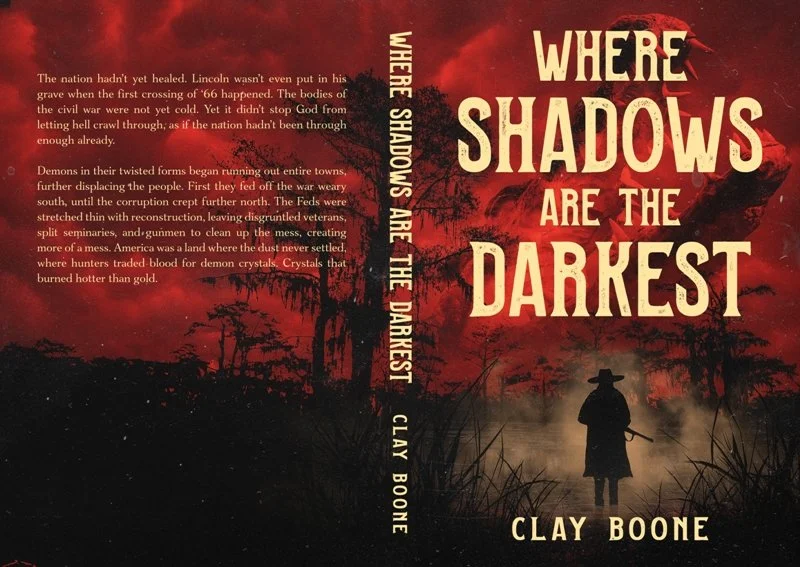
Clay Boone is the author of Where Shadows Are the Darkest. He grew up in rural Missouri, where stories about the Civil War and Reconstruction were passed down through generations by word of mouth. That sense of lived history shapes everything he writes. His work blends the brutal realities of the post-war South with folklore, fear, and the religious tensions of the period. It is not gunsmoke and glory. It is the copper taste of blood, the smell of last night's fire, and the burning in your lungs when you run.
Read Clay’s Articles, HERE.
Visit ClayBoone.com
Buy The Book on Amazon: Where Shadows Are the Darkest
Follow Clay:Facebook / YouTube / Instagram / TikTok / Goodreads
