
Original Horror Fiction: A Four-Part Ghost Story for Halloween Season
Editor’s Note: We continue our four part short horror story, by Clay Boone…with Part 2 of “Misery Loves Company. If you haven’t read part 1 yet, click here.
Enjoy, -Mike.
The second semester began with resounding drums and trumpets playing in cadence as the elder cadets shouted orders at new cadets. The new cadets ran around like scared rabbits. The faculty was buzzing with both fear and excitement for the things to come. I was glad to be back. I had been wasting away wallowing in junk food and depression all Christmas.
Going to work gave me a purpose again!
That morning I sat in the mess hall with a few of the other TAC officers, working my way through a plate of eggs, sausage, biscuits and gravy. The food wasn't anything to brag about, but after two weeks of frozen pizza and Chinese takeout it might as well have been Sunday dinner.
“You keep eating like that, we're gonna have to get you a new uniform,” one of the TACs said.
I looked around the table. Most of us weren't exactly recruiting-poster material.
“Having a belly seems to be regulation around here.”
That got a few laughs and a couple nasty looks from the heavier men at the table.
Before anybody could fire back, a voice boomed across the mess hall.
“AN ARM AND SIX INCHES! AN ARM AND A DICK!”
One of the cadet first sergeants was trying to get the new recruits into proper formation before they filed through the chow line. One kid made the mistake of laughing and stepped farther back.
The first sergeant grabbed him by the shoulder and shoved him forward.
“IN LINE, HORSE-COCK BOY!”
The kid's smile disappeared.
Mine didn't.
I took another bite of biscuit and gravy.
It was good to be back.
The novelty of the new semester wore off quickly. Within a week the new cadets had figured out where they were supposed to stand, the older cadets had mostly stopped screaming themselves hoarse, and the rest of us settled back into our routines. For me, that meant night shift.
I was making my rounds one night when I noticed one of the basement windows of the Scholastic Building wasn't closed all the way. So I unlocked the door, descended the stairs, then closed and latched the window. When I ascended the stairs, I felt something brush against the top of my head. I reached up, grabbed it, and shined a light over it.
It was the apple. Someone had crudely taped the two halves back together.
What the hell?
I turned it over in my hand. Same stupid painted words. Same break I'd put through the middle of it before Christmas. Something was scratched into the bottom, too, a couple of letters worn down almost smooth. I didn't bother trying to read them.
This time I put it in my pocket.
When my shift ended at 0700, I briefed the Commandant on the happenings of my shift and set the apple on his desk. When I told him about it turning up in the dark room again, he just shrugged and laughed.
“Didn’t I tell you at the interview? You’ll hear all kinds of stories around here! Cadets like to scare one another, the stories are a part of the culture here! Faculty party next Friday at the Spotted Pig by the way!”
I shrugged and turned to leave, and he stopped me.
“Oh, and don’t forget your apple!”
I nodded, putting the wooden apple back in my pocket.
As I crossed the street toward the Alumni House, a man in a one-piece maintenance suit stopped me. He was an old black man, old as sin, with gray stubble, a face full of creases, and forearms that looked like they'd been turning wrenches since Eisenhower. He smelled like cheap cigars.
The old man's eyes dropped to the wooden apple sticking out of my coat pocket.
“Where'd you find that?”
“This?”
I pulled it out.
“Scholastic Building. Damn thing keeps turning up.”
He smiled.
“Well, I'll be damned. Albert's apple.”
Well, Albert sounds like a real asshole.
“Who’s Albert?”
The old man held out his hand.
“Tod Ruspringer. Maintenance.”
I shook it, though that didn’t answer my question.
“I’ll take that off your hands,” he said, nodding toward the apple. “I’ve been putting it back up there. It belonged to Albert. Never seemed right having people throw his things away.”
That explained how the damn thing kept coming back, at least. So much for Jeremy Weaver. I'd spent half a semester blaming that little shit for the apple. Turned out the worst thing he'd done was tie a freshman to a chair in the dark, which was plenty, but I figured I owed him about a third of an apology. He wasn't getting it.
“You knew him?”
“I did. Strange kid, but not a bad one.”
“What happened to him?”
Tod looked down at the apple.
“He died here. Back in ’71.”
The way he said it made me hesitate.
“How?”
Tod took a pull from his cigar.
“That's a longer story than I've got time for this morning.”
He held out his hand for the apple.
“His parents left that behind with some of his things. I've been putting it back where it belongs ever since.”
I handed it over.
“You've been doing that for thirty years?”
He smiled.
“You either take a bit of Wentworth with you, or it takes a bit of you, I suppose.”
“And you still haven’t retired?”
He snorted.
“Retire to what? My daughter wants me up in Kansas City on the weekends. In one of those apartments with a pull cord in the bathroom in case you fall down.” He pointed the cigar at me. “Besides, those HVAC boys the school hired couldn't work a level worth a damn. Somebody's got to come in behind them.”
I didn't have much of an answer for that. I was a guy eating three squares a day at a military school so he wouldn't have to go home and look at his own living room.
“It was a pleasure meeting you, we ought to talk some more sometime!” I said, wanting to move on.
“Anytime! If I’m not out fixing something, I’ll be here!” he said, pointing back to the Alumni House.
For the next week, things were quiet. I passed through the Scholastic Building several times and even checked the dark room once.
Nothing out of the ordinary. As far as I was concerned, old Tod had solved that mystery for me.
A few nights later, one of the younger cadets caught me outside the TAC office.
“Sir, can I use the phone?”
“What for?”
“My grandma's sick. My mom called earlier and said she's gotten worse.”
The phones were downstairs in Tillotson Barracks, and cadets weren't supposed to just wander down there whenever they felt like making a call. Usually when one asked permission, it was because he wanted to talk to a girlfriend or beg his parents to send money.
The kid wasn't giving me that look.
“Go ahead.”
“Thank you, sir.”
“And don't make me come looking for you.”
“I won't.”
He disappeared down the stairs.
About twenty minutes later he came back up. His eyes were red, but he was doing his damnedest not to show it.
“Everything all right?”
He nodded.
“Yes, sir.”
It obviously wasn't.
I could've asked him about it, but I remembered being that age and having grown men ask me questions I didn't want to answer.
“All right. Get some sleep.”
“Yes, sir.”
He started down the hall, then stopped.
“Thanks for letting me call.”
“Yeah. Go on.”
He left, and I went on with my game of FreeCell on the Dell.
For a while I could hear him down the hall talking with the others.
It was already TAPS, but I decided to let it go. It was good he had the other kids to talk to.
It was strange how quickly the place had stopped feeling like just another job.
Things went on like that for a while. Cadets got into trouble, I did my rounds, and somewhere in between I managed to get pretty damn good at FreeCell. I saw Tod around campus once or twice, usually off in the distance, and we'd exchange a wave.
A few nights later I stepped out to make my rounds. It was cold enough that I could see my breath, and I shoved my hands into my coat pockets as I crossed the quad. Behind me, I could still hear a couple of cadets talking somewhere inside the barracks. Somebody laughed, then another voice told him to shut the hell up.
The farther I got from the barracks, the quieter it became. Soon there was nothing but my boots against the pavement and the occasional hum of one of the old exterior lights.
My rounds took me past Hickman Hall.
At night the place looked even worse than it did during the day. Several windows were boarded up, and what glass remained reflected the lights from across campus. I could make out the face in the third-story window where I'd first seen it during my interview.
I stopped and looked up at it.
Same place with the same empty eyes.
“Jesus.”
I was about to keep walking when something crashed inside Hickman.
It was loud enough to make me jump.
I stood there listening.
Nothing.
Then I heard something scrape across the floor.
I assumed it was either a critter that had gotten inside or cadets going where they shouldn’t be.
“Hello?”
Nothing answered.
I walked up to the front door, sifting through my keys.
The lock gave with a hard click. I pulled the glass door open and the hinges squealed loud enough to carry through the building.
The smell hit me first. Dust, old wood, and something damp that reminded me of a basement.
I flicked on my flashlight.
For a second I didn't move.
I'd seen this before.
Not exactly like this, but close enough. The empty hallway. The old furniture. The flashlight in my hand.
That damn dream I'd had before my first day.
I almost laughed at myself.
“Hello? If you’re in here, you’re getting a demerit! It’s not safe in here!”
My voice carried farther than I expected.
Nothing.
I stepped inside.
Dust covered damn near everything. Old desks and chairs had been shoved against the walls, along with whatever else nobody had bothered hauling away when they closed the building. My flashlight caught cobwebs hanging between them.
I listened.
Silence.
“Come on. I know somebody's in here.”
Still nothing.
I swept the light across the floor before taking another step.
What the fuck?
One of the old school desks lay in the middle of the hallway, flipped onto its back with its legs sticking up like a dead bug. Two long drag marks ran through the dust behind it, back to a gap in the furniture along the wall.
So that was the scrape.
I crouched down without touching it and put the light on the underside of the desktop.
Somebody had drawn on it. The alphabet ran across the wood in two careful arcs, with the numbers one through nine and a zero underneath, YES in one corner, NO in the other, and GOODBYE along the bottom edge. A Ouija board. It was all in pencil, gone faint and silvery with age, and the letters had little feet on them, like somebody had copied a store-bought one letter for letter.
I'd been a teenager once. Nobody puts that kind of work into a prank. I couldn't get a kid to put that kind of work into making his bed.
There was no planchette. No glass, no coin, nothing to push around. Just the board, turned face-up in the middle of the hall where I couldn't miss it.
“Wouldn’t go in there if I were you.”
I nearly shit myself.
I spun around.
Old Tod stood outside the door.
“Jesus Christ, man! What the hell are you doing up this late?”
He pulled out one of his cheap cigars and lit it.
“Working late on the HVAC in Foxtrot. Lucky I found you. Even the fire department won't go into Hickman anymore. Floors are warped to hell, stairs are half collapsed, and—”
“And this.”
I pointed my flashlight at the desk.
“Who the hell would do that?”
Tod looked past me at it.
For the first time since I'd met him, the old man wasn't smiling.
“Wouldn't know.”
“You've worked here thirty-some years and you've never seen anything like that?”
He took another pull from his cigar.
“Didn't say that.”
That got my attention.
“What the hell does that mean?”
“It means you're standing inside a condemned building in the middle of the night.”
He nodded toward the door.
“Do yourself a favor. Lock the damn thing up and leave it be.”
Then he turned and started toward the Alumni House.
“Tod.”
He raised a hand without turning around.
“It's late. I need to rest.”
I watched him go.
Something cold brushed the back of my arm.
I jerked around.
Nothing.
I rubbed the spot through my coat. The cold had gone straight through it, like I hadn't been wearing the damn thing at all.
For a moment I stood there looking down Hickman's empty hallway.
Then I remembered the dream.
Look.
“Nope.”
I pulled the door shut and turned the key. The heavy bolt slid into place with a clunk that echoed through the building.
I didn't stick around to hear if anything answered.
Over the next few days, I kept hoping I'd run into Tod again, but never did. I had questions, and something told me he'd know the answers. The trouble was, the old man seemed to show up whenever he damn well pleased.
When a leak sprung up in Tillotson Barracks, it finally gave me an excuse to go looking for him.
The Alumni House was an old place mostly used for storage, slathered in the school's red and white paint to hide its age. When I stepped onto the porch, the floorboards creaked beneath me. A bent nail stuck up near one of the steps, and a section of wood sagged when I put my weight on it.
Maintenance guy with a home in disrepair. How ironic.
I approached the door a little more carefully and knocked.
No answer.
I knocked again.
“Tod?”
Nothing.
I leaned toward one of the dust-caked windows and squinted inside.
The place looked like a time capsule from the 1950s. There was an old refrigerator, a television with one of those insect-looking antennas sticking off the top, and furniture that looked like it hadn't been moved in decades. In one corner, a closet had been crammed so full of broken chairs, old uniforms, and God knew what else that the door wouldn't close. One whole wall was covered in framed photographs, cadets and teachers and work crews in coveralls lined up in front of buildings, some of them so old they'd gone brown.
I tried the knob.
Locked.
For about half a second I considered finding another way inside. It felt like one of those B horror movies where the idiot breaks into the creepy house because he's convinced there's some big secret waiting for him.
Then I remembered I lived in the real world and didn't particularly want burglary charges.
So I left.
By Friday, the faculty party at the Spotted Pig had rolled around. I'd been looking forward to seeing what some of my coworkers were like once they weren't wearing uniforms and dealing with cadets.
I'd never been to the place before, but I'd heard plenty about it. Former Wentworth cadets had been drinking there for years, and a handful of them had settled in Lexington rather than moving on. Everybody called them the Old Boys.
By the time I arrived, some of the faculty had already killed a pitcher with a couple of them over plates of appetizers.
I grabbed a beer and joined in.
For a while I mostly listened. The Old Boys traded stories about Wentworth the way veterans tell war stories. Cadets sneaking out after TAPS. Fights. Pranks. Officers nobody could stand. Half the stories probably got better every time they were told.
A few beers in, the conversation took a strange turn.
“What was that old maintenance guy's name?” one of the Old Boys asked. “The one who worked at the school?”
“The one who saved all those old alumni photos?”
The second man scratched his chin.
I'd been quiet most of the conversation, but the name came out before I thought about it.
“Tod Ruspringer?”
“That's him.”
Then nobody said anything.
The two of them looked at each other.
Then at me.
One of them raised his eyebrows.
“How'd you know Tod?”
I shrugged.
“I've talked to him.”
The man's expression changed.
“Son, Tod Ruspringer died of a heart attack five years ago.”
For a second I thought I'd missed the joke.
Then I laughed.
They didn't.
The two men just kept looking at me.
Old Boys and bad jokes. That had to be it.
Except neither one of them was smiling.
“I overheard some of the faculty talking about him. That's all.”
I tried my best to sound casual, but I could already feel that familiar social anxiety crawling up my neck.
“I... I better get home before I have any more.”
I stood and the room tilted sideways.
“Whoa, buddy.”
One of the Old Boys caught my arm before I stumbled into the table.
“Let's get you a cab.”
I didn't argue.
The ride home felt a hell of a lot longer than it actually was.
I told myself I was drunk. Maybe I'd misunderstood them. Maybe they were messing with me and I was too loaded to catch it.
But I knew what I'd heard.
I'd seen Tod Ruspringer in broad daylight. I'd talked to him. I'd shaken his hand.
He was alive.
He had to be.
I'd sooner believe I was exhausted, drunk, or losing my goddamned mind than throw out everything I'd believed my entire life.
Then the other things started working their way in.
The wooden apple.
The Ouija board under that desk in Hickman.
The hollow-eyed face in Hickman's window.
If this was some kind of joke, then everybody had to be in on it.
We’ll end it there this week. Tune in next week for Part 3 of “Misery Loves Company”.
AUTHOR BIO:
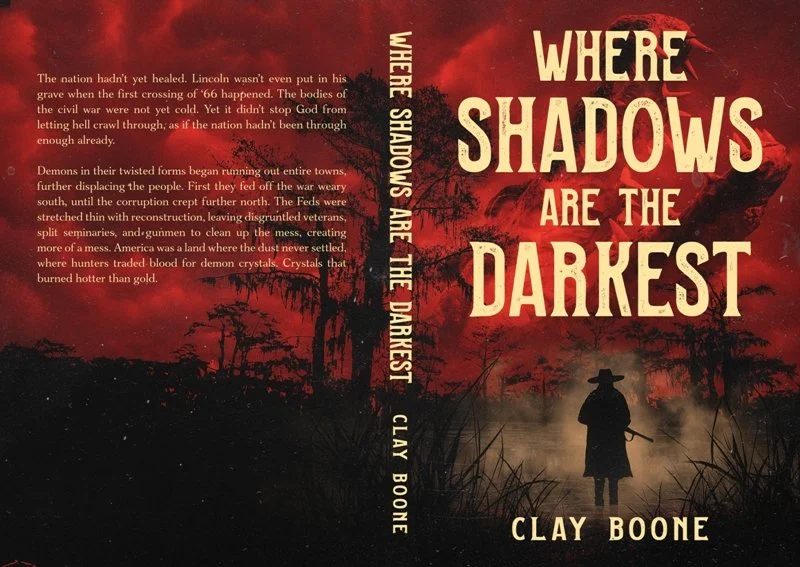
Clay Boone is the author of Where Shadows Are the Darkest. He grew up in rural Missouri, where stories about the Civil War and Reconstruction were passed down through generations by word of mouth. That sense of lived history shapes everything he writes. His work blends the brutal realities of the post-war South with folklore, fear, and the religious tensions of the period. It is not gunsmoke and glory. It is the copper taste of blood, the smell of last night's fire, and the burning in your lungs when you run.
Read Clay’s Articles, HERE.
Visit ClayBoone.com
Buy The Book on Amazon: Where Shadows Are the Darkest
Follow Clay:Facebook / YouTube / Instagram / TikTok / Goodreads
