
Original Horror Fiction: A Four-Part Ghost Story for Halloween Season
When the weekend came things didn’t get much better. An email from my ex-wife’s lawyer came in detailing what she wanted for alimony, at this point in my life there was no way I was going to pay that! The numbers had to have been based off of my last job, because with my current job she wasn’t getting shit! I remembered what my old sergeant once told me, “Not all women will destroy you in divorce court but, all women can destroy you in divorce court.” That guy had been through 3 divorces at 30, so at least I wasn’t there. Where I was, was spam and ramen on the weekends to pay for my lawyer. At least I had the three squares at the school. God damn I sounded like a prisoner. I needed to organize my thoughts. I forwarded the email to my lawyer and expressed my concerns, then got back to organizing what had happened Friday night.
A. Everyone was in a faculty wide joke being played on me.- unlikely
B. Maybe I heard the maintenance guy's name wrong?- no
C. I’ve gone into psychosis from the stress of losing my last job and wife- possibly
D. Ghosts are real and I’ve become their favorite guy on campus to haunt— No.
Later that week I made an appointment with a psychiatrist.
I felt stupid sitting in his office. There were diplomas on the wall, a box of tissues on the table, and one of those little fountains in the corner that was supposed to make people relax. All it did was make me have to piss.
He asked why I was there, and I spent a few seconds trying to figure out how to answer without sounding completely insane.
"I've been seeing things."
"What kind of things?"
I told him about the face in the window, the apple, the Ouija board. I left Tod for last.
"And there's an old maintenance man I've talked to a couple times."
"What about him?"
"Apparently he's been dead for five years."
The psychiatrist stopped writing. That wasn't encouraging.
"You've seen him more than once?"
"Yeah. We've had conversations."
He asked if I heard voices when nobody was around. I told him no. Then he asked how much sleep I was getting.
"Four hours sometimes. Six if I'm lucky."
"And how much are you drinking?"
"Depends on the night."
He looked up at me.
"That's not an answer."
"When I do drink? A lot."
From there we got into the divorce, losing my programming job, working nights, and everything else that had happened over the last few months. By the time I finished, he seemed a hell of a lot less interested in Tod Ruspringer than I was.
To him, there wasn't much mystery. When somebody runs himself down long enough, he explained, the brain starts doing strange things. You hear things that aren't there. You catch movement out of the corner of your eye. You even see somebody who isn't actually standing in front of you.
"The brain doesn't always make a clean break between being asleep and being awake," he said, like he'd said it to a hundred other guys in that chair.
"So I'm dreaming while I'm awake?"
"Not exactly, but you're close enough."
That I could live with.
He didn't tell me I was schizophrenic, or possessed.
So hallelujah to that.
I guess.
He wrote me a prescription for an antidepressant and another for Xanax, then told me to get more sleep and give the pills time to work.
"And don't drink on these. Not with the Xanax."
"Sure," I said.
He gave me a look that said he'd heard that one before, but I let it go.
I should've walked out happy. Instead I sat there thinking about Tod.
"What about a brain tumor?"
The psychiatrist looked at me like I'd just changed the subject to lawn care.
"What about one?"
"Can one make you see things?"
"It can cause neurological problems, but nothing you've told me makes me think that's what this is."
"I want my head checked."
He tried to talk me out of it, but I kept at him until he finally gave me a referral.
A few appointments and one expensive MRI later, I got exactly what I'd asked for.
Nothing.
No tumor. No brain damage. Nothing growing inside my skull that could explain why I'd shaken hands with a dead man. I walked out with a big envelope of scans under my arm, prescriptions in my pocket, and another medical bill I really couldn't afford.
Strangely enough, I felt better. There was nothing wrong with my brain, and that made sense. More importantly, I wanted it to make sense.
I felt great for the next few weeks. No weird occurrences, no dead maintenance men popping up out of nowhere, and the medication seemed to be doing what it was supposed to do.
Even the divorce started looking better. My lawyer filed to have my income reconsidered, since I was making a fraction of what I'd made as a programmer. According to him, when my ex found out what that might do to her alimony, he could hear her screaming in the background.
I would've paid good money to hear that.
Things at Wentworth were going well too. The kids had grown on me more than I cared to admit, and having a routine kept my mind busy. I even started volunteering for weekend overtime. Once the cadets settled down after TAPS, the place got quiet, and I'd make a pot of black coffee, heat up whatever takeout I'd brought, and throw a movie into the laptop. Every so often I'd get up, walk the barracks, make sure everybody was where they were supposed to be, then go back to my chair.
It was boring. Gloriously boring. For the first time in months, boring felt pretty damn good.
I slept better too. I stopped thinking about Tod every time I crossed the street near Alumni House. Hickman was still up there staring down at the campus like a corpse nobody had gotten around to burying, but I'd quit paying much attention to it.
The psychiatrist had been right. At least that's what I kept telling myself.
One evening after head count, I came up three cadets short. I checked the latrine, the stairwells, the common areas, and every other place a teenager might think was clever enough to hide. Nothing. That left the Scholastic Building, and more specifically, the dark room.
"Goddammit."
I grabbed my jacket and headed out. Spring was starting to show itself by then, with most of the snow gone and the sidewalks lined with mud and wet grass. The night air was still cold, but it had lost the bite it had a month earlier.
I found all three of them climbing out through a basement window. I stood there with my arms crossed while the first one hit the ground, turned around, and nearly jumped out of his skin. The second froze halfway through the window. The third apparently decided staying inside was safer.
"Evening."
"Sir."
"What the hell are you three doing?"
Nobody answered.
"I asked you a question."
The one in front finally spoke. "We were looking for ghosts, sir."
I closed my eyes for a second. Of course they were.
"You find any?"
"No, sir."
"Congratulations. You found demerits instead."
They didn't appreciate that. I wrote all three of them up and marched them back to Tillotson.
At the end of my shift, after the sun came up, I went back to the Scholastic Building to make sure they hadn't broken anything getting in. I checked the outside windows first, then unlocked the door and stopped at the top of the basement stairs. The hallway below was still dark.
For a moment I just stood there. Then I felt stupid. I was a grown-ass man afraid to walk into a basement because some teenagers had gone looking for ghosts. What was I, eight?
I smirked and patted the pocket where I kept my pills.
"When all else fails, pray for a fire drill," I said to nobody. I hadn't thought about that damn apple in weeks.
I went downstairs. Nothing happened. No voices, no cold spots, no wooden apples hanging from the ceiling. Just a basement. I checked every window and latch, then went outside to inspect the one the cadets had used.
Something was mashed into the mud beneath it. At first I took it for trash, but when I dug it out and wiped it with my thumb, it turned out to be a metal 35mm film canister. Most film I'd seen came in little plastic ones by then. This thing looked older. I slipped it into my pocket.
When I asked the three cadets about it, all of them denied it was theirs. Maybe they were lying. I didn't think much more about it until breakfast, when I reached for my wallet and felt the canister again. I rolled it between my fingers.
I told myself it was curiosity. That afternoon I dropped it off at the CVS in town and asked if there was anything they could do with it.
The clerk turned it over in her hand. "This is old."
"How old?"
"Won't know until we get into it. If it's still good."
A couple days later they called and said they'd managed to pull pictures from it. The same woman handed me an envelope.
"You find this at an estate sale or something?"
"No. Why?"
She smiled. "Some interesting stuff on there."
I didn't like the way she said it.
I opened the envelope in my car. The first few photographs were harmless: old Lexington, storefronts, cars, streets that looked familiar but not quite right. Then came Wentworth. The academy looked younger. Hickman wasn't boarded up. Cadets stood in formation on the quad, and there were parades, inspections, football games, and groups of kids screwing around for the camera. Where Tillotson stood now, there was nothing but open ground.
I caught myself smiling. Whatever this roll of film was, somebody had documented a part of the school I'd never seen.
Then I found Tod.
He looked to be in his fifties, standing beside a cadet with one arm around the kid's shoulder, wearing the same smile he'd worn when he introduced himself outside Alumni House. The next photograph was a self-portrait, taken at arm's length, the same kid grinning into his own lens. Which meant the camera had been his.
After that came a night shot of a man in what looked like a Civil War uniform standing near the doughboy monument. At least, I thought it was a man. The flash had washed out half the image, and the figure went transparent around the edges. Bad exposure, I decided. There were a dozen explanations. I thought about that soldier's letter to his Sarah for about half a second and made myself quit.
Then a second night shot of the quad, with long shadows stretched across the pavement. I assumed they belonged to whoever was standing behind the photographer, until I noticed that every shadow had a head, and every head seemed to be turned toward the camera.
I held the picture closer. Creepy, but explainable. Lighting could do strange things, especially with an old camera.
The next two had been taken inside Hickman. In the first, shadows crept along the walls, thin and crooked, like people standing just out of frame. The second was shot from an upper window, looking down on a parade in progress. Cadets in formation, spectators lining the pavement.
I wasn't looking at the parade. I was looking at the window.
The face was there. The same hollow-eyed face I'd seen from the ground, only now I was seeing it from the other side. The window was double-paned, and the face wasn't drawn on the inside glass or the outside glass. It sat in the dust between them.
I remembered what the Commandant had told me at my interview. Some cadet probably snuck up there and drew that with their finger.
"How the fuck would he get his finger in there?"
I said it out loud, alone in a parked car. The Commandant had also said the face came up a few years ago. This film had been lying in the mud for thirty.
The next photograph was aimed at Hickman's bell tower, focused on the round window near the top. Something stood behind it. At first it looked like nothing more than a patch of dark inside a dark room. Then I noticed two tiny points of light. I told myself it was the flash bouncing off the glass, and that held until I made out the outline of shoulders and a head, tilted down toward whoever held the camera.
The last picture was the entrance to the dark room.
To the right of the doorway was a face. Long and narrow, with deep, empty eyes, like the one in Hickman's window, except this one was smiling, the way a skull smiles, which isn't really smiling so much as what's left over. A thick black shape surrounded it, like smoke or flames frozen in place.
I stared at that picture longer than I should have. Then I shoved the whole stack back into the envelope, and it took me two tries to get the flap tucked in.
"Fuck this."
I threw the envelope onto the passenger seat and reached for my Xanax.
Then I stopped.
I thought about the Spotted Pig, and the way those two Old Boys had looked at me when I said Tod Ruspringer's name. One of them had done most of the talking that night. I sat there trying to fish his name out of the beer-soaked mess of an evening.
Hal. Hal Mercer.
He'd known Tod. Maybe he'd known the kid in the photograph too.
I put the pills back in my pocket.
The Spotted Pig wasn't far, and by the time I got there the lunch crowd had mostly cleared out. Hal was at the end of the bar with a beer in front of him. He recognized me as soon as I walked in.
"Well, look who survived."
"Barely."
He laughed and nodded at the stool beside him. I sat down and set the envelope on the bar.
"You mind if I ask you something about Wentworth?"
"That depends. You planning on telling me about any more dead maintenance men?"
I didn't laugh, and his smile faded.
I slid the photograph of Tod and the cadet across the bar. "You know either of them?"
Hal picked it up. He only glanced at Tod. He looked at the kid a lot longer.
"Where the hell did you get this?"
"Found some old film at the school."
"That's Tod."
"Yeah. I got that part."
I pointed at the cadet. "Who's the kid?"
Hal rubbed his thumb along the edge of the photograph. "Albert."
Albert's apple.
"Albert?" I said.
Hal looked up. "You really don't know?"
"No."
He set the photograph down and took a deep breath. "Kid hung himself in the Scholastic Building."
"I thought that was Hickman. That's what all the websites said."
"Websites." Hal took a drink. "Every story about Wentworth ends up in Hickman sooner or later. It was the dark room. Pulled the fire alarm and did it once the building cleared out."
I thought of Cadet Dunston tied to that chair in the dark, screaming for somebody to let him out, and me standing in the doorway asking why he was squealing like a stuck pig. I'd sent him back to his bunk like he was the problem. He'd lasted one semester, and I'd never once wondered where he went. Then the wooden apple swinging above my head. When all else fails, pray for a fire drill.
"Jesus."
"Yeah."
"Did you know him?"
"Some. I was a couple years behind him. But everybody knew who Albert was." He pushed the photograph back toward me. "He wasn't some screwup. That's the part people forget when they tell it. Good cadet. Made sergeant. Wrote for the school paper. Loved this place more than most of us did."
I looked at the picture again, at Tod's arm around Albert's shoulders.
"Then why'd he kill himself?"
Hal stared into his beer. "Hell if I know. Nobody ever really said."
He told me Albert's parents had left him at the school a lot. Holidays, long weekends, sometimes damn near the whole year. If the tuition was paid and somebody signed off on it, Wentworth wasn't going to throw a kid into the street.
"That sounds miserable."
Hal shrugged. "Maybe for you. Albert loved Wentworth."
"So he wasn't depressed?"
"I didn't say that." He tapped the photograph. "Tod looked after him some. Everybody knew that much."
I studied Albert's face in the photograph. He didn't look miserable. He looked like every other kid I'd seen at Wentworth, young and proud of his uniform and happy to have his picture taken.
I slid the photograph back into the envelope.
"Why are you digging into this?"
"I don't know."
That was a lie. I knew exactly why. I just didn't want to say it out loud.
Hal leaned back on his stool. "Take some advice from an Old Boy. Wentworth's got enough stories without going looking for new ones."
"Little late for that."
He didn't argue. He just finished his beer.
I gathered up the photographs and stood.
"You all right?" he asked.
"Yeah."
It came out too fast. Hal gave me the look you give a guy at closing time who swears he's fine to drive.
By the time I got home I was wrung out, but my brain wouldn't stop. Why had I found those pictures? Better question: why had my dumb ass gone and developed them?
I went into the bathroom, ran the water cold, and splashed my face a few times. The guy in the mirror looked like hell. Bags under his eyes, gray coming in at the temples, a collar that had seen better weeks. I leaned on the sink to get a better look at him, and something rolled under my palm.
I jerked my hand back.
It was the apple. Sitting on the edge of the sink next to my toothbrush, the two halves held together with the same crooked strips of tape.
The last time I'd seen it, I'd put it in Tod Ruspringer's hand on the sidewalk outside the Alumni House.
I didn't pick it up. I stood there with the water still running and looked at it for a long time. Then I turned off the faucet, turned off the light, and shut the door on it.
I had Saturday overtime, so I went to bed at a decent hour like a responsible adult and lay there staring at the ceiling fan, which wobbled on high and had been wobbling since the day I moved in, and which I'd been meaning to fix for about as long as I'd been meaning to call my mother. Every time I closed my eyes I got Tod's arm around that kid's shoulder. Then the window. Then that thing in the dark room, grinning at the camera like it had been waiting for me to show up with my little envelope. Then the apple, sitting on the other side of the bathroom door. Somewhere around midnight I gave up and turned on the computer, hoping the internet would distract me. It didn't take long.
My lawyer had emailed. The motion to reconsider my income had been denied. I read it twice, then a third time, as if it’d change anything. The email explained why in a paragraph full of heretofore and notwithstanding, which I understood about as well as I'd understood anything these days.
What I got out of it was that my ex-wife was going to take what was left of me and pay a man in a nice suit to help her do it. I called him anyway. His voicemail picked up on the first ring, which told me he'd seen my name and was smart enough not to answer at 1:40 in the morning.
I sat there with the phone in my hand, and the whole week added itself up. Dead men. Photographs. Money I didn't have, going to a woman who'd once cried over a TV commercial about a dog. It felt like one long practical joke, and I was the only one who hadn't gotten the punchline.
I took another Xanax. Twenty minutes later I was still awake, and that pissed me off in a whole new way.
In the freezer, behind a box of waffles I'd bought in an optimistic mood, sat the bottle of Jack Daniel's I kept there. The psychiatrist had told me not to. I could hear him say it, calm and a little bored, like he already knew how the story ended. I poured a healthy glass anyway, sat down at the desk, and drank.
I remember finishing it. I remember pouring more.
After that it gets soft around the edges. I have a picture in my head of the orange prescription bottle sitting open beside the keyboard. I remember picking it up. What I did with it, I couldn't tell you. Mostly I remember being tired. Like closing your eyes seems like the smartest idea you've ever had.
I made it to bed. I think.
The next thing I knew, sunlight was coming through the window, and I glared at it as if it had insulted me. Then I saw the clock.
"Shit."
Two hours late. I threw on my uniform and raced across town.
The Commandant was at his desk. I started explaining before I'd made it through the door, and he let me go the whole way through, which was worse than being interrupted. Twelve years of TAC officers had taught him the value of silence. When I finally ran dry, he nodded.
"You've been going through a lot."
"Yes, sir."
"You all right to work?"
"Fine, sir."
He studied me for a long moment. Then he opened his desk drawer, took out a piece of mint gum, and held it across the desk.
I stared at it. I knew exactly what I was looking at. It was the same look I gave cadets at 0600 on Monday mornings, the one that says I know what you did and I'm choosing to let you keep your dignity. Now I was on the receiving end, and I could still smell the Jack coming off my own breath.
"Thanks," I said, and took the gum knowing I’d never live it down.
My stomach turned about ten minutes later. Anxiety, the pills, the booze, or all three holding a meeting in my gut. I made it outside, though only as far as the back of Hickman, where I braced one hand on the brick and gave the grass everything I'd eaten since Tuesday. Across the lawn, the face in the third-story window looked down at me the way you'd look at a dog that got into the trash.
"Goddammit."
Nine months of pulling myself together, and here I was, drunk, late, and puking in the shadow of a haunted building. They were going to fire me. They had to.
I spent the rest of the shift waiting for it. Every set of boots in the hall made me brace, and every one of them walked right past the door. Nobody stopped. Nobody so much as glanced in. My mouth stayed dry no matter how much water I drank, and the fluorescent lights hummed at a pitch I could feel in my teeth. Eventually the barracks went quiet. No cadets missing. Nothing strange. For once, Wentworth seemed content to leave me alone.
Toward the end of the shift I put my head back and shut my eyes. Just for a second.
When I woke, the shift was almost over. I sat looking at the empty coffee cup next to the computer, thinking the last few weeks had convinced me I was getting better.
Maybe I wasn't.
We’ll end it there this week. Tune in next week for the 4th and final installment of “Misery Loves Company”.
Author Bio:
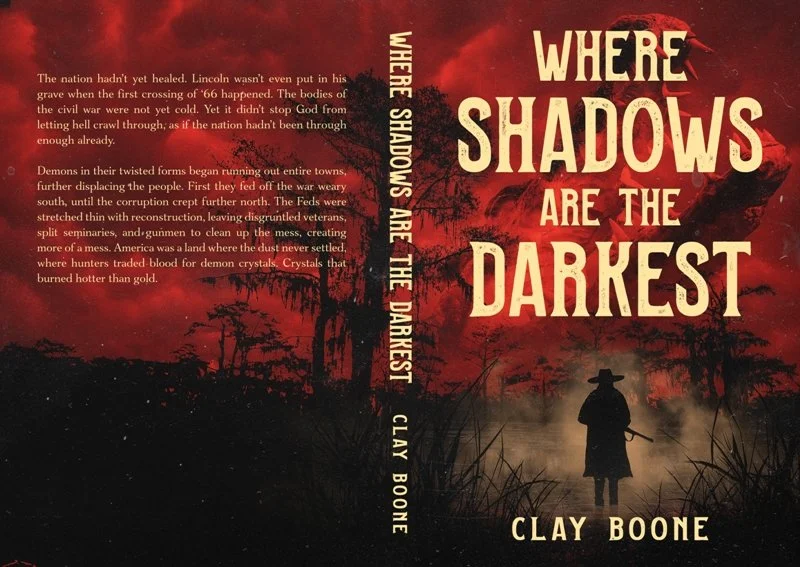
Clay Boone is the author of Where Shadows Are the Darkest. He grew up in rural Missouri, where stories about the Civil War and Reconstruction were passed down through generations by word of mouth. That sense of lived history shapes everything he writes. His work blends the brutal realities of the post-war South with folklore, fear, and the religious tensions of the period. It is not gunsmoke and glory. It is the copper taste of blood, the smell of last night's fire, and the burning in your lungs when you run.
Read Clay’s Articles, HERE.
Visit ClayBoone.com
Buy The Book on Amazon: Where Shadows Are the Darkest
Follow Clay:Facebook / YouTube / Instagram / TikTok / Goodreads
