
From Structure to Atmosphere: How I Build My Digital Art Prints
There is a moment in every piece where I stop knowing what it will become.
That moment is the point I work toward.
I create digital art prints using Adobe Photoshop and Lightroom. But the tools are only part of the story. What drives the work is something older — a tension between order and drift, between the geometry of the built world and the organic language of nature. My prints live in that space. They are built from three distinct currents: urban forms, floral watercolours, and abstract oils. Each one pulls in a different direction. The work happens where they meet.
Where It Begins — The Urban Anchor
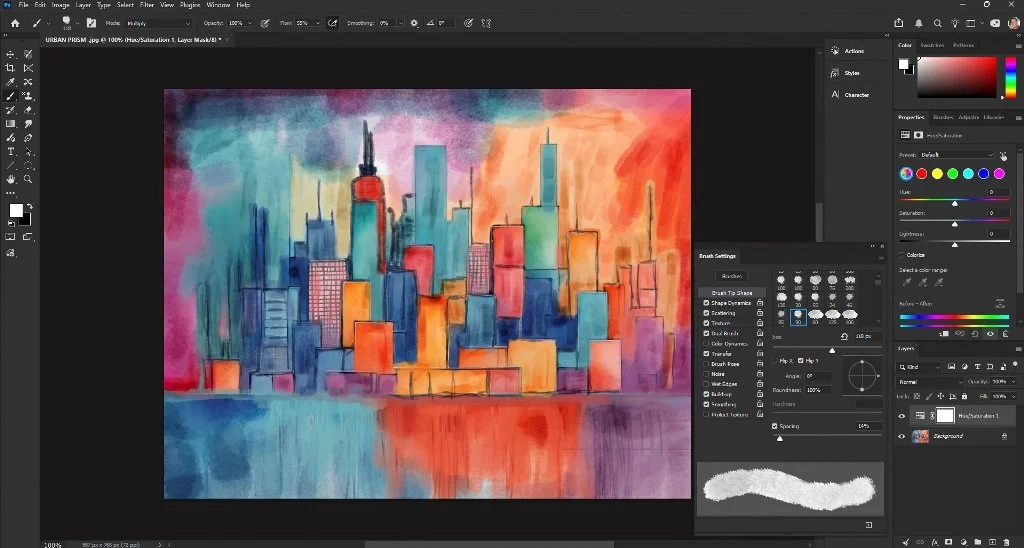
I grew up paying attention to structures. Skylines. Facades. The quiet mathematics inside everyday spaces — a window grid, a roofline, the way shadow falls across concrete at a particular hour.
Geometry gives me my anchor. Clean lines. Measured ratios. A sense of order that feels honest rather than cold. When I open a new canvas in Photoshop, I often start here — with structure. A framework. Something to push against.
I work at high resolution from the beginning. The canvas is large. The layers are named. There is intention in the early stages, a kind of architectural thinking that shapes the composition before anything organic enters the frame.
This is the foundation. But a foundation alone is not a print. It is just a plan.
The Second Current — Floral Watercolour
Floral watercolour brings the opposite energy entirely.
Where geometry is measured, florals drift. Where structure obeys, petals bloom past their edges. Colour in a watercolour wash does not stay where you place it — it moves, bleeds, softens at the margins. That unpredictability is exactly what I need.
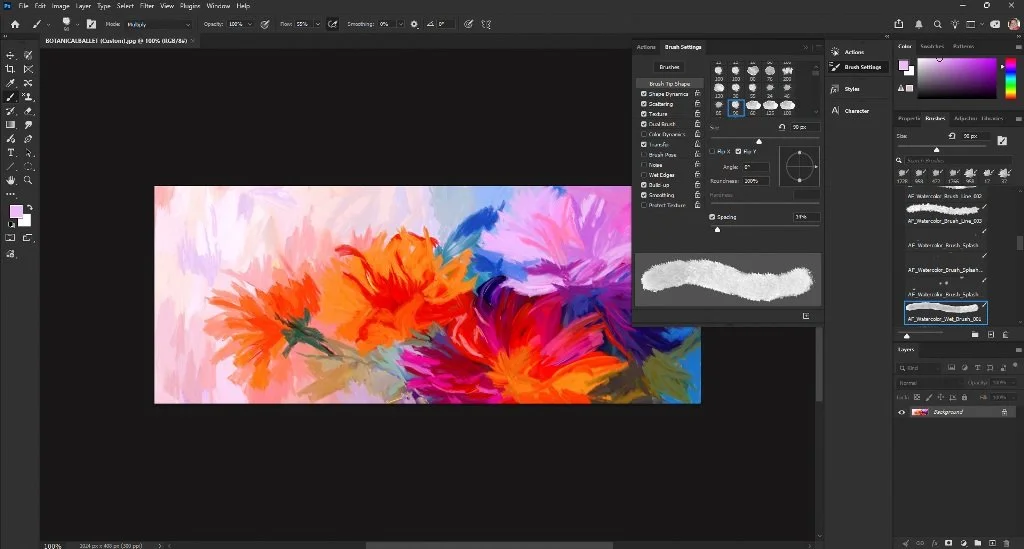
I source high-resolution watercolour textures and paint my own digital washes inside Photoshop using pressure-sensitive brushes that mimic the behaviour of real pigment on wet paper. The goal is not to replicate traditional watercolour perfectly. The goal is to capture its spirit — the way colour breathes, the way edges dissolve, the way light seems to come from inside the pigment rather than falling on top of it.
When I bring floral elements into a piece that began with geometry, something shifts. The rigid forms begin to soften. A skyline silhouette takes on warmth. A grid of lines becomes a trellis for colour to climb. The structure is still there — but it is no longer cold.
Lightroom enters the process here. Once the layered composition reaches a certain point, I move it into Lightroom to work on the overall colour story. Tone curves. Hue shifts. The warmth or coolness of the light. Lightroom lets me see the piece as a whole rather than as a collection of layers. It is where the mood settles.
The Third Current — Abstract Oils
The third influence is the one that gives a piece its weight.
Abstract oil marks — gestural, imperfect, human — add a quality that neither geometry nor watercolour can provide on their own. There is texture in an oil stroke. There is evidence of a hand, a decision, a moment of commitment. Even translated into a digital medium, that quality survives.
I work with high-resolution oil texture overlays and build them into the composition using blend modes — Multiply, Overlay, Soft Light — adjusting opacity until the marks feel embedded rather than applied. The oils sit beneath the watercolour haze in some pieces. In others they push through to the surface, adding depth and shadow that grounds the whole composition.
This is the layer that makes a print feel alive rather than designed.

The Meeting Place
Photoshop is where all three currents converge.
I layer, wash, erase, and rebuild. I work non-destructively — every decision is reversible, every layer preserved — because the process is exploratory. I do not always know which direction a piece will take. I follow the work rather than directing it.
Structure loosens as florals breathe into shapes. Oils add depth beneath the watercolour haze. The composition shifts between clarity and atmosphere, sometimes within a single piece. I am looking for a particular tension — the moment when a rigid form has softened just enough, when the organic elements have enough structure to hold, when the abstract marks have settled into the piece rather than sitting on top of it.
That tension is what I am chasing in every print.
When I return to Lightroom for the final pass, I am refining rather than changing. Colour temperature. Contrast. The luminosity of the lightest areas. I want the final file to feel like light is moving through it — not a flat image, but something with atmosphere and depth.
The print is exported at the highest resolution the format allows. It is designed to be printed large — to hold its detail at A2, A1, and beyond. Every decision made during the process serves that final moment: ink on paper, colour in a room, a piece of work that holds its own on a wall.
Why I Create This Way
I did not set out to work across three visual languages. It happened gradually, as I followed what interested me and let the influences accumulate.
Urban forms taught me about composition and proportion. Floral watercolours taught me about colour and softness. Abstract oils taught me about gesture and weight. Photoshop gave me a space where none of those influences had to be chosen over the others.
The work I make now is the result of letting those currents run together — showing how different visual languages can merge, how a rigid form can soften, how a floral wash can carry architecture, how abstraction can give a whole piece its pulse.
That is why I create the way I do.
Not to master a single style. But to find what happens when several of them lean into each other.
— Phillip J Gordon
About the Author
Phillip J Gordon is an Australian digital watercolour artist whose work explores the intersection of architecture, nature, and abstract expression. Phillip's prints are available as instant digital downloads at PhillipJGordonDigitalArtPrints.com
Follow on: Pinterest / Instagram / Facebook / LinkedIn
See Phillip’s other articles: HERE
