
A Photographer Turns the Knife on His Own Work
If I was an art critic, I would write about how try-hard my work was — desperate to be seen as some grandiose photographer, exploring cliché topics through a millennial lens. I'd dissect the obvious contradictions, explain exactly why certain images don't work, and maybe, grudgingly, throw in the occasional compliment.
So here I am. Adopting the attitude of an art critic evaluating my own work, walking you — the reader — through the flaws I quietly negotiate with myself, and the cognitive dissonance I face every time I sit down to write an artist statement.
Condoms, Crucifixes, Cigarettes. Radford's early period can be summarised as: found three vaguely iconographic objects, discovered they alliterate, built a couple of mediocre projects out of arranging them near each other under moody lighting.
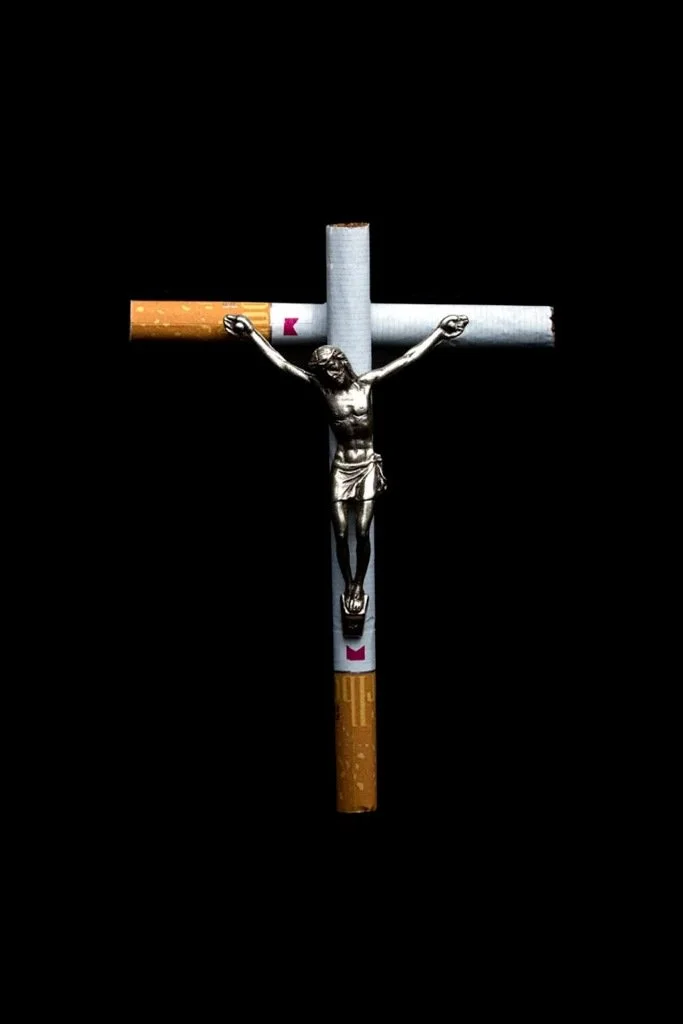
Holy Smokes juxtaposes religious iconography with cigarettes and calls the juxtaposition a meditation on ritual and addiction. One particular image from the project (Fag Christ) — a knockoff of Andres Serrano's Piss Christ — depicts a metallic figurine of Jesus crucified on two cigarettes. Pulled from an auction at the Laura I Gallery in 2021, not because the piece was too blasphemous, but because of the connotations around the word "fag." Somewhat amusing, I suppose Radford saw the opportunity in the coincidental wordplay to imply Jesus was gay, having long since accepted that the worst reaction to your work is no reaction at all.
Objectification is William putting condoms on things in the name of Spanish grammatical gender — a Durex advert dressed up as a meditation on identity because “gender identity” sounds considerably more important than “I found gendered nouns confusing as a child.” And yet, irritatingly, there is something genuinely interesting here. The project carries enough visual commentary to give the viewer plenty to dissect, particularly at a time when gender and identity have become so entangled with language that even the most mundane objects seem to inherit the burden. In Spanish, a table is feminine, a shoe is masculine, and suddenly we are assigning identities to things that have no stake in possessing one. Against the backdrop of increasingly intense debates over gender, pronouns and the expectation that language reflect identity correctly, the absurdity becomes almost productive: we are capable of becoming deeply offended when a person is addressed incorrectly, while spending centuries insisting that a chair is somehow a “she.”
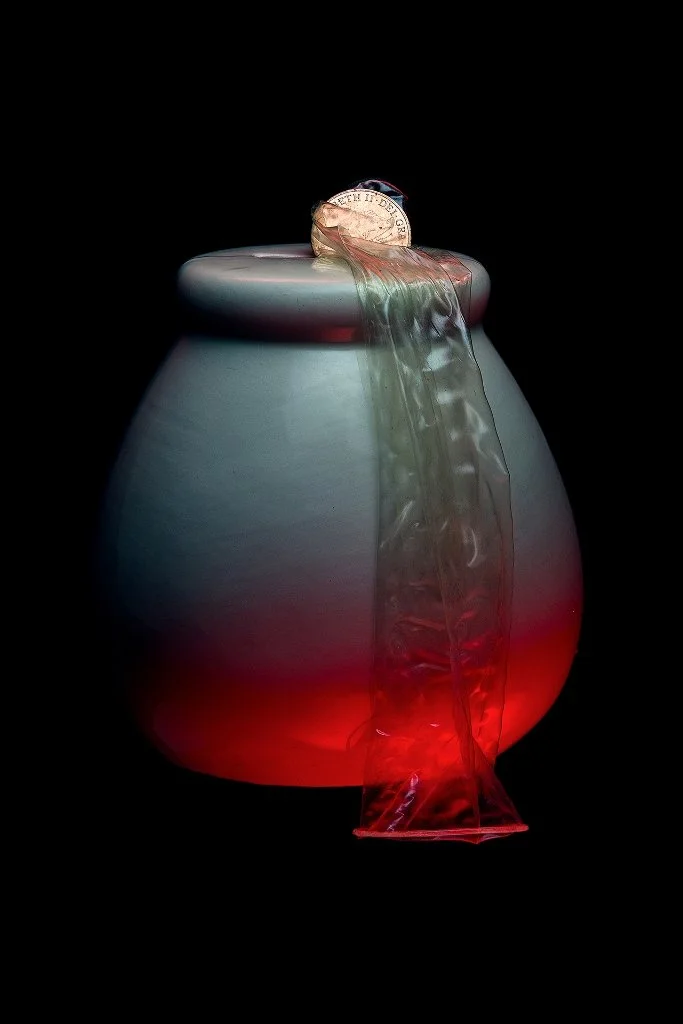
Some of the stronger images - Mr Coin & Mrs Piggy Bank, for example, reads initially as little more than an amusing pairing of masculine and feminine objects, but the sexualised framing and transactional symbolism open another interpretation entirely: money, bodies, exchange, prostitution. It is one of those images that starts as a visual joke and becomes considerably more interesting the longer you look at it.
Then there's Strangely Familiar, in which Radford photographs his own family with stockings pulled over their heads, ostensibly to interrogate the artifice of the family album — though one suspects his relatives describe it as "the year cousin William made us wear tights on our head." It's either a searing critique of performative domesticity, or the reason he's not getting invited back.
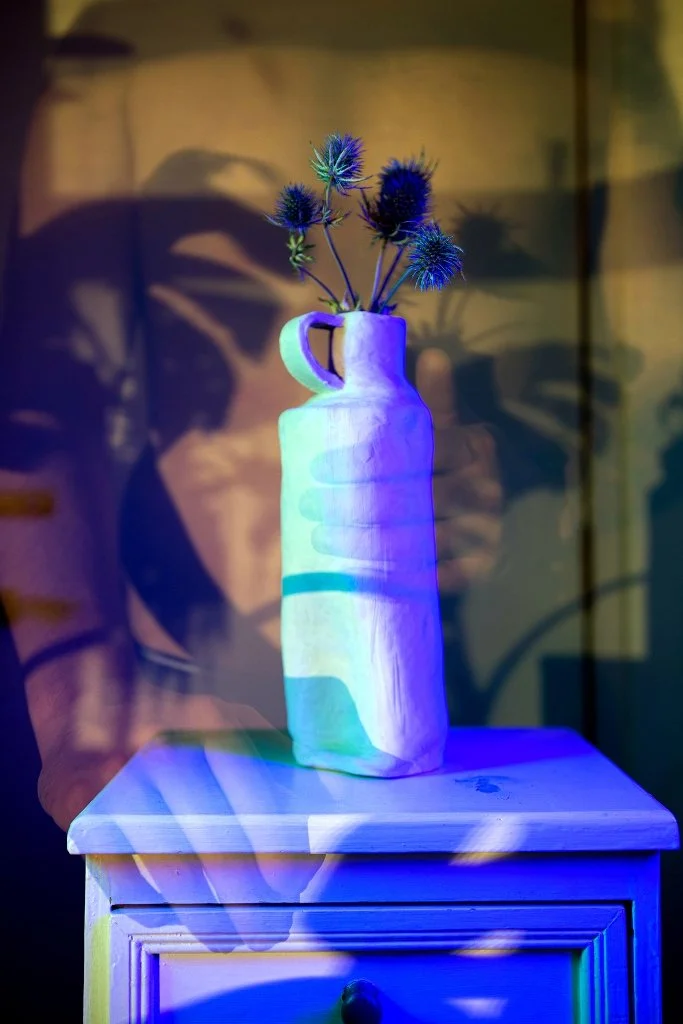
Deflowered uses nudity as pure shock architecture. Floral arrangements are lit by phone screens playing pornography. What the viewer actually sees is seductive colour and competent light-painting. The stated theme — porn addiction and desensitisation — arrives only in the wall text. Radford claims this bait-and-switch is intentional, mirroring the way pornography itself operates. The claim is convenient. Having mastered light-painting, he appears primarily interested in proving he can make anything look mildly interesting, rebranding the technique “light tainting” as though coining a movement.
Having mastered light painting, the project reads less like an urgent statement on addiction and more like a victory lap — proof he could point any light source at a flower and still make something worth hanging on a wall.

Exposed, or: Ten Blank JPEGs. A series of completely white photographs, each one secretly documenting the artist showering, urinating, or masturbating — submitted to a gallery that opened the files and, quite reasonably, wrote back to ask why they'd been sent nothing.
The project is imitation dressed as flattery. Claiming to be the first to translate white paintings into photography, Radford stakes a claim on an image every photographer has accidentally taken at some point in their career, then insists it's intentional. Knowing the blank canvas alone can't carry a concept, he injects meaning by telling us what he was doing behind the overexposure — as though an edgy postgrad had discovered Jackson Pollock's Cum Paintings, or Salvatore Garau's Invisible Sculpture, or Jens Haaning's Take the Money and Run, and thought: I could do that too.
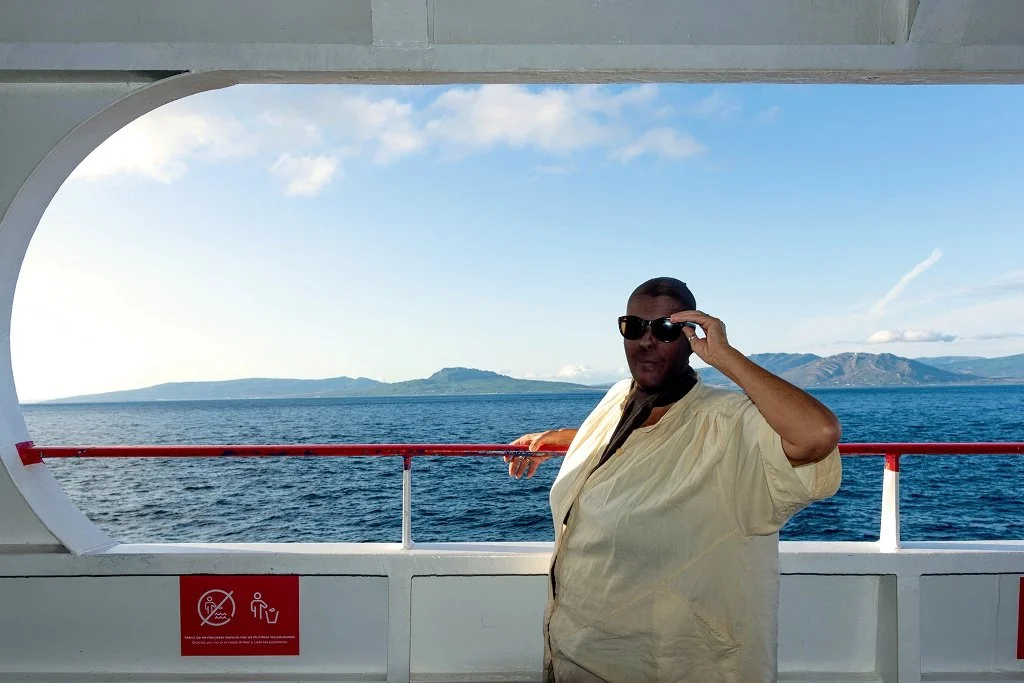
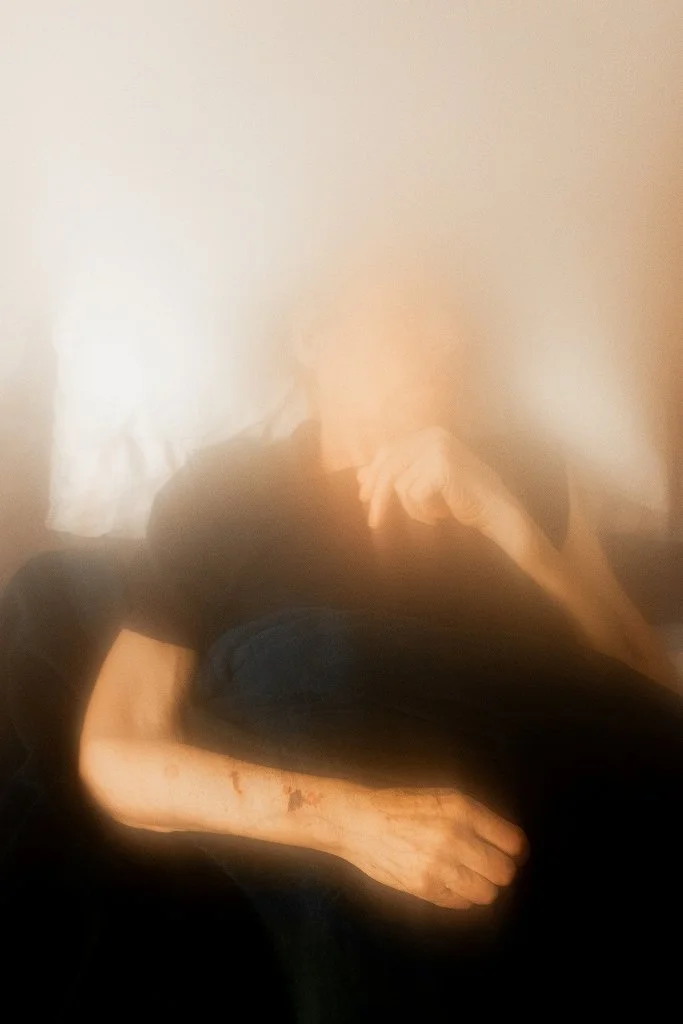
Let's talk about Semi-Detached, which Radford describes as being "brought about during a period of my life that was spent mostly drunk or high." One does wonder whether the intentional camera movement was quite as intentional as advertised, or whether the wine and weed simply meant the camera was moving regardless, and Radford — ever the opportunist — decided retroactively to call it a technique. It is the photographic equivalent of falling down the stairs and telling everyone it was choreography.
To his credit, "ghosting" himself out of frames to represent psychological absence is a genuinely elegant idea — right up until you remember it's also just what happens when you're too drunk to hold a pose for a thirty-second exposure.
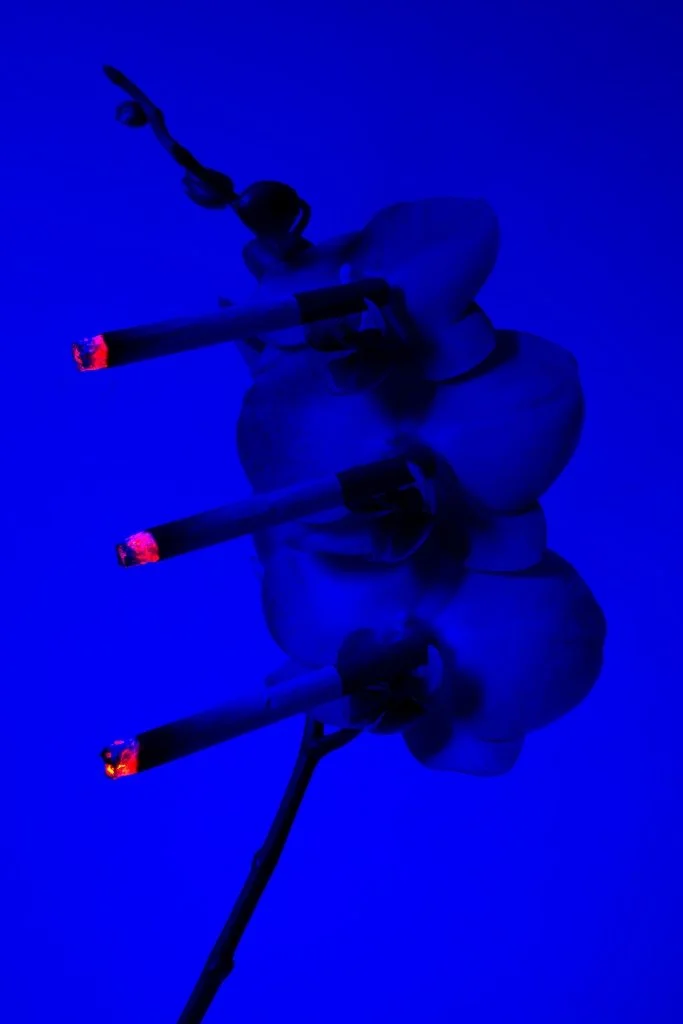
Nor should we forget Cherry Blossom, in which the artist romanticises his own burnout — cigarettes nestled in flowers, collected on the walk home from waiting tables — and calls it a meditation on "the delicate line between creative fulfilment and physical exhaustion." It's evident Radford concerns himself with the big questions in life: can I rebrand a weed habit as creative escapism? Will people buy the work if I keep mentioning I'm broke and waiting tables? And How many projects can be extracted from a father’s death before the sad-artist trope runs thin?
Which brings us, inevitably, to grief. Nothing revives a stalling practice quite like a dead parent, and Radford has managed to draw not one but several projects from the same loss. Here we see what the art world has made of Radford: standing at his father’s deathbed with a camera in hand, the pressure to become a “serious” artist like a devil on his shoulder whispering that this is what a real artist would do. Not sit with him. Not hold his hand or stroke his head the way his sister did. Photograph the final hours instead, only to sit months later judging the frames for aesthetic value—as if the moment’s only lasting weight was how well it looked on a screen.
The subsequent projects map the internal conflict that followed. White Knight is some of Radford’s most technically rigorous work—red-and-blue masking, vaseline haze, carefully constructed symbols—driven by the need to do his father proud. Grief and the medium became so entangled that he felt guilty whenever he put the camera down. That pressure eases, project by project. Gradient Loss abandons colour for the first time, shooting in black and white. Residual Noise pushes the ISO to its limit until clarity itself dissolves. The final two chapters, made in parallel, mark a further release: Mourning Routine confines itself to the view from a living-room window while the artist quits a long-standing weed habit and begins, tentatively, to look after himself.
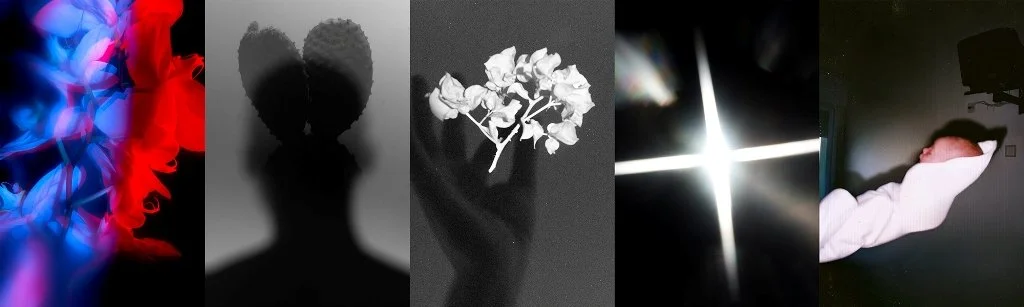
Transparent, due to release on the anniversary of his father's death, goes further still—digitally removing the father from the few remaining family photographs and, in doing so, finally letting go of photography as the primary means of holding on.
At under thirty, Radford has already assembled a body of work that feels less like a finished statement than an ongoing negotiation with visibility, ambition, and the cost of being seen. The exhibitions and open-call placements suggest not only persistence, but the determination required to sustain a practice in which significance must continually be earned, performed, and financed. What lingers is not simply provocation, but the more revealing tension beneath it: the pressure to transform a personal mythology into artistic coherence before the work has fully decided what it wants to become.
About William Josephs Radford:
Born in Spain and based in the UK, William Josephs Radford is a conceptual photographer whose work uses symbolism and visual metaphor to turn psychological and social themes into constructed imagery. His projects explore childhood, addiction, loss, identity, and burnout, with each body of work built around a distinct technique that becomes part of the narrative. His photography has been exhibited internationally, including in Arles, Barcelona, Paris, and Rome, and has received awards from the Fine Art Photography Awards, Boynes, 1839 Awards, and others.
See more at JosephsRadford.com or on Instagram / Facebook
