FC? Editorial By: Mike Meyerson
A computer scientist spent the better part of a decade trying to convince the American legal system that a machine deserved authorship credit for a piece of artwork. Every court said no. Then the Supreme Court (in its most powerful move) is simply choosing not to even bother…please let that NO! stand forever.
On March 2, 2026, the Supreme Court denied the appeal in Thaler v. Perlmutter, quietly closing one of the stranger chapters in the ongoing argument about AI and creative ownership. I say strange because when you actually look at the details, the whole thing borders on absurd.
Here is the image at the center of it, A Recent Entrance to Paradise:
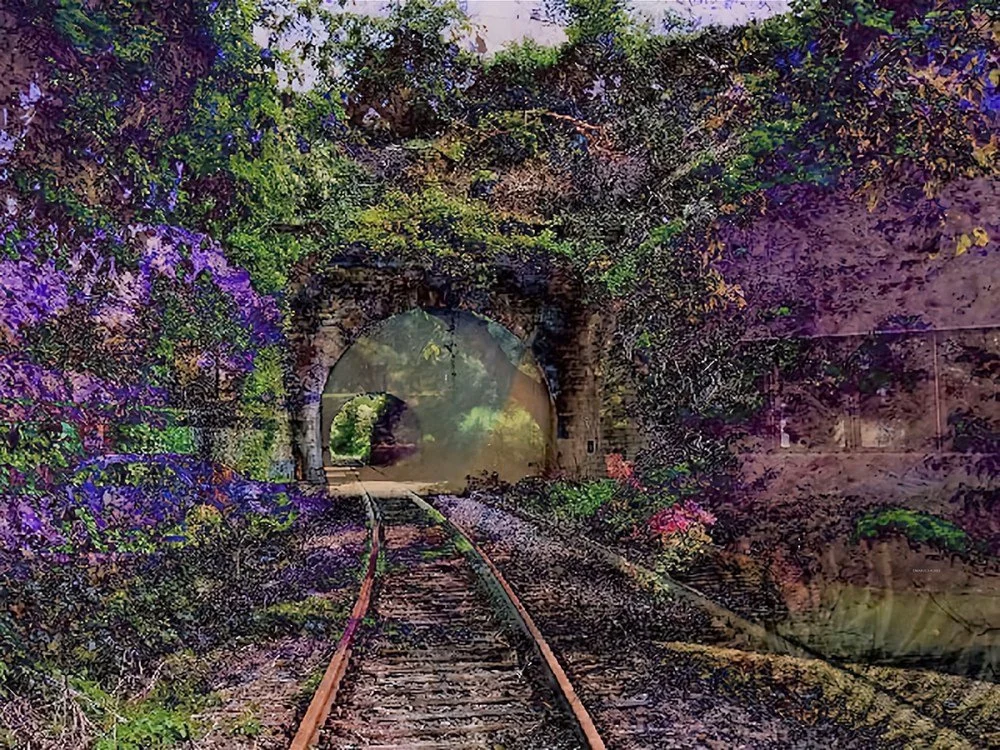
"A Recent Entrance to Paradise" / Generated by Stephen Thaler's Creativity Machine
Let me paint you a picture (you’re welcome).
The Man Who Told On Himself
Dr. Stephen Thaler is a computer scientist and AI researcher who built a system he called the "Creativity Machine." He wasn't using AI the way most of us (probably) do…as a tool, a collaborator, a shortcut. He set it loose completely on its own, and the machine independently generated A Recent Entrance to Paradise: a dreamlike, a painted looking image of light at the end of a tunnel. It could be called “lush” or “otherworldly” I guess. Some say it’s the kind of painting you'd expect to see in a gallery with a human signature on it. I don’t know…not sure I’d buy it to hang on my wall.
In 2018, Thaler filed a copyright registration application with the U.S. Copyright Office. On that application, he listed the Creativity Machine as the sole author. He also voluntarily disclosed, in his own words…that the work "lacked traditional human authorship."
Sooooo, he basically told on himself. He admitted to having no creative input what-so-ever.
His argument was essentially: I built the AI, the AI made the art, therefore I should own the copyright as the machine's owner. The Copyright Office said no in 2019. He appealed. They said no again. He appealed further. No. Supreme Court. No. See a pattern here?
What makes this genuinely worth talking about isn't the stubbornness…it's the why. Thaler isn't some frustrated artist trying to protect his work. He holds patents on AI systems. The real play here was legal precedent. If he could establish that AI-generated work qualifies for copyright protection, the commercial value of owning and licensing AI systems skyrockets. This wasn't about one painting. It was about reshaping intellectual property law in a way that would make AI ownership extraordinarily lucrative. He used a pretty picture as a chess piece.
Thankfully, the courts weren't impressed.
Why the Law Said No (In Plain English)
Copyright law in the U.S. goes back to the Constitution, which gives Congress the power to protect the work of "Authors and Inventors." For over a century, courts have interpreted "author" to mean a human being, ya know…someone who brings creative judgment, intention, and a piece of themselves to what they make.
There's actually a case from 1884, Burrow-Giles Lithographic Co. v. Sarony, about whether photographs could even be copyrighted, since cameras are machines. The court said yes, photographs qualify, but specifically because the photographer made human decisions: how to frame the shot, where to place the light, how to direct the subject. The human was in the room. That's the standard that has held ever since, and it’s a good one.
Every judge in the Thaler case came back to the same wall. The D.C. Circuit Court put it plainly: the Copyright Act requires work to be "authored in the first instance by a human being." The machine can't be the author. And since Thaler himself admitted no human was creatively involved, there was nothing left to argue.
What This Actually Means for Creatives
Here's where it gets real for photographers, illustrators, filmmakers, writers, tattoo artists…anyone creating things in 2026 with AI somewhere in the workflow.
The ruling didn't say AI-assisted work can't be copyrighted. It said fully autonomous AI output with no human creative input, no human in the chair, can't be. That's an important distinction.
If you're using AI as a tool…generating options, combining elements, helping to speed up your workflow, you are still the author. Your creative judgment is present. That's protectable. The human has to be meaningfully driving the process, not just hitting "generate" and walking away.
What this also means, practically, is that fully AI-generated content sits in a kind of legal no man's land. No one owns it. Anyone can copy it, use it, remix it and even sell it. If you're a brand or a business thinking you can flood the market with autonomous AI art and lock it down with copyright, the Supreme Court just said nope, that's not how this works (ok, they probably didn’t use the word nope).
For human artists who've been watching AI encroach on their livelihoods, that's not nothing. It's not a complete solution, the economic pressure is real and ongoing, but legally, the work you make with your own hands and judgment still has protections that a machine's output does not.
And it's not just visual art. The same logic applies to music, writing, and film (one would hope). An AI that composes a track, writes a screenplay, or generates a voiceover entirely on its own, produces work that legally belongs to no one. For musicians and producers already nervously watching AI-generated songs flood streaming platforms, that's a double-edged sword…it means those tracks can't be locked down by whoever ran the algorithm, but it also means the economic damage keeps coming with no clear legal remedy.
The Bigger Question Nobody's Answering Yet
The ruling was deliberately narrow (great, what could go wrong?). The courts specifically avoided the bigger constitutional questions…they ruled only on what the current law says, not on what it should say (you were expecting some common sense? Shame on you). That means Congress could, theoretically, change this. Lobbyists for the tech industry are certainly aware of that (oh boy).
The gray zone is also widening. How much human input is "enough" to qualify for copyright? One prompt? A hundred? Selecting from AI outputs? Editing them? There's no clear line yet, and that ambiguity is where the next wave of litigation is already forming (shocking, I know).
What Thaler's long, expensive, ultimately failed crusade did accomplish, despite losing at every turn, is force the legal system to draw a line in the sand. For now, that line says: creativity requires a human. A machine, no matter how sophisticated, no matter how beautiful the thing it makes, cannot own what it creates.
As someone who spends a lot of time thinking about art, creativity, and what makes something worth protecting... I think they got this one right, but I see a lot more court cases coming in our future.
Have thoughts on AI and creative ownership? We'd love to hear them. Drop a comment below, or even better yet…write an article.
Author’s Bio:
Mike Meyerson is the founder of FEELING CREATIVE?, and has worked in the video/film/advertising industries for over 25 years. He also enjoys photography and has dabbled in screenwriting. He does see some usefulness in AI tools, but absolutely hates the threat it poses on the creative world. Currently located in NY’s Hudson Valley Region and is always looking to build the network, find a new cool trail to hike and a new place to grab a slice of pizza.
Read Mike’s other articles - HERE.