
Artist Q&A:
What’s your name, where are you based, and how long have you been tattooing?
My name is Julia, and I work under the name JRockTattoo. I’m based in Heidelberg, Baden-Württemberg, Germany. I’ve been tattooing for nine years.
What got you into tattooing?
What really drew me in was the desire to create. I simply love making things. I’ve had quite a few different jobs throughout my life, and almost all of them were connected to creativity in one way or another. Before getting into tattooing, I worked as a magazine designer, then as a florist, creating floral arrangements and decorating weddings. Eventually, I found my way into tattooing because I love creating something unique, something special and genuinely cool.
I’ve also loved tattoos since I was a child. I was always fascinated by the way artwork looked on skin, and I had tattoos of my own long before I ever considered becoming a tattoo artist.
Did you start off as an apprentice? If so, what was that like?
My journey was a little different from the traditional apprenticeship route. I was managing my own tattoo studio, where I was also responsible for design and administration. There were five tattoo artists working there, and they were the ones who taught me the basics, explained things, shared their experience and guided me through those first steps.
One of the artists, Dmitrii Uhlyx - also known as Uglyluxury - was one of my head teachers. He taught me an incredible amount and had a huge influence on my development. In many ways, the look of my work today is partly thanks to him, his love of graffiti, and his great eye for aesthetics.
What or who has been your biggest inspiration?
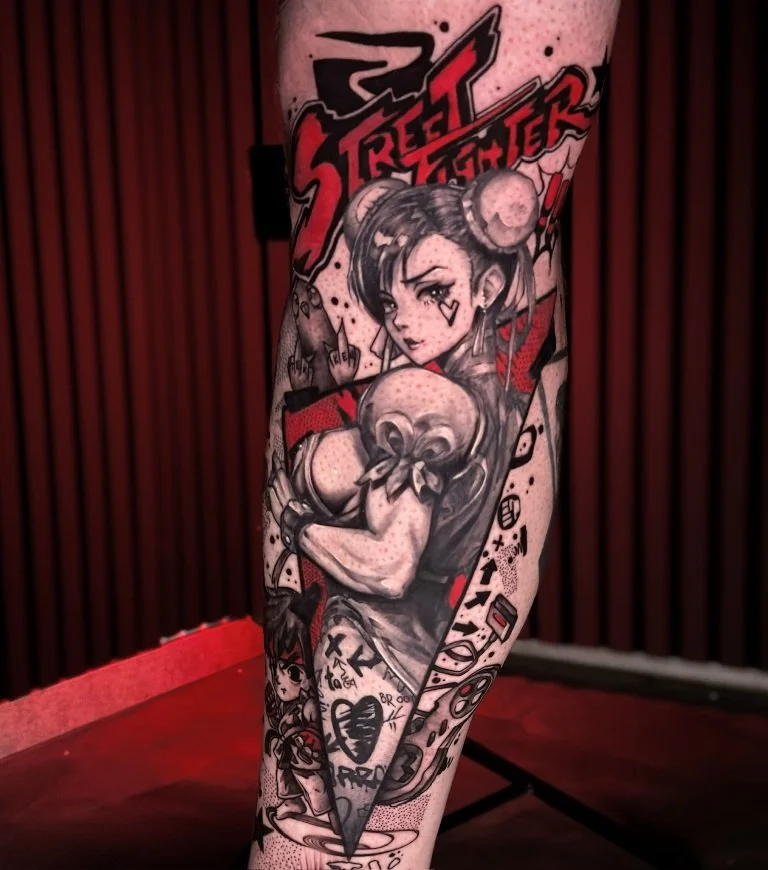
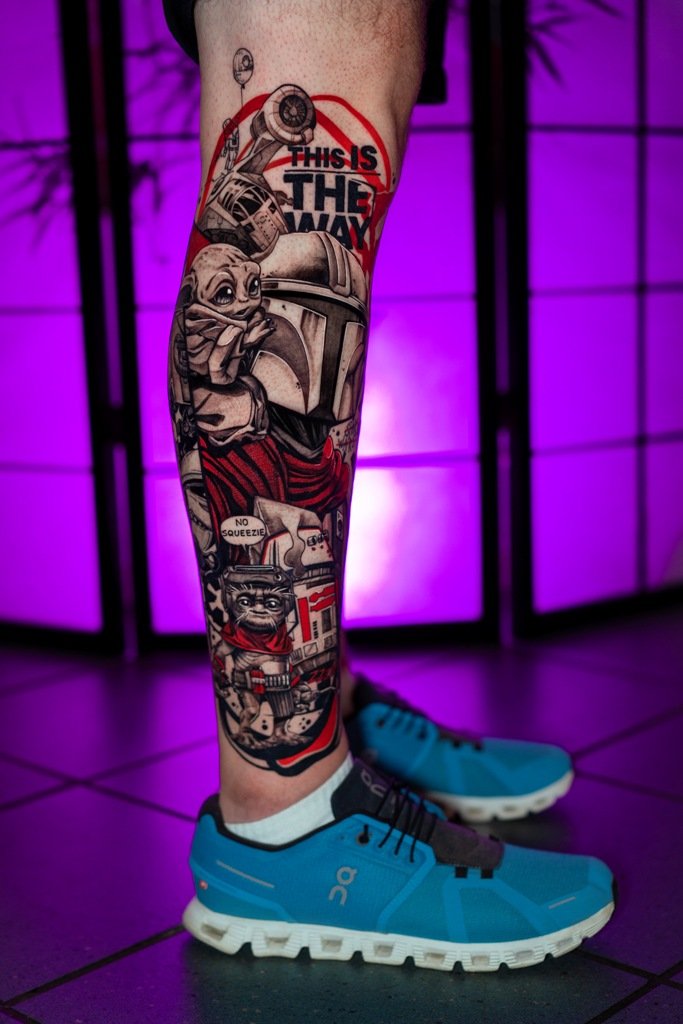
Honestly, this is probably the easiest question -- I’m a geek. I absolutely love comics, cartoons, movies, TV shows, video games, and heavy rock music. All of these things inspire me every single day and influence what I create.
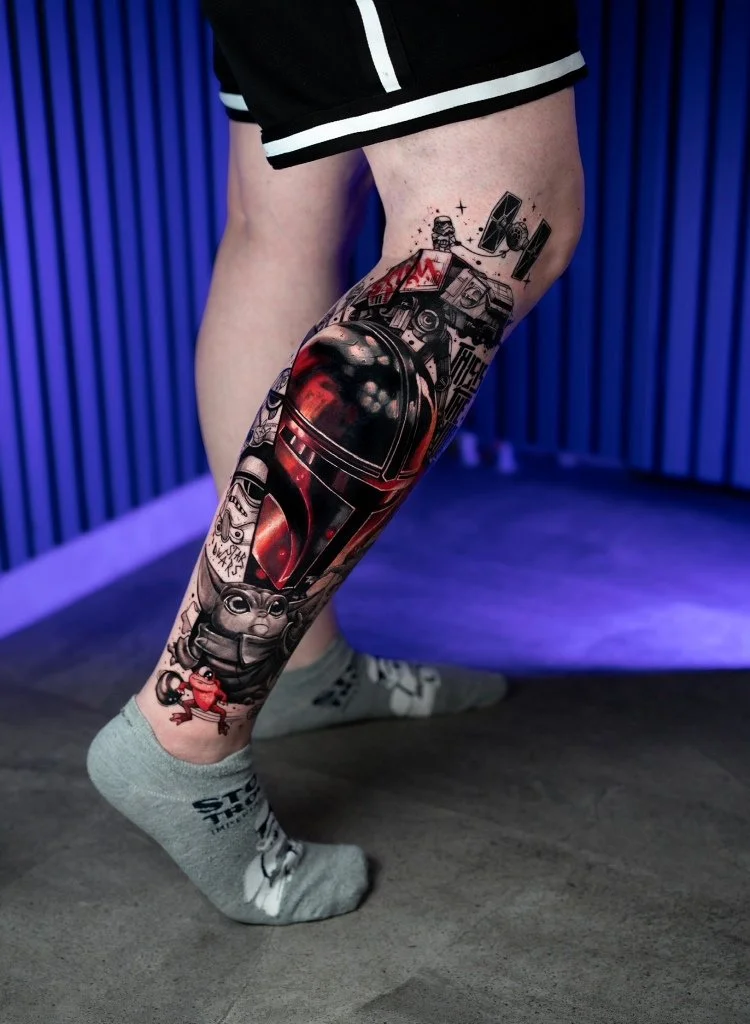
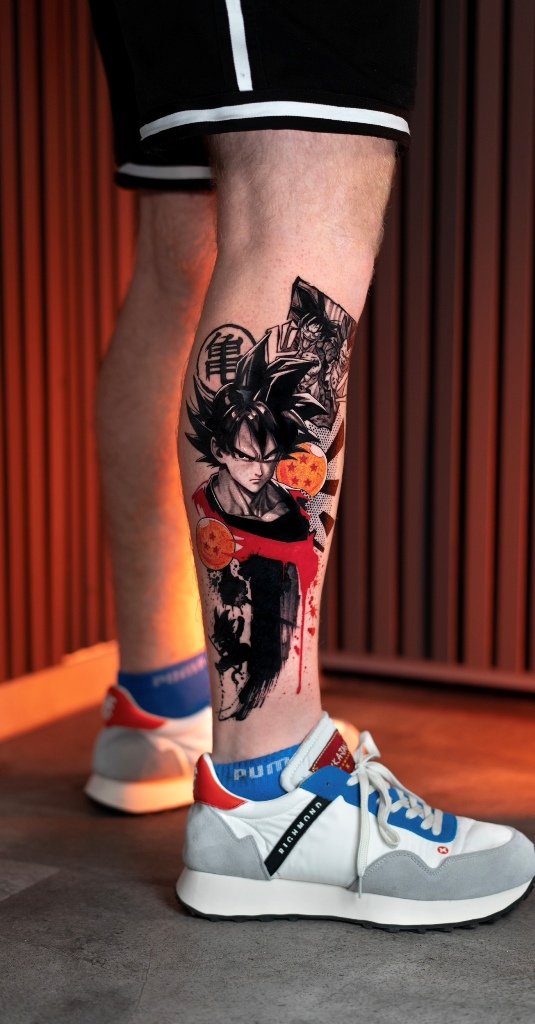
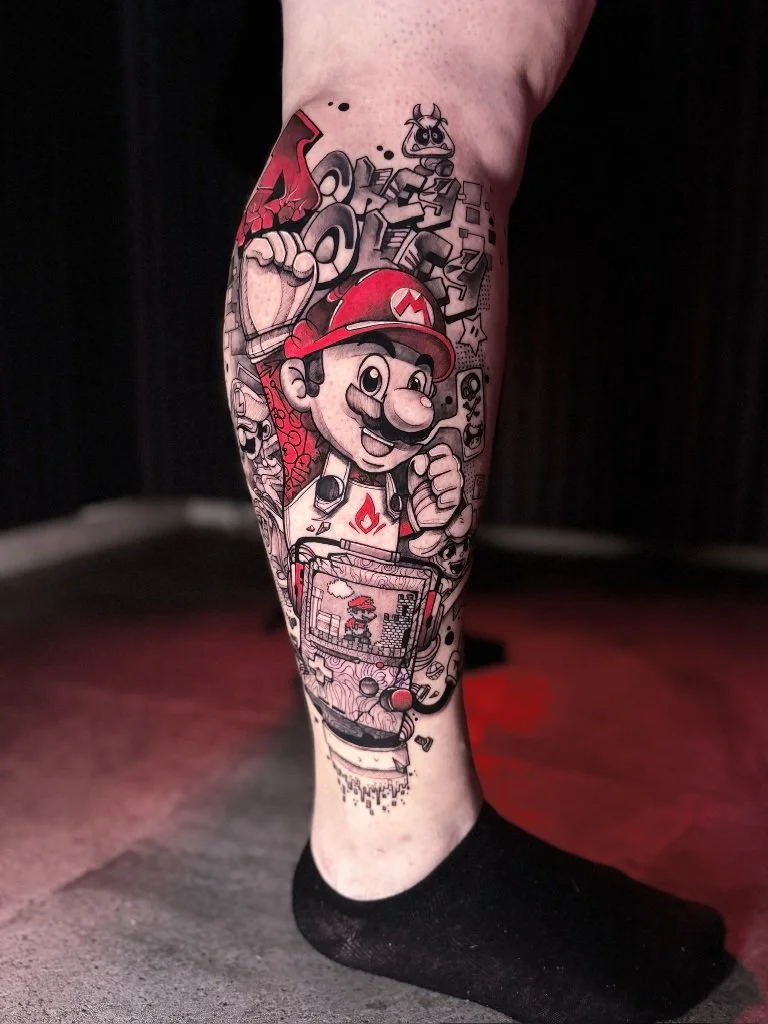
I love doing comic-inspired tattoos because I’m genuinely passionate about these universes and the characters in them. I really care about the stories behind them. For me, every tattoo is an opportunity to tell a story -- it might be the story of a particular character or an entire fictional universe. I love incorporating humour, references, and little details that not everyone will notice. Those hidden Easter eggs that only real fans, fellow geeks like myself, will recognise and appreciate. That’s a big part of what defines my style. I don’t just want to reproduce a character someone likes. I want to capture the atmosphere of their universe, add my own personality, and tell a little story through the tattoo.
Did you work in other mediums first, or go straight to tattoos?
Design was probably my first real introduction to visual art. I also worked as a florist and decorated weddings, which I consider an art form in its own right. Floristry develops your sense of composition, colour, and aesthetics. It also requires a lot of fine motor skills, which -- as it turns out -- are incredibly useful in tattooing. I think all these experiences helped shape my artistic perspective and influenced the way I approach my work today.
Do you work in other mediums now?
Besides tattooing, I enjoy all sorts of creative projects. I love decorating shoes, painting backpacks, adding studs and spikes to clothes, and experimenting with different materials. Basically, I’m into anything that involves creativity, working with my hands, and fine motor skills. As long as it’s fun, playful, and maybe a little bit naughty!
Do you have a specific niche or style you specialise in?
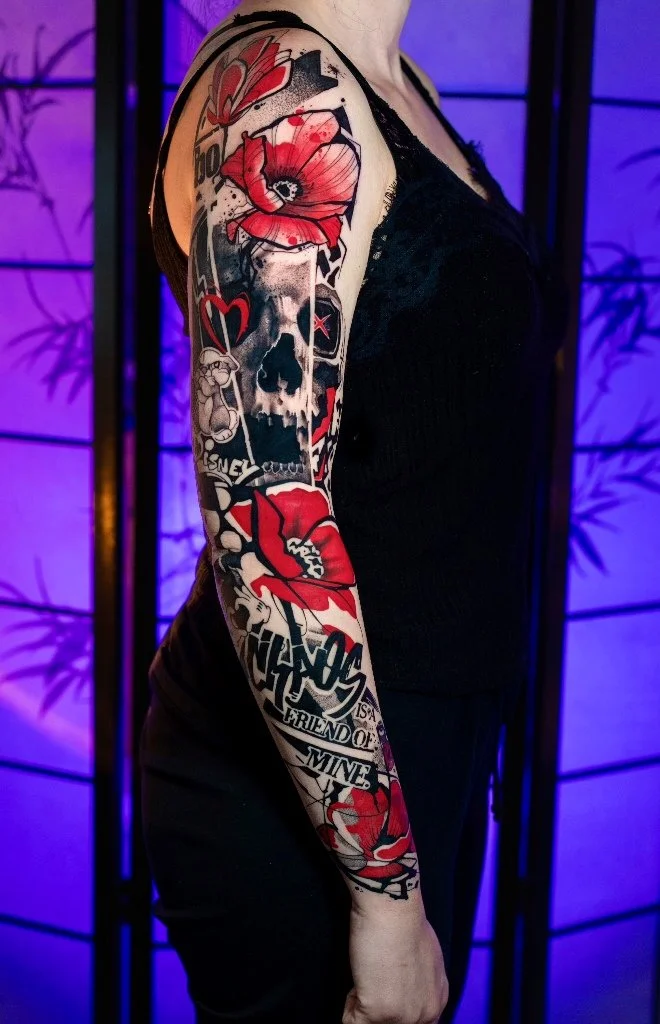
I love to work in different styles, but my heart belongs primarily to Trash Polka. I love the boldness of this style, its energy, its slightly chaotic nature, and the way it combines different elements. However, I have my own interpretation of it. I’m not particularly fond of the overly messy, chaotic approach. I prefer something cleaner, more geometric and structured -- with some comic vibes -- while still maintaining that energy and boldness. So I’d say I identify primarily as a Trash Polka tattoo artist, although I’m always interested in exploring other styles.
How do you handle the pressure of knowing there’s no “undo” button?
I think almost every tattoo artist goes through this during their first year. For me, that sense of responsibility was particularly overwhelming. During the first six months of my training, I worked exclusively on fake skin. I wouldn’t even pick up the machine to tattoo real people because I understood how serious that responsibility was. I decided I wouldn’t move on to working on actual skin until my tattoos on fake skin started looking genuinely good.
Eventually, you realise that your job is to give it your absolute best and do everything you possibly can for the person who has trusted you with their skin. And that goes far beyond the technical side of tattooing. I believe it’s equally important to support your client psychologically, put them at ease, explain everything clearly, create a welcoming atmosphere, and make the whole experience as comfortable as possible. Getting tattooed is a painful and very personal experience. As artists, our job is to make that process easier for people in every way we can -- not just to produce the best tattoo possible from a technical point of view.
Has there ever been a tattoo request you’ve refused to do?
Yes - there are certain types of tattoos I personally choose not to do. For example, I don’t do portraits of close family members, children, wives, husbands, or romantic partners.
When it comes to portraits of children, I believe you need to be a genuinely talented portrait artist. Children’s facial features are very delicate and can be quite easily distorted. That’s why I always recommend finding an artist who specialises in portraits and really knows how to capture a child’s face.
Portraits of partners are a slightly different story. Unfortunately, these tattoos quite often end up being covered up later. Life is unpredictable, relationships change, and we can never know what the future holds. I’ve actually had situations where, on the very same day, one person came in wanting a portrait of their girlfriend, while another came in wanting to cover up a portrait of their former partner.
There’s another issue too. Sometimes a portrait is technically perfect and beautifully reproduces the reference photograph, but the person in the portrait feels that it doesn’t look like them. And suddenly you’re caught in the middle of a family disagreement. Personally, I would rather stay out of other people’s relationship drama!
Do you prefer clients who come with a finished idea, or ones who give you a vague concept and let you run with it?
I’m quite lucky because most of my clients are willing to trust me and give me creative freedom -- and I actually prefer it that way. Since I mainly work in a comic-inspired style, I often just ask clients to list their favourite characters. That’s usually enough for me to start putting together an interesting concept.
I always work individually and draw custom designs for every client. I never use ready-made motifs or generic designs. Even for the smallest tattoos, I create something specifically for that person.
I’m also absolutely fine with clients bringing me images they’ve generated with AI. I think it’s a great way to visualise an idea and communicate what they have in mind. But I see those images purely as inspiration -- never as finished designs that should simply be copied onto the skin. I’m always grateful to my clients for trusting me with that creative freedom. It allows me to create truly individual pieces.
You’ve probably heard a lot of backstories. Is there one that’s stuck with you?
I actually believe there’s a story behind every tattoo. It might be someone’s personal journey, a story of overcoming something difficult, a symbol of an important moment in their life, or a way of remembering someone they have lost. I’ve had clients with all kinds of stories -- some connected to overcoming extremely difficult periods in life, others memorial tattoos for beloved pets who had passed away, and many more.
All of these stories touch me in their own way. There are so many of them that I honestly wouldn’t want to single out just one. I think a tattoo is much more than just an image on someone’s skin. It’s something deeply personal. A tattoo stays with you forever, and I believe that every tattoo -- even when a client doesn’t share their story with me -- has something meaningful behind it.
Do you have a favourite tattoo you’ve done?
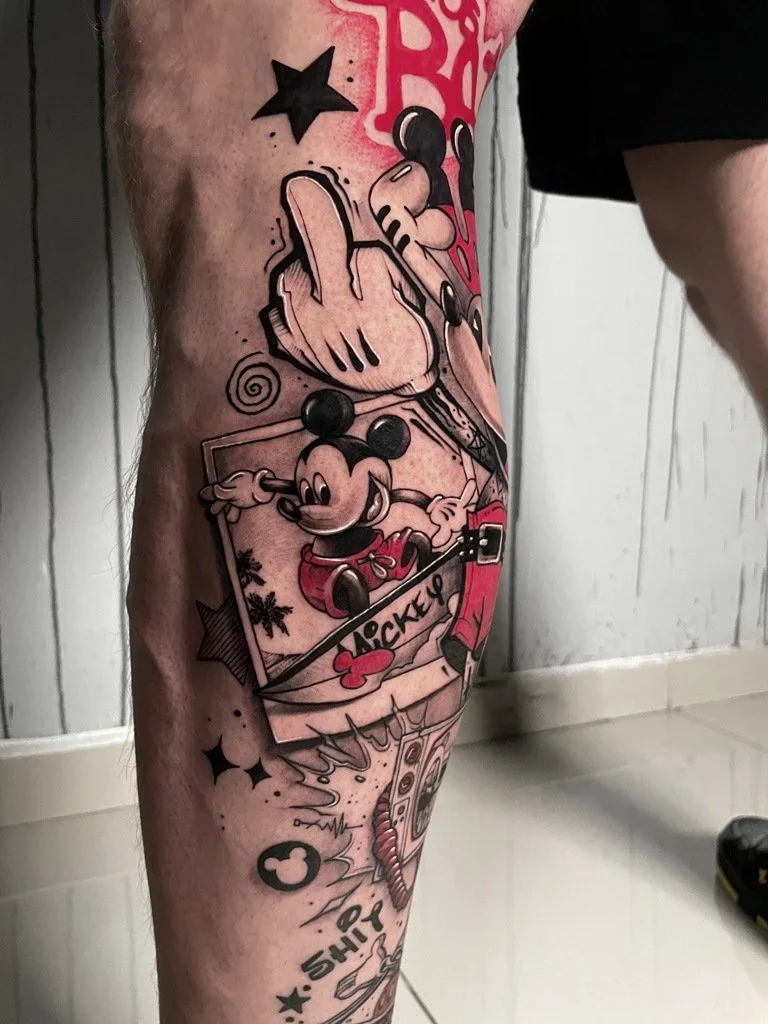
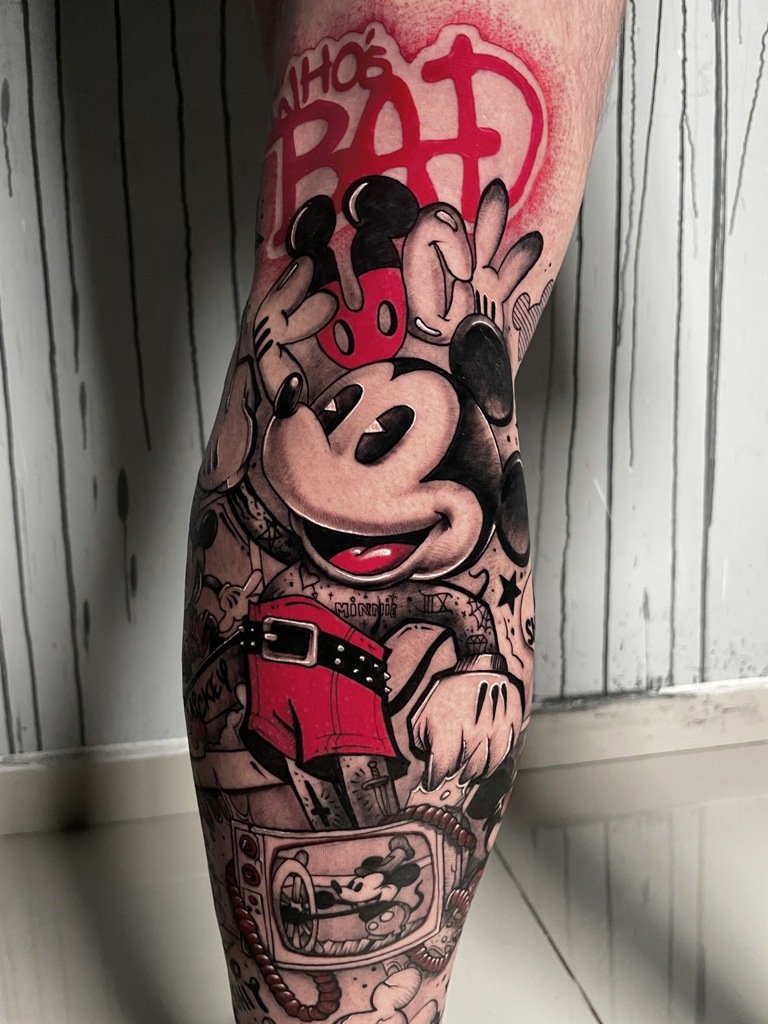
Yes - it’s a tattoo of Mickey Mouse giving the middle finger on Nikolai’s leg.
Nikolai actually helped me find and develop my own style. At one point, he simply told me: “I trust you. Do whatever you want.” He was possibly one of the first clients who genuinely meant it and gave me complete creative freedom to tattoo something I’d come up with entirely on my own.
Creating that tattoo was quite a challenge. I spent a long time redrawing and reworking the design. The version you see today was probably the tenth or fifteenth attempt! I wouldn’t necessarily say it’s my technically best tattoo. But it’s incredibly valuable to me for a different reason -- that’s where everything started. It was the first tattoo that really represented what I now consider my own style. Before that, I had experimented with all sorts of things: graphic work, realism, different approaches. But while working on this particular piece, something finally clicked. I realised what I genuinely enjoyed, what felt right, and what kind of artistic direction I wanted to pursue. So for me, this tattoo is much more than just another piece of work. It was the starting point.
What’s the worst advice you hear given to new artists?
“Just do it this way, and you’ll be fine.”
I think that’s probably one of the worst pieces of advice you could give a beginner. There’s no single universally correct way to tattoo. When I was learning, many tattoo artists tried to change the way I worked -- correcting my hand position and explaining exactly how I should use the machine. But over time, I realised that every artist needs to find their own way: the hand position that feels right, the materials that work best for them, their own technique and approach. It’s all very individual.
There’s no point trying to copy another artist down to the smallest detail or tattoo exactly the way someone else does. It simply doesn’t work like that. Everyone needs to find their own path. Because ultimately, what matters isn’t how you tattoo -- but what the finished tattoo looks like.
Aside from the actual drawing, what skills does a tattoo artist need that people don’t realise? What challenges do tattoo artists face?
First and foremost -- work on your back, guys! One of the biggest challenges of being a tattoo artist is sitting for eight hours in a shrimp-like position and somehow keeping your back healthy. Exercise, especially strengthening your lower back muscles, is incredibly important.
The second thing is developing your fine motor skills. No matter how well you can draw, if your fine motor skills aren’t there and you don’t particularly enjoy working with your hands on small things, tattooing will be quite difficult for you. Fine art has all sorts of techniques: broad brushstrokes, palette knives, and so on. Tattooing is a completely different story. It’s all about tiny details, painstaking work, and the ability to sit still and concentrate for long periods.
So take up embroidery, do puzzles, build Lego sets -- anything that helps develop your fine motor skills.
In short: work on your back, develop your fine motor skills, and don’t forget to visit your eye doctor for regular check-ups!
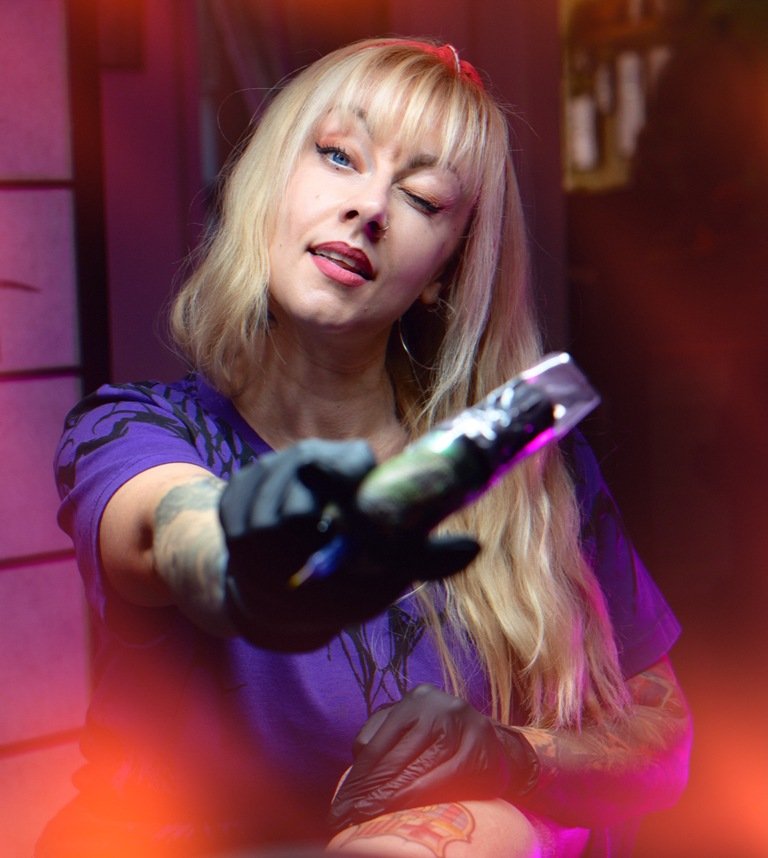
Julia (JRockTattoo) is a tattoo artist based in Heidelberg, Germany, specialising in Trash Polka and comic-inspired work. She has been tattooing for nine years.
