
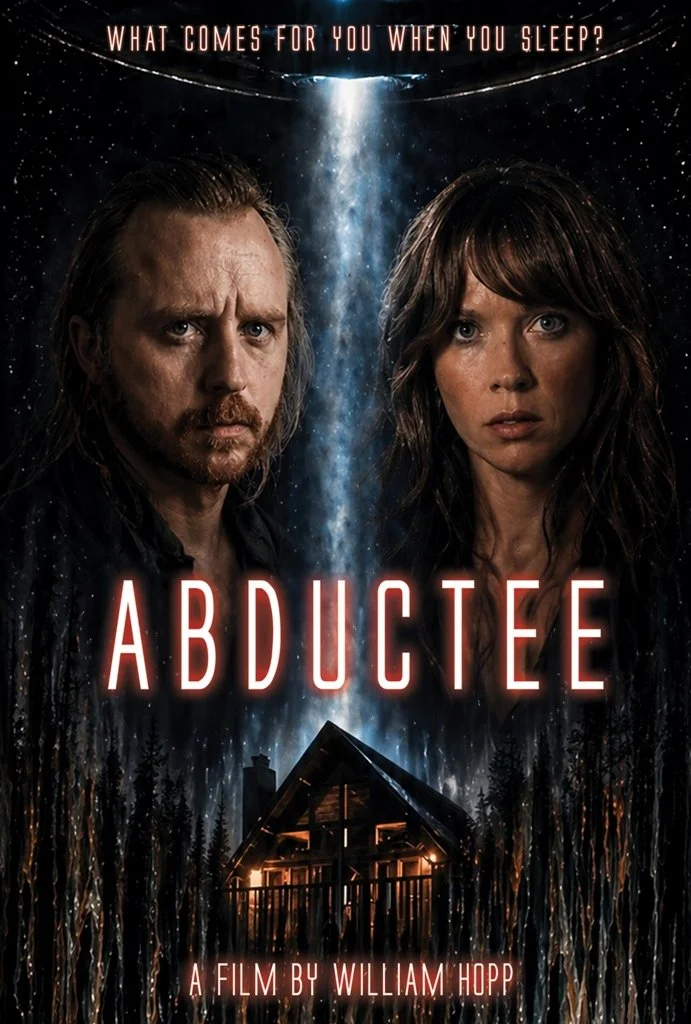
Note from Editor: With government UFO disclosures dominating headlines, the idea of alien interference feels less like fringe theory and more like just another Tuesday…so please check out Abductee, a film by William Hopp.
Abductee
The small creature was perched on the pillow next to me, its disgruntled frown apparent even in the pre-dawn darkness. A minute later, when I could finally move, I understood the motivation for the resurgence of my sleep paralysis. Two years prior I had written Abductee, a low-budget screenplay steeped in the aftermath of alien abductions and how it affects those who dare to believe in the truth.
It was a simple story with complicated subject matter. The kind that could ask the big questions and reinvent a barren genre. So, as per custom for most wet-behind-the-ears screenwriters, I promptly hid it in the bowels of my documents folder. But as I found myself in bed, my breath still coming to me in short bursts, I remembered Abductee, and the catalyst of the main character — sleep paralysis.
The decision was the easy part. Turning a screenplay of any budget into an actual feature film was a Herculean effort even for the biggest names in Hollywood. But I had something else on my side that most didn't. Maybe it was luck, or maybe it was a 3 a.m. pact with forces unknown, as evident with the fact that we managed to secure just enough funding to satisfy the line items of the movie's budget. And once my bank account felt the weight of the additional zeroes, development became active pre-production, and the roller coaster lap bar came down. Point of no return.
It was already a remarkable undertaking. We aimed to produce the 108-page screenplay in sixteen days. Forget the fact that we had been told by a Hollywood professional that we'd never do it. Why listen to him? He had only written for Roseanne and Quantum Leap, and even submitted one of the drafts of Close Encounters of the Third Kind to Steven Spielberg. He had bold ideas about how to chop up the story to cut pages, and as a young aspiring filmmaker, my ego couldn't handle it. But it seemed that all of his concerns were unfounded. We came in under budget and ahead of schedule. October of 2014 was a great month. We had achieved a minor miracle. We had a movie. And the world would see it next Halloween.
But my ego caught up with me after we finished trimming the fat in post-production to a clean 102-minute final cut.
"Format Hard Drive?"
The words stared at me on the screen of one of the five hard drives that contained all of the raw footage.
In confusion, I plugged in the next drive.
"Format Hard Drive?"
Tiny dots danced across my vision, pixels of disbelief. We had used a lower-quality cut of the footage to edit the film, but the raw, 4K footage was what we needed for the VFX. It was what we needed for color correction. It was what we'd need if we had any hope of getting into a theater or being picked up by a streamer. According to the words on my screen, it was as if the raw footage had never existed. I expected my late night visitor to return and share some of the blame, but sleepless nights about my impending financial and emotional ruin led me to believe my own hubris was to blame.
An inspection of the drives revealed both what I hoped and what I feared. The footage was there, but the computer repair shop I took it to would have to dig to scrape it out. And dig they did — for four more years. We recovered a random assortment of raw footage, high-resolution shots, and other bits and pieces to fill in the gaps — an alphabet soup of the entire movie. None of them were labeled properly. Every single file had to be reviewed and cataloged with correct names so our project file would sync to it.
A new challenge presented itself. Without the original raw footage, color correction was virtually impossible. Every scene of our film had to be carefully colored by our VFX tech, and the effects were now far more difficult. Several more years were spent cobbling everything together. Dr. Frankenstein himself might have thrown in the towel.
We were given small gifts from fate for our persistence. The sound was somehow all usable. We didn't need to record a single minute of ADR. We got a film score for free from a world-class musician. Our sound mixer offered us an unbelievable deal that fit within our dwindling budget. The movie became something of a legend among our circles. Family and friends stopped asking when it would come out. It had been long forgotten by everyone but a small few too stubborn to give up.
And then, in February of 2024, almost ten years after we wrapped, the film that everyone else had moved on from finally saw the taut screen of a movie theater. The seats were packed, popcorn aroma and anticipation heavy in the air. Our friends and family got to see what had been an open wound in my mind, one that was just starting to mend.
My sleep paralysis, something so common in my youth, has yet to return, and as such, neither has the creature who tricked me into making a movie. Should I curse it, or thank it? Maybe both? Perhaps for now, I just ignore it.
Abductee isn't perfect. It looks and feels like a low-budget film that punches above its weight class — stellar performances that elevate a good script into something greater. But I see how it clawed and scratched its way out of the grave. How the metaphorical dirt and grime is proof of life. A testament to my defiance, bending the will of the universe just enough to rescue it from the ether.
And now, even after submitting it to festivals and securing distribution, I am fighting to keep it from being quietly released to the streaming platforms. I'm taking it across the country, bringing it directly to the audience it deserves, to be shown in the only theaters worthy of screening it right now — the small, independent, family-owned boutique theaters that are just as scrappy as my little flick.
Whether you get to see Abductee from a theater seat or the comfort of your own couch, the battle scars are bright and deep. They are distracting. They bear the weight of a thousand hours of hope and grief and love and spite. And I hope you see them. Because it means we succeeded.
Abductee follows the story of Andrew Freeman, plagued by lifelong sleep paralysis, who embarks on a quest for answers that forces his sister, Laurie, into a whirlwind of uncertainty. As Andrew becomes convinced of extraterrestrial interference, the film delves into a gripping narrative that explores the impact of belief, trauma, and the bonds that hold siblings together.
About William Hopp
William Hopp is the writer, director, and producer of Abductee, the debut feature film from SCG Studios. A longtime independent storyteller, Hopp spent nearly a decade bringing the film to completion, overcoming production setbacks, lost footage, and distribution challenges through persistence and a grassroots filmmaking approach. Known for crafting character-driven psychological thrillers on micro-budgets, he focuses on strong performances, contained locations, and practical effects to maximize realism and tension. Having written more than 25 screenplays and teleplays, Hopp continues to develop genre stories centered on human experience within extraordinary circumstances.
Visit: AbducteeMovie.com
Upcoming Screenings: Follow us on our Roadshow
