
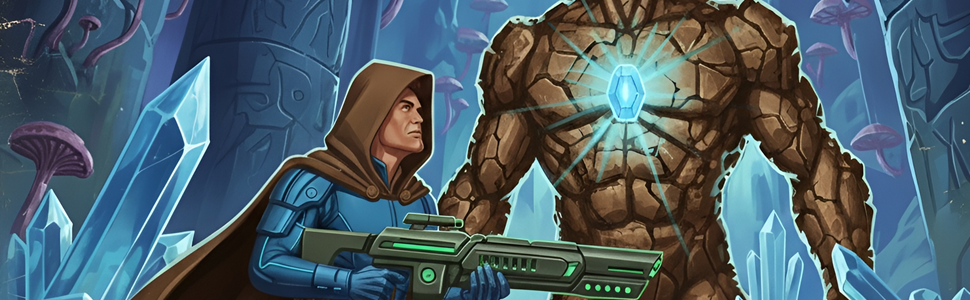
In my last feature, I wrote about my core inspirations for writing my debut novella, Arkolny Armageddon. This time, I'd like to go deeper and explain some equally important inspirations that led to me settling on the final format for the series. When I began writing the Arkolny series, I set out to bring science fiction back to its roots.
Equally important to me was writing a series that would be accessible to modern day working-class men. It's no secret that the publishing industry as a whole is dominated by women—and for good reason, the number of men reading recreationally has decreased dramatically in recent years. Many men in my life haven't read an entire novel since high school, and I believe the primary contributing factor for them is time. It can be hard to dedicate the necessary amount of time to read an entire novel while also balancing certain responsibilities.
I believe that I have proven a story can be written far more succinctly while still offering the same amount of excitement as a full-length novel.
The Changing Media Landscape
The internet has changed the way that we consume television programming. Since the advent of streaming services, we no longer have television shows that contain an entire story (beginning, middle and end) in a single episode. Now, television shows share more in common with the cliffhanger serials of the 30s and 40s, with each episode leading into the next. When I think of my favorite childhood television program (Mighty Morphin' Power Rangers), It becomes immediately apparent that children's television programming values its audience far more than anything written for adults.
The first episode of Power Rangers may be the single greatest first-episode ever written for the medium of television. In less than twenty minutes, the viewer is introduced to more than a dozen characters, the core premise/conflict and given three separate fight scenes. Considering that these twenty minutes were written for children, it's astounding how much the writers trust the audience to be able to keep up. Equally impressive is how this single television episode never feels rushed. Now compare that to modern television programming for adults and you'll find the differences to be staggering.
Modern television is written to be running in the background while the audience is occupied with other things. It's not uncommon to have exposition dumps repeated incessantly for an audience who's attention is increasingly waning.
With all this in mind, I knew I wanted my books to be designed to be read in a single sitting. I also wanted to model them after the aforementioned Cliffhanger Serials, with each and every chapter ending in a cliffhanger that would motivate the reader to keep reading. This would be no small task as each of the fifteen chapters (sixteen in the final manuscript) would need to be written as succinctly as possible to reach my goal of less than twelve thousand words. Also, I wanted to trust my readership's intelligence by not over-explaining or reiterating through expositional dumps. Instead, it became more important than ever to "show don't tell" and allow my readers to fill-in the gaps wherever I deliberately chose to leave details out. For example, certain plot devices and elements are left decidedly vague. Instead, I use implications to guide the reader to certain conclusions.
Characterization And Theming
At its core, Arkolny Armageddon is a story about perseverance; Blast Johnson needs to push forward even in the face of insurmountable odds. When thinking about a cast of supporting characters, I thought about science fiction's most famous triumvirate: Kirk, Spock and McCoy. Similarly, I created two supporting characters (Juliet & Orion) who would each approach problems from very disparate points of view, only to have Blast find the middle ground.
My first book essentially functions as a pilot episode, introducing the reader to the characters and setting. Since I had tasked myself with a focus on brevity and action, this left little time for anything other than the most basic of characterization. For the sequel, I wanted to expand on the trio's characterization by showing how they function together in a crisis.
Arkolny Abyss actually started out as an unrelated story about Atlantis in space, I published Armageddon not knowing if there would be a sequel and I deliberately chose to leave no unresolved cliffhangers in the event that remained a standalone story. However, I had become so attached to the characters and world of Arkolny that I needed to write what happened to them next. My "Atlantis in Space" story was nearly completed, and retroactively turning it into another Blast Johnson Adventure was fairly simple. Abyss asks the question "is violence the answer?" and I think my three characters are perfectly positioned to answer that question in their latest adventure.
An Excerpt From Arkolny Abyss: A Blast Johnson Adventure
Blast took cover behind a large boulder, peering at the creatures. They were humanoid, but with the lean, powerful build of a velociraptor. Their scales, a mottled gray-green, glistened in the sun, and their heads were crested with a ridge of what looked like hardened bone. Gills pulsed rhythmically just behind their jaws, a clear sign of their amphibian nature. But what truly caught Blast’s eye was their gear. They wore sleek, metallic armor and held what were unmistakably laser rifles—familiar, deadly technology.
“They’re soldiers,” Blast murmured, his mind racing. “And they have directed energy weapons. We can’t just charge in.”
Orion nodded solemnly. “Such a direct assault would be… unwise. They possess great power.”
“They are also too confident,” Juliet interjected, her voice a low growl. She had already pulled a sling from her belt and was fitting a small, smooth stone into its pouch. “Here, one less to worry about.”
Before Blast or Orion could react, she spun the sling and let the stone fly. It hit the nearest Golodyte with a sharp thwack, and the creature crumpled to the ground without a sound, its armored head a dead weight.
Orion looked at the unconscious Golodyte, then at Juliet, a look of profound exasperation on his face. “Was that really necessary?” he said, his voice a quiet sigh.
About the Author
Brendan Onfrichuk is a pulp sci-fi author and restaurant manager. He fell in love with the genre watching the premiere of Star Trek: Voyager with his father at age five. He lives in Ontario, Canada with his wife.
And follow Brendan on X/Twitter: @SegaStardust
