
In the studio, "letting go" isn't an act of surrender—it’s a tactical maneuver.
For many artists, the hardest part of the creative process isn't the 2 a.m. inspiration; it’s the 2 p.m. realization that a project is done. We often mistake endless "polishing" for improvement, when in reality, we are just moving the dust around.
The Perfectionist’s Trap
There is a massive diminishing return in the arts. You get incredible results in the first 80% of a project. But in that final 20%, we spend weeks obsessing over a snare drum transient or a brushstroke that no one—not even other experts—will ever consciously notice.
This is usually just a defense mechanism. As long as a work is "in progress," it can't be judged. It stays perfect in our heads. The moment we let go, it becomes a fixed object in the real world, subject to gravity and criticism.
How to Let Go: A 3-Step Framework
For a sonic architect, or any creator, letting go requires a shift from emotional attachment to objective systems.
1. Define 'Done' at the Start: Before you open your DAW or pick up a brush, write down three specific goals. For example: "The vocal must feel intimate," or "The low end must be tight." Once those three boxes are checked, the project is technically finished. Everything else is just gold plating.
2. The 'Fresh Ears' Deadline: Work in short, high-intensity sprints to combat ear fatigue. If you find yourself tweaking the same 4-bar loop for more than 30 minutes, you've lost objectivity. Walk away for 24 hours. If it doesn't sound "broken" when you return, it's finished.
3. Ship the 90% Version: Accept that the difference between 90% and 100% is usually invisible to the audience but fatal to your productivity. Taking the leap of faith and releasing "the 90%" allows you to move on to the next project, where you can actually apply everything you just learned.
The Holistic Perspective
The philosopher and musician Brian Eno famously used "Oblique Strategies" to force himself to let go. One of his core tenets was: "Honor thy error as a hidden intention."
When we let go of the need for total control, we allow the "happy accidents" to happen. The slightly out-of-tune string, the bleeding microphone, the over-saturated color—these are the things that provide the soul that perfection lacks. Perfection is sterile; letting go is where the humanity lives.
You don't finish an album. You abandon it. The goal is simply to abandon it at the highest possible point of its trajectory.
Recommended Reading: The Marketing Machine Behind Your Favorite Music
About the Author:
Miguel Dembora is an audio engineer, producer, and guitarist. Born in Gijón, Spain, he picked up the guitar at fourteen, blending classical technique with flamenco, jazz, and rock. By nineteen, he was playing over 100 shows a year with a 10-piece band while working as a studio guitarist and studying at the Conservatory.
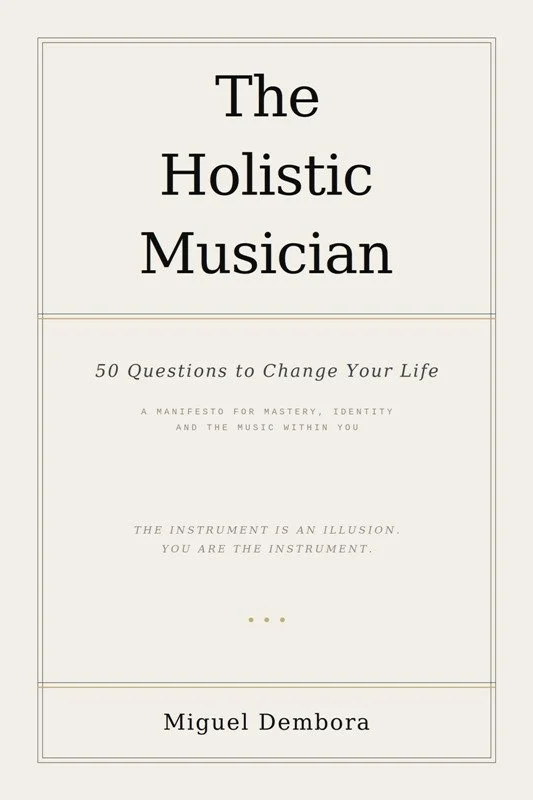
His work naturally evolved from playing the instrument to shaping the sound itself. In 2004, he played alongside Bob Moog on his last visit to Spain, endorsing his Moogerfooger pedals and appearing in a national documentary. After years of working in Madrid and London, Miguel transitioned into online mixing and mastering in 2014, working with artists across five continents. He is the author of The Holistic Musician—a manifesto for mastery, identity, and the music within you.
Website: MDembora.com
The Holistic Musician on Amazon
