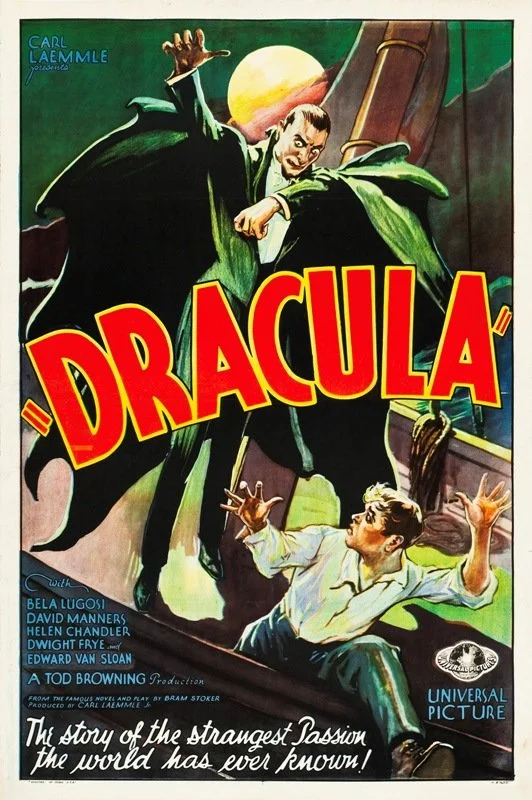
Before Bram Stoker, there was Vlad. Before Vlad, there were the dead who wouldn't stay dead. And people were genuinely terrified.
Two Boston College professors walked into a bar in Bucharest in the late 1960s, ordered plum brandy, and changed how the world understood Dracula.
Radu Florescu, a Romanian-born historian whose own family lineage traced back to Vlad's era, and Raymond McNally, a specialist in Eastern European history, had been chasing a hunch: that Bram Stoker's fictional vampire count wasn't entirely fictional. Their research, conducted through archives in Romania, medieval manuscripts, and libraries across Europe, culminated in the 1972 bestseller In Search of Dracula, which introduced most of the Western world to the idea that there had been a real Dracula, and that the real one was considerably more terrifying than anything Stoker invented.
It became a bestseller translated into 15 languages. It boosted Romanian tourism substantially. And it permanently changed the way people think about the most famous monster in literary and horror history. It's truly a great read if you're interested.
The two didn't stop there. They followed up with Dracula: A Biography of Vlad the Impaler in 1974, which went deeper into the historical record, and Dracula, Prince of Many Faces in 1989, which examined his political career and military campaigns in full detail. Across three books they built the most complete scholarly account of both the historical Vlad and the mythological Dracula available in English.
McNally died in 2002. Florescu died in 2014. All three books are great and worth a read if you’re interested in the real history.
This is that story…
The Man: Vlad III, Son of the Dragon
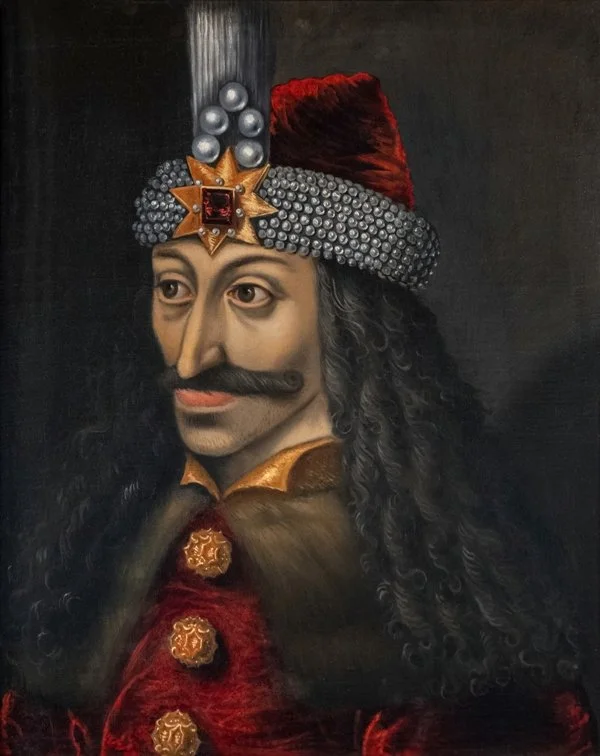
Before he was a vampire, Dracula was a prince. Specifically, Vlad III, ruler of Wallachia, a small principality in what is now southern Romania, who lived from approximately 1431 to 1476. His father was Vlad II Dracul, a knight of the Order of the Dragon, a Christian military order founded to defend Europe against Ottoman expansion. The name Dracul in Romanian means dragon. Dracula means son of the dragon.
This is one of history's great linguistic ironies. Stoker, who researched his novel at the London Library without ever setting foot in Transylvania, believed Dracula meant devil, which wasn’t exactly correct. The monster he created was named after a dragon-knight's son.
Vlad's childhood was shaped by political hostage-taking, standard diplomatic practice in 15th-century Eastern Europe. When he was around eleven years old, his father sent him and his younger brother Radu to the Ottoman court as guarantees of Wallachian loyalty. His father and older brother were subsequently murdered by Hungarian forces while the boys were in Ottoman custody. Vlad spent years watching the empire that held him prisoner consolidate power over his homeland.
This is the psychological foundation of everything that followed.
When Vlad eventually reclaimed the Wallachian throne, the methods he used to consolidate power and resist Ottoman expansion were extreme even by the standards of an extremely violent century. His preferred method of execution was impalement: victims placed on long wooden stakes arranged at varying angles to prolong suffering and delay death, sometimes remaining alive for hours or days. He reportedly killed tens of thousands over the course of his reign, including enemies, criminals, corrupt noblemen, and occasionally people whose behavior simply offended him.
The most famous single incident occurred in 1462, when Ottoman Sultan Mehmed II led an invasion force into Wallachia. As Vlad retreated, he left behind what became known as the Forest of the Impaled: an estimated 20,000 impaled corpses arranged outside the city of Târgoviște. The Ottoman chronicles record that even Mehmed II, a man of considerable military experience, was so disturbed by the sight that he turned his army around…hard to imagine how gruesome it truly must have been.
Vlad was eventually captured and imprisoned by Hungarian forces, released years later, reclaimed his throne again briefly, and was killed in battle in 1476. His body was reportedly dismembered and his head sent to the Ottoman sultan as proof of death. His remains have never been found. Hmmm.
In Romania, he is remembered as a national hero…because why not? Outside Romania, especially in German pamphlets of the time and later in Western popular culture, he became the monster. Both versions contain truth. He was a brutal ruler who used terror as a military and political instrument, and he was also a defender of his people against an empire that had taken everything from him since childhood. As Florescu and McNally noted, the historical sources all described him according to their own political needs. The truth lies somewhere in the middle.
When the Dead Came Back: Real Vampire Panics
Here's the part most Dracula articles skip entirely: for centuries, across Europe and America, ordinary people genuinely believed the dead were rising from their graves to feed on the living. Not as metaphor. As “real life”. And they took practical steps to stop it.
Before germ theory, nobody understood how bodies decomposed. When gravediggers reopened mass graves during plague epidemics to add new bodies, what they found looked, to eyes that didn't understand decomposition, deeply alarming. Bloating from internal gases made corpses appear well-fed. Receding gums made teeth look longer. Blood expelled from the mouth during decomposition looked like a recent meal. Hair and nails appeared to keep growing. These were normal biological processes. To a 17th-century villager, they were evidence of something that refused to die.
The Vampire of Venice
In 2006, archaeologists excavating a 16th-century plague pit on the Venetian island of Lazzaretto Nuovo made a discovery that forensic anthropologist Matteo Borrini of the University of Florence later described as "the first time archaeology has succeeded in reconstructing the ritual of exorcism of a vampire.
They discovered the skeleton of a woman, estimated to be between 61 and 71 years old at the time of her death, with a brick intentionally placed inside her oral cavity, keeping her mouth wide open.
The explanation: when gravediggers returned to the plague pit to add new bodies, they found this woman's burial shroud had sagged at the mouth. Fluids from decomposition had moistened the cloth and caused it to tear. To eyes that didn't understand decomposition, it looked like she had been chewing through the shroud. The local belief held that plague-spreading vampires chewed their burial cloths as a kind of supernatural mechanism for spreading disease. The gravediggers jammed a brick in her jaw to stop her.
She died during the same 1576 plague outbreak that killed the painter Titian, in which the city lost roughly a third of its population. In that context, the desperate logic of blaming the dead for spreading disease makes a grim kind of sense. She was buried unceremoniously in a mass pit on a quarantine island and is now one of the most studied archaeological vampire cases in history. The irony being that this anonymous woman, tossed into a plague grave at the edge of the lagoon, has had her face reconstructed by forensic scientists five hundred years later. So we know what she could have looked like, but still don’t know her name.
The Vampire of Pien
This one is extraordinarily current: a peer-reviewed study published just days ago in the Journal of Archaeological Science: Reports has revealed new details about one of the most remarkable anti-vampire burials ever discovered.
In August 2022, at a cemetery in Pień in north-central Poland, archaeologists excavating what they called Grave 75 found the 400-year-old remains of a young woman buried with a curved iron sickle placed directly over her neck with its blade angled toward her throat, a triangular iron padlock fastened to the big toe of her left foot, and fragments of a decorative band woven from pure silver and gold threads running through fine silk.
That last detail is significant: this was not a peasant. Whoever she was, she came from wealth or nobility. Whatever she was accused of, the community was so frightened of her that they buried her with three separate physical restraints. The sickle was positioned so that any attempt to sit up would press the blade inward. The padlock was meant to lock her soul within the grave. When the community later experienced unexplained misfortune, they dug up the grave and added the sickle on top of the padlock they had already placed.
This sickle-and-padlock combination documented here has never before been recorded in a single grave in the published archaeological literature. The cemetery at Pień contains over 100 burials, and at least 30 of them include features interpreted as deliberate efforts to restrain the dead. This wasn't an isolated incident. It was a systematic community practice.
The full study was published in the Journal of Archaeological Science: Reports on August 25, 2026. You can read the coverage HERE.
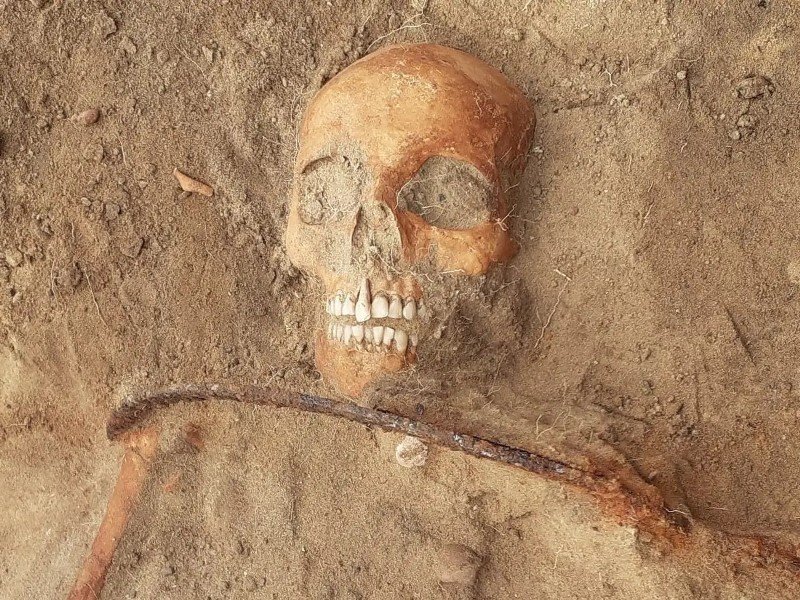
Vampire grave with a sickle across the neck. Photo: Mirosław Blicharski
The New England Panic
Vampire belief wasn't confined to medieval Europe. In 1892, in Exeter, Rhode Island, it was happening in America.
The Brown family had been devastated by tuberculosis over the preceding decade. The mother died in 1883. The eldest daughter died in 1888. In January 1892, nineteen-year-old Mercy Brown died of the same disease. Her brother Edwin was gravely ill.
Desperate neighbors convinced the family that one of the dead was a vampire, draining Edwin's life from the grave. Against his better judgment, George Brown allowed the locals to exhume the bodies of his family. The mother and eldest daughter had decomposed normally. Mercy, however, had been stored in an above-ground crypt over a New England winter. Her body showed almost no decomposition and her heart was still full of clotted blood.
That was all the proof anyone needed. Mercy's heart was burned, mixed with water, and given to her brother Edwin as a cure. He died two months later. The tuberculosis ran its course through the family and stopped, which the community interpreted as confirmation that the treatment had worked. Sounds legit to me.
Mercy Brown was the last documented case of anti-vampire exhumation in America. There had been at least 18 before her in New England alone. Bram Stoker reportedly read newspaper accounts of the case, which was covered by the Providence Journal. Dracula was published five years later.
Bram Stoker and the Monster He Actually Built
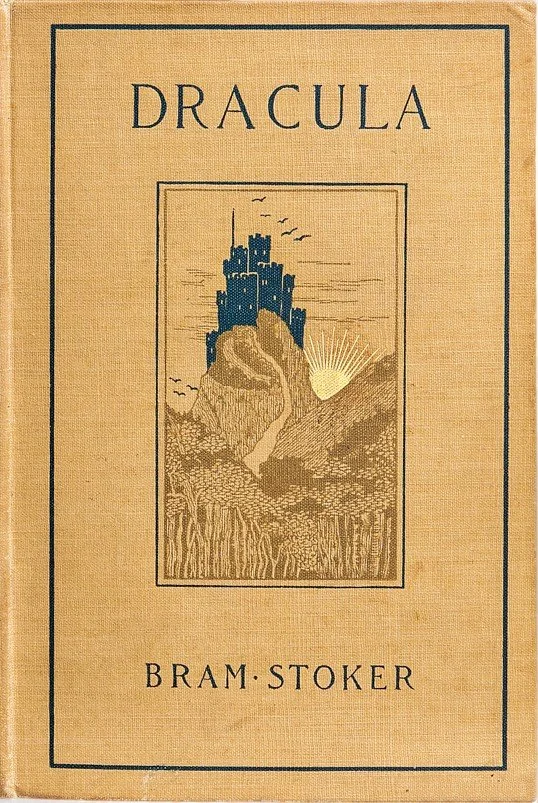
Stoker was an Irish theater manager, not a professional novelist. He spent seven years working on Dracula between 1890 and its publication in 1897, doing his research not in Transylvania but at the London Library in London. He never went to Romania. Researchers later found 26 of the roughly 30 books he consulted still on the library's shelves, some with annotations matching his known handwriting.
He initially planned to call his vampire Count Wampyr. Then he came across the name Dracula in a history book, believed it meant devil, and switched. The discovery of the historical Vlad appears to have been a minor find in his research. The Paris Review has noted that Vlad's connection to Stoker's character was "more fortuitous than inspirational" and that Stoker's research into Vlad specifically was "surprisingly thin." But…let’s not let facts get in the way of a great story.
What Stoker actually built was a synthesis: Vlad's name and geographic setting, vampire folklore from across Eastern Europe, the aristocratic vampire template established by John Polidori's 1819 novella The Vampyre, the female vampire tradition introduced by Sheridan Le Fanu's 1872 Carmilla, and almost certainly some influence from the New England tuberculosis panics that were making newspaper headlines while he was writing.
The result was a monster that felt simultaneously ancient and modern, foreign and familiar, sexual and death-dealing. And for horror fans…thankfully, it hit something deep enough to never stop being relevant.
How Cinema Kept Changing the Rules
The 1922 German film Nosferatu, made without obtaining rights from Stoker's estate and with all the names changed, introduced one crucial rule that wasn't in Stoker's novel: sunlight kills vampires. Count Dracula walks around in daylight in the original book. Sunlight only had a weakening affect on the Count. The burning-in-sunlight rule, which has governed vampire fiction ever since, was invented by a German expressionist filmmaker who needed to defeat his monster cinematically in epic fashion (at the time).
Bela Lugosi's 1931 Universal film gave us the visual archetype that stuck for decades: the formal dress, the cape, the Hungarian accent, the hypnotic seduction. Christopher Lee's Hammer Films Dracula in the 1950s brought explicit blood and sexuality. Gary Oldman's 1992 Coppola version was the first major film to bring the Vlad connection explicitly into the narrative and it was a welcome storyline.
Lugosi's influence reached further than anyone anticipated. In 1972, Sesame Street introduced the world to Count von Count, a purple Muppet with a cape, an accent, and an obsessive love of counting. The character was a direct affectionate parody of the Lugosi archetype, and for millions of children he was their first introduction to Dracula, which is either deeply funny or slightly concerning depending on how you look at it. Ah-ah-ah! Either way, the Count has been teaching kids to count for over fifty years, which may be Bram Stoker's most unexpected legacy.
Anne Rice's Interview with the Vampire in 1976 fundamentally shifted the vampire from predator to protagonist and was/is a huge influence. Practically every sympathetic vampire in fiction and film since then traces that lineage back through Rice to Stoker and ultimately back through folklore to those ancient Mesopotamian blood demons.
To put the cultural footprint in perspective: more than 200 films have been made featuring Count Dracula specifically, a number second only to Sherlock Holmes in the history of cinema. That doesn't count the broader vampire genre he spawned, which adds thousands more films, television series, novels, comics, video games, and stage productions.
Rice's Vampire Chronicles alone is a 13-novel series that generated films, a TV series, and an entire subgenre of sympathetic vampire fiction. Love ‘em or hate ‘em…Twilight sold 160 million copies worldwide. True Blood ran seven seasons. What We Do in the Shadows is currently in its sixth season. The vampire as a cultural figure has never been more present than it is right now, 129 years after a theater manager in London finished his novel and sent it to his publisher.
Bram Stoker died in 1912, and at the time was largely forgotten, never having made significant money from the book. His widow had to fight Nosferatu in court just to keep the estate solvent. The irony of what that novel eventually became is almost too large to measure.
Why the Monster Endures
The vampire endures because it embodies whatever a given era most fears. For Stoker's Victorian readership it was the foreign aristocrat with hypnotic power over respectable women. For the Cold War it was the lurking infiltrator. For the AIDS era it was disease transmitted through blood and intimacy. For the contemporary moment it's either the romantic outsider or the ultimate predator depending on who's writing it.
Vlad the Impaler made this possible without intending to. He was a 15th-century prince fighting an empire that had destroyed his family, using extreme methods to hold a principality together. He was not attempting to become mythology. He became it anyway.
Two Boston College professors over plum brandy in Bucharest made the connection concrete. Bram Stoker, working in the London Library under the false impression that a dragon-knight's name meant devil, gave the myth its permanent form. Ordinary people across centuries burying their dead with bricks in their mouths and sickles across their throats built the genuine terror that made it all believable (and still terrifying).
About The Author
Mike Meyerson is the founder of FEELING CREATIVE?, and has been a horror nut ever since Alien and The Exorcist gave him nightmares as a boy. Currently located in NY’s Hudson Valley Region, is always looking to build the network, find a new cool trail to hike and a new horror movie to watch.
Read Mike’s other articles - HERE.