Horror didn't begin with Dracula or Frankenstein. It's older…and much stranger.
People have always been terrified of the dark and the unknown. Thankfully someone figured out they could deliberately scare each other for entertainment. So when did the horror genre start being a thing?
The First Horror Literature
Long before vampires and slashers, the earliest written horror elements appeared in ancient Mesopotamia. The Epic of Gilgamesh, dating back to roughly 2100 B.C., weaves supernatural terror into its story. Ghost stories followed: the ancient Greek historian Plutarch wrote an account of a restless spirit named Damon who haunted the local bathhouse where he was murdered, which is essentially the plot of nearly every haunted location horror film ever made.
But if you want the first official horror novel, the title belongs to Horace Walpole. In 1764 he published The Castle of Otranto, a story about a prince trying to dodge an ancient prophecy after his son suffers a bizarre and unnatural death. People at the time thought it was entirely in poor taste. It also single-handedly coined the term "Gothic" and laid the foundation for the entire sub-genre.
Fifty-four years later, an eighteen-year-old named Mary Shelley raised the stakes considerably. Written on a dare during a rainy summer in Switzerland, Frankenstein (1818) didn't just scare people. It invented science fiction horror, introduced the mad scientist archetype, and asked questions about creation, responsibility, and what it means to be human that nobody has fully answered since. The fact that it was written by a teenager makes it more impressive and flat out epic.
The First Horror Art
Ancient art was full of monsters, but one of the earliest examples of deliberate visual horror is the demon Pazuzu from the 8th century B.C. You probably know the name from The Exorcist, but the actual ancient amulets and statues are genuinely disturbing: two pairs of wings, eagle talons, a scorpion tail, and a snarling canine face.
Here's the twist: ancient people didn't carve Pazuzu to scare themselves. They used his terrifying image as a weapon. Pregnant women wore his hideous face as an amulet because Pazuzu was the only demon frightening enough to ward off Lamashtu, a female demon who preyed on newborns. They were fighting horror with horror. Fun times.
Fast forward to 1819. The Spanish painter Francisco Goya, by then deaf, increasingly bitter, and deeply shaken by war and the Spanish Inquisition, moved into a house outside Madrid and did something deeply strange. He painted a series of fourteen murals directly onto the walls of his own home. He called them nothing. They’re now known as the Black Paintings.
The most famous is Saturn Devouring His Son, painted on the wall of his dining room. It depicts the Roman god Saturn, wild-eyed and disheveled, in the act of consuming one of his children. The corpse is headless, already partially eaten. The god's knuckles are white. His eyes are the eyes of something that has broken entirely.
Goya never intended anyone to see these paintings. They weren't commissioned. They weren't shown. They were private, painted for himself alone in a house he called the Villa of the Deaf Man. After his death, the murals were transferred to canvas and are now in the Prado Museum in Madrid.
The idea that the most viscerally horrifying painting in Western art was made by an old, deaf, isolated man for his own private walls says something profound about what horror actually is. Not performance or entertainment. Maybe sometimes just the only way to process what you've seen.
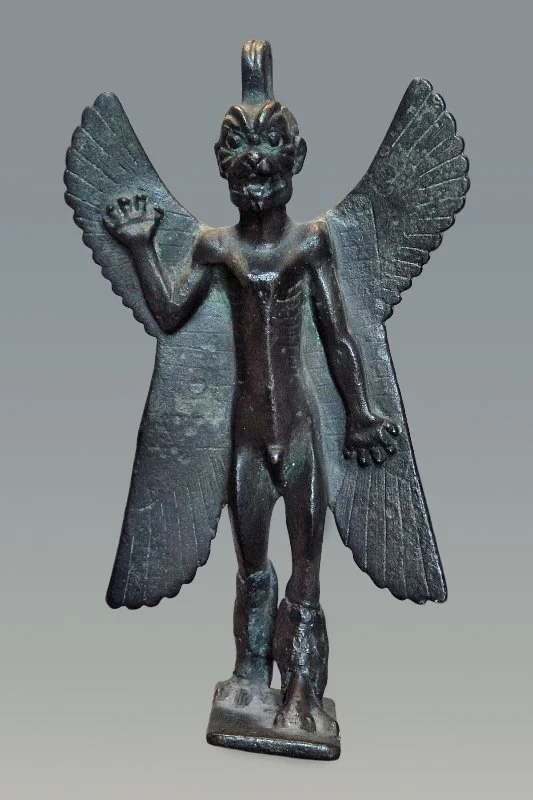
Pazuzu
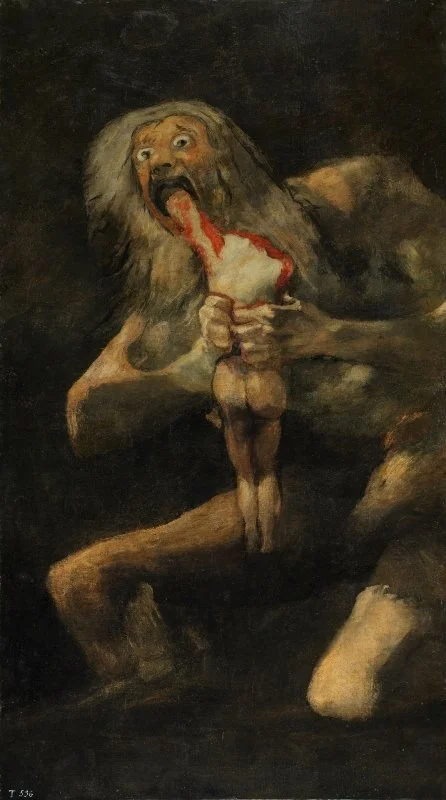
Saturn Devouring His Son by Francisco de Goya y Lucientes
The First Horror Music
You've heard this melody. You just don't know what it is or what it's called.
In the 13th century, a Catholic monk composed a Gregorian chant called the Dies Irae, which translates as "Day of Wrath." It was written for funeral masses and describes the day of divine judgment, the moment when all souls face their eternal destiny. Four descending notes. Simple and dark.
For eight hundred years it has been the musical shorthand for death, dread, and the end of things. Classical composers used it: Berlioz in his Symphonie Fantastique, Mozart in his Requiem, Chopin in his Prelude. Then film composers discovered it and it never stopped.
Those same four notes found their way into The Shining. The Lion King. Star Wars. It's a Wonderful Life and a long list of other film scores. Led Zeppelin used it in Stairway to Heaven. Berklee College of Music professor Alex Ludwig has spent years cataloguing its appearances in film alone and the list keeps growing.
The reason it works is almost neurological. The four notes create a descending pattern that the human ear instinctively associates with loss and ending. It has been doing this for so long that the association is baked into the culture at a level below conscious thought. So, it’s the oldest piece of music still actively used to terrify people.
The First Horror Theater
The Greeks invented stage violence. They say the first truly unnerving moment in theater history happened around 480 B.C. with Aeschylus's Prometheus Bound. The audience walked in to find the Titan Prometheus chained to a massive cliff with an iron wedge driven through his chest. No warmup, no context…and no CGI.
The love of horror escalated quickly. By 60 A.D. the playwright Seneca wrote Thyestes, a tragedy whose climax features a father unknowingly eating his own children at a banquet (yikes!). It makes most modern slasher films look restrained…well except for Art The Clown, that’s just another Tuesday for him.
By the late 1890s, a small theater in Paris called the Grand Guignol had taken all of this and turned it into something systematic. Their specialty: realistic, graphic depictions of torture, murder, mutilation, and psychological terror performed for paying audiences. They employed a full-time doctor to treat audience members who fainted or went into shock during performances. This was considered a selling point.
The Grand Guignol ran for 65 years, closing in 1962. Its director reportedly said at the end that horror had moved to the streets and they couldn't compete. Sad.

The First Horror Photography
Photography was invented in the 1830s, and it only took a few decades for someone to figure out how to make it creepy.
In 1862, a Boston jewelry engraver named William Mumler took a self-portrait in his studio. When he developed the image, the faint outline of a figure appeared standing behind him. He claimed it was the ghost of his dead cousin.
Skeptics quickly determined that Mumler had been improperly cleaning his glass photographic plates, causing previous portraits to double-expose onto new ones. The ghost was a leftover image from a previous sitting. Meh…skeptics be damned.
Mumler's response to being caught in an accidental forgery was to deliberately keep doing it. He realized people desperately wanted to believe and turned it into a business, charging grieving families to be photographed alongside their deceased loved ones. His most famous image shows Mary Todd Lincoln with what appears to be the ghostly hands of Abraham Lincoln resting on her shoulders, taken just a few years after the assassination.
He was eventually tried for fraud in New York in 1869. The prosecution couldn't prove the photos were faked beyond reasonable doubt. He was acquitted and continued his business.
Spirit photography inspired an entire movement that lasted well into the 20th century. Arthur Conan Doyle, creator of Sherlock Holmes and a man who presumably understood evidence, was a passionate believer and defender of spirit photographs until his death.

Mary Lincoln with the alleged ghost of her husband behind her. Photo by William Mumler
The First Horror Film
Georges Méliès made a three-minute silent film in 1896 called Le Manoir du Diable, known as The House of the Devil or The Haunted Castle in English. He wasn't trying to scare anyone. He was a stage illusionist who wanted to show off camera tricks he'd invented.
The film featured a bat transforming into Mephistopheles, appearing skeletons, and vanishing ghosts. Méliès intended it to be amusing. Audiences found it deeply unsettling. The supernatural, brought to life on screen for the first time, hit differently than anyone expected.
He had accidentally invented horror cinema, and it was a glorious day.
The First Horror Radio
Most people think of Orson Welles and his 1938 War of the Worlds broadcast when they think of scary radio. But horror radio started seven years earlier, in 1931, with a show called The Witch's Tale.
It was hosted by a cackling old witch named Nancy and her black cat Satan, and every week Nancy introduced a new audio horror play. The show ran for six years and laid the exact blueprint for everything that followed: Tales from the Crypt, Suspense, Inner Sanctum Mysteries, and the CBS Radio Mystery Theater, which kept the format alive all the way into the 1980s.
The First Horror Comic Book
Avon Periodicals released Eerie Comics number 1 in 1947, widely recognized as the first dedicated horror comic. It featured a teenager kidnapping a girl and throwing her to ghouls. Parents hated it immediately.
This single issue helped trigger the comic book moral panic of the late 1940s and early 1950s that eventually brought government censorship hearings and the Comics Code Authority, which effectively sanitized comics for a generation. EC Comics, whose Tales from the Crypt and Vault of Horror titles were the most popular horror comics of the era, was driven out of the horror business entirely.
The horror comics came back eventually. They always do.
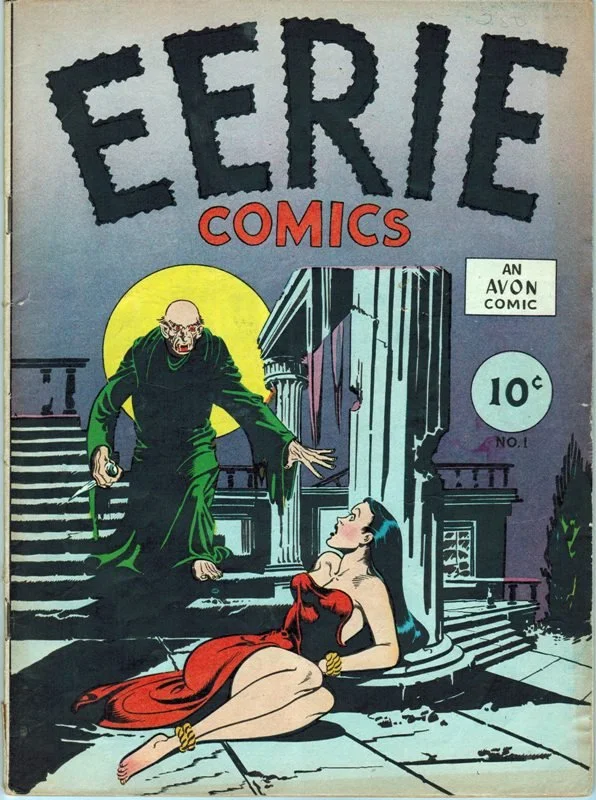
The First Horror Video Game
In 1982, an Atari 2600 game called Haunted House gave players a pitch-black mansion, a pair of disembodied eyes, and a ghost named Mr. Graves. You had to navigate the darkness striking matches to find urn pieces while bats, tarantulas, and the ghost hunted you. No graphics to speak of. Just the dark and the fear of what was in it…it looked a lot like Pac-Man, except the ghosts were chasing you. OK, not exactly nightmare fuel, but it was a start.
The First Horror Holiday
Every entry on this list so far has been a creative format, but horror also gave us its own holiday, and its origins are considerably darker than what we celebrate today.
Halloween traces back to Samhain, pronounced "SAH-win," an ancient Celtic festival marking the end of the harvest and the beginning of the dark half of the year. The Celts, who lived roughly 2,000 years ago across what is now Ireland, the UK, and northern France, believed that on the night of October 31st the boundary between the living and the dead dissolved entirely. Spirits roamed freely. Chaos was possible. Druid priests lit massive communal bonfires and people wore costumes not for fun but for protection, to confuse the spirits and avoid being recognized.
The Romans absorbed Celtic territories and blended their own festivals into Samhain. Then in the 8th century, Pope Gregory III designated November 1st as All Saints' Day, a Christian feast deliberately placed to absorb the pagan celebration underneath it. The night before became All Hallows' Eve. Eventually Halloween.
Irish and Scottish immigrants brought the traditions to America in the 19th century. The costumes stayed but the purpose changed. The bonfires became jack-o'-lanterns, which were originally carved from turnips (and are creepy as hell…see below) in Ireland before someone realized pumpkins were easier to work with. The disguises meant to fool evil spirits became candy-seeking children. Trick-or-treating evolved from an older tradition called mumming, where people went door to door performing in exchange for food.
The holiday we celebrate today is about as far from its origins as it's possible to get while still technically being the same event. Which is its own kind of interesting. We kept the costumes and the darkness and the sense that something creepy is happening on that night, even if most of us just use it as an excuse to eat candy and watch a horror movie (I may be guilty of that).
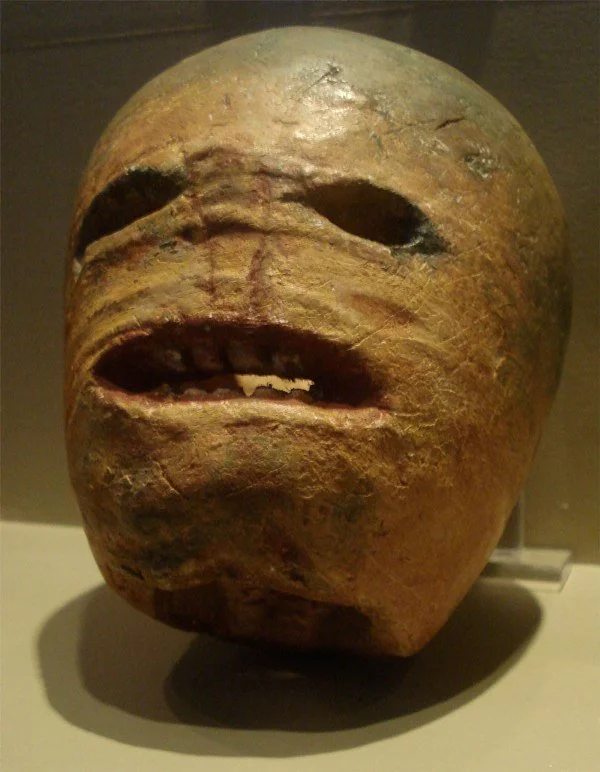
Traditional Irish Halloween jack-o'-lantern
The Pattern
What runs through all of this, from Pazuzu amulets to spirit photography to the Dies Irae, is that humans have always needed to engage with horror deliberately. Not just to be frightened, but to process something: death, loss, grief, dread, the unknown, the things we can't explain or control.
The formats change. The need doesn't…and the genre is strong.
Think You'd Make It Out Alive?
Centuries of horror have given us every possible blueprint for survival...and every possible way to fail. Our friends at Brainrot Quizzes put those instincts to the test with their Would You Survive in a Horror Movie quiz. Take it below and find out how long you’d last.
Quiz by Brainrot Quizzes
About The Author
Mike Meyerson is the founder of FEELING CREATIVE?, and has been a horror nut ever since Alien and The Exorcist gave him nightmares as a boy. Currently located in NY’s Hudson Valley Region, is always looking to build the network, find a new cool trail to hike and a new horror movie to watch.
Read Mike’s other articles - HERE.