
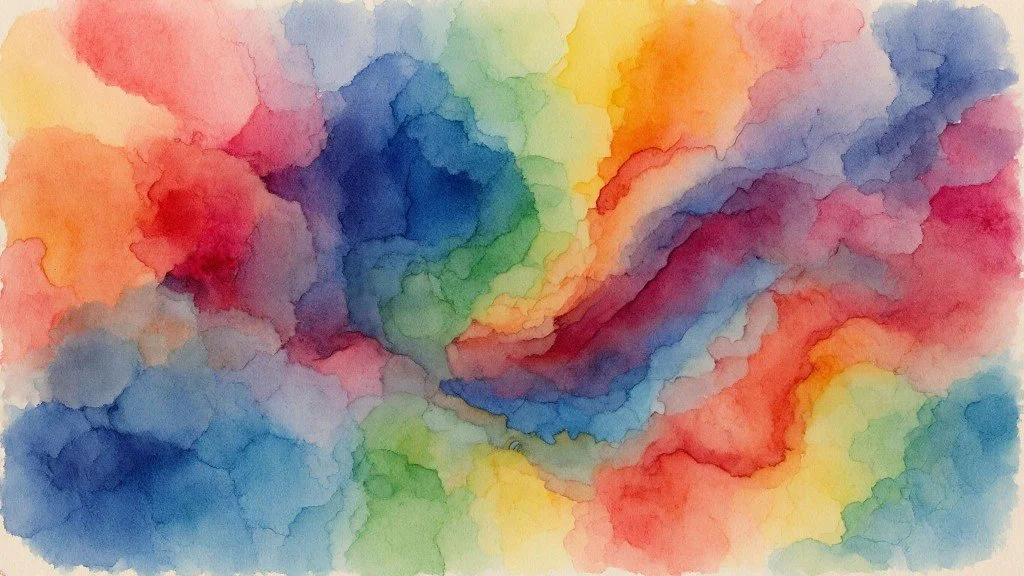
Phil Gordon on Experimental Digital Watercolour and the Grammar of Disruption
There is a version of creativity that moves in straight lines. It knows where it's going. It arrives on time. It produces exactly what was planned.
I have never been particularly interested in that version.
The work that stays with me — the work that feels alive long after it's finished — always began somewhere unexpected. A wrong turn that became the whole direction. A mistake that refused to be corrected. A moment where the process stopped following instructions and started writing its own.
This is what Experimental Techniques is about. Not the absence of skill. The deliberate suspension of certainty.
When the Medium Becomes the Question
Digital watercolour carries a paradox at its centre.
On one hand, it offers complete control. Every mark can be undone. Every layer adjusted. Every colour shifted by a fraction until it sits exactly where you want it. The constraints that govern traditional watercolour — gravity, drying time, the irreversibility of pigment on wet paper — simply don't apply.
On the other hand, that freedom is only interesting if you're willing to misuse it.
In Experimental Techniques, I use the tools against their own logic. Brushes designed for smooth gradients are pushed into collision with textures they were never meant to touch. Layers built for transparency are loaded with opacity. Techniques borrowed from entirely different disciplines arrive uninvited and stay.
The medium becomes a question rather than an answer. And the question is always the same: how far can this go before it becomes something else entirely?
Mistakes as Method
There is a particular moment in experimental work that I have come to recognise and trust.
It arrives when something goes wrong.
Not catastrophically wrong. Subtly wrong. A colour bleeds further than intended. A texture appears in the wrong layer. A brush stroke lands at an angle that breaks the composition's logic. In conventional practice, this is the moment you undo and try again. In this series, it is the moment you stop and look more carefully.
Because sometimes the mistake is more honest than the plan.
Some of the most resolved pieces in this series began as errors. A layer collision that produced a texture I had never seen before and couldn't reproduce deliberately. A colour inversion applied by accident that shifted the entire emotional register of a piece — from warmth to tension, from stillness to urgency. A distortion that looked like noise until I stopped trying to remove it and started building around it instead.
Experimentation is not randomness. It is a trained willingness to recognise when the accident knows something you don't.
The Grammar of Disruption
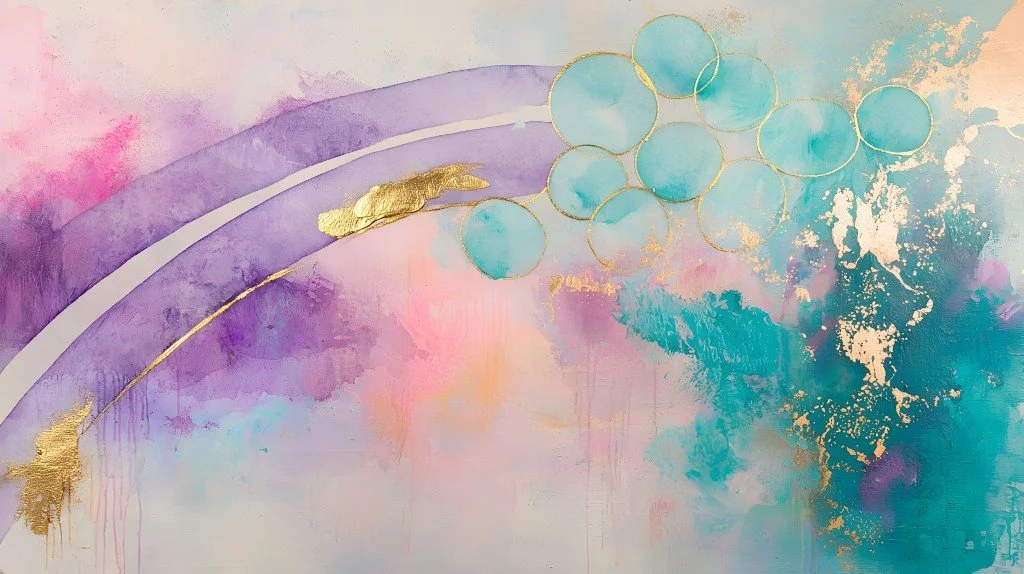
Every series develops its own visual language. In Experimental Techniques, that language is built from disruption.
Edges that dissolve where they should hold. Geometry introduced into compositions that were moving toward pure fluidity. Colour temperatures that shift without warning — cool shadows interrupted by burning oranges, luminous teals pressed against deep neutrals that have no business sitting beside them.
The eye is never quite allowed to settle.
This is intentional. Comfort produces beautiful images. Discomfort produces images that stay with you. I am more interested in the second kind — work that asks something of the viewer, that refuses to resolve completely, that carries a tension even in stillness.
Asymmetry is part of this. So is scale — the unexpected weight of a small mark in a large field of colour. So is the deliberate introduction of elements that feel foreign to the medium: digital noise, hard geometry, opacity used where transparency is the rule.
Each disruption is a small argument against the inherited grammar of watercolour. And each one opens a door the medium didn't know it had.
What the Digital Space Makes Possible
Traditional watercolour is governed by physics. Pigment moves because water carries it. Edges form where moisture ends. The paper itself becomes a collaborator — its texture, its weight, its capacity to absorb determining as much as the artist's hand.
In a digital space, none of these constraints exist unless you choose them.
This is not a loss. It is an expansion.
Without gravity, colour can move in any direction. Without drying time, layers can be rebuilt from the inside out. Without the irreversibility of wet pigment on paper, risk becomes cheaper — and so it becomes possible to take more of it.
Experimental Techniques exists because of this freedom. Not despite the absence of physical constraints, but because of it. The digital space allows watercolour to evolve into something that carries its spirit — the luminosity, the sense of fluid movement, the particular quality of light — while speaking in a voice that belongs entirely to now.
Familiar and entirely new at the same time. That tension is the work.
The Only Rule
I have one rule in this series.
Follow the work wherever it goes.
Not wherever I planned for it to go. Not wherever convention suggests it should go. Wherever the process itself is pointing — even when that direction feels uncertain, even when the destination isn't visible yet.
The most powerful discoveries in this series came from moments I didn't plan. They came from the willingness to stay in the uncertainty long enough for something genuine to emerge.
Experimental Techniques is not a finished statement. It is an ongoing conversation between a medium and its own possibilities. Between tradition and the future, it hasn't yet imagined.
Every piece is a record of a risk taken. A boundary stretched. An idea followed past the point where it felt safe.
I don't know where this series ends.
I'm not sure it does.
About the Author
Phillip J Gordon is an Australian digital watercolour artist whose work explores the intersection of architecture, nature, and abstract expression. Phillip's prints are available as instant digital downloads at PhillipJGordonDigitalArtPrints.com
Follow on: Pinterest / Instagram / Facebook / LinkedIn
See Phillip’s other articles: HERE
