

Author Spotlight: Dino Stankovic
The turn is the chapter, the map is the world
Those were the words that kept me up from 4 am until 6 am on that early spring Wednesday, when I, coincidentally, felt the worst this year.
Let's rewind 11 hours.
I'm at my final exam, remote, and I'm 100% certain I'll pass. It's exam 12 of 12 and the last gatekeeper between a great, historical-tourism related job and I. Twenty questions, I need to answer sixteen correctly to pass.
I'm at question 11. Doing phenomenal.Getting each question right. You just know when you know.
I'm counting the amount of remaining questions. I'm almost there.
My breaker trips.
I lose all electricity – internet included. I scream.
“NOOOOOOOOOOOOOOOOOOOOOOOOOOOOOOOOOOOOOOOOO”, thundered from the soles of my body.
Then, in a flash of a moment, I went into pointing the finger at myself. Sad. Angry. Depressed. Everything inbetween.
“You mocked Destiny herself. This is what you get!” I thought to myself, almost crying – before I ultimately snapped myself out of a dangerous wormhole and ran back to the sweet and sour embrace of reality.
Get the electricity going. Turn on the PC. Go online. Do your damn exam.
I did.
And I'm proud to say this whole ordeal took no more than a single minute – only enough to miss 1 out of the 20 questions on the final exam.
Suffice to say, I passed – which I knew I would that very same day.
Still, something changed inside of me. A very vocal, extroverted person didn't only become quiet – it became humbled.
Humbled by life itself. Destiny, if you will.
I couldn't speak a word for the rest of the day. I felt unworthy. Embarrassed. Humbled.
I was forced to crawl back into the very depths of myself to hide away from the shame... And that's where I found joy.
Every Poet Needs His Pain
I never wrote a book.
I did, however, write as a journalist for ten years, and even earlier, in the years when I didn't have to worry whether or not the quality of what I wrote meant I'd flick on the switch and the light went on.
I tried to write a book several times. Sometimes to make someone fall in love with me, sometimes to make myself feel important, and, sometimes, well, I just needed a place to vent, and, as it turns out, a blank piece of paper is just it.
Or so I thought.
I'd more than often find myself actually arguing with the reader (myself) as a character in the book (also me). It didn't take me long to ctrl + a and backspace it all.
I gave up. My head was just the right place to keep all those thoughts – unlike a physical form, like a piece of paper, where they become real.
Instead, as I'm a very curious, world-oriented person, I focused on writing foreign affairs articles on Gaza, Ukraine, Tibet, Myanmar, and all the other unfortunate lands plagued by being strategically important in current age.
It was a living. Not life.
Age 31, I found myself sitting at my chair, head in hands, in pure disbelief that what I'm writing is actually not a plot for the new South Park episode.
So I quit. Decided to leave writing behind and turn to tourism. I had to pay the bills.
And “writing” wasn't cutting it.
Who Even Made The Rule We Need To Sleep?
I couldn't wait to fall asleep since the very second I got the idea.
I simultaneously wanted to get up, and start writing – and fall asleep so I could wake up as soon as possible, and start writing.
You could hear me softly giggling myself to sleep, like a child waiting for Christmas. It was unlike anything I ever felt in my entire life.
The idea was there. The script was there. The story was there.
It was just waiting for me to press the buttons on my keyboard. It's that damn simple. And, as it turns out: it's sort of my specialty.
Since the age of 3 I loved video games. Born in 1994, I'm not quite what you'd call an “old-school gamer”, but I'm sure as hell not too far. Sid Meier's Civilization is one of the games I got hooked to most.
The premise of the game is simple: you pick one of the available civilization leaders (i.e. Theodore Roosevelt, Cleopatra, Shaka, Gandhi...), then use what you can of the location where the game spawned you on the world map. Usually, a single campaign takes a player around 500 turns, and it goes from slingers to atomic bombs and death robots from the future.
Forty-six thousand words of the volume I of The Americana Chronicles is based on the first 24 turns of the game... We didn't even make it to the slingers.
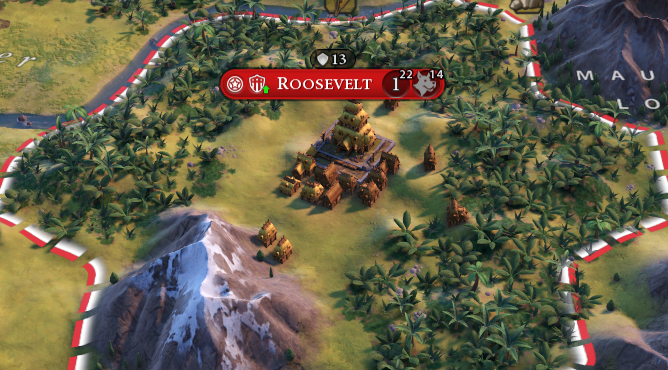
The idea felt incredible – I pick Theodore Roosevelt, and 20 other nations, including 24 City-States, make the game length marathon (most lengthy) and pick the largest possible map, which was Continents and Islands. It has zero resemblance to the world map we know.
Start playing, and just chronicle what's happening through the eyes of the leader – President Roosevelt.
Again, it felt incredible. I kept getting this very, very warm feeling in my chest which I only get in moments I'll remember for the rest of my life. I knew I was onto something. The game provides the skeleton and acts as a co-author, and I have the joy and fun of filling in the blanks.
This was it. It.
I loaded up the game, and the Universe, somehow, just rewarded me.
The Horseshoe Rainforest
My settlers and warriors (which are the first two units the game awards you) were placed right next to a rainforest shaped like a literal horseshoe – with a clearing in the middle. It was too perfect. A river was just to the north of it.
The story... The story was already writing itself.
I followed the game – one turn means one chapter, the map means the world.
Anyone that played this game knows that it starts out very slow – so I had my work to do. I had to write about nothing important happening in the game.
And it was a challenge. It was difficult to make something out of “nothing”.
But it was exactly what I was looking for my entire life. And when I got the idea at 4 am on that Wednesday... The floodgates just opened.
Once I sat at that desk, writing was my entire life for 7 days. I cursed the need to sleep. 15 hours of writing felt like 15 minutes.
It was like nothing I felt before – and it was everything I ever wanted to feel for the rest of my days.
Feeling like this, as inspired as I've ever been, I created not six characters – I created six distinct voices in the book. Some of them would've been the stars of a different book of mine - had it come to be in the past – but being in this book was simply meant to be for them.
And they were born out of pure freedom. The game's “skeleton” saved me from the curse of the “blank page”.
All I have to do, as lazy as it sounds, is add layers to a base someone else already set. I don't know what the game has in store for me. Which nations I'll meet.Which wars we'll fight.
And neither do you.
And the best part? I think I'm actually more curious than you to find out.
I discovered a whole new literary form - and, as it turns out, my entire life's calling. The characters can channel every thought, world view, and personality I've ever encountered. The game keeps surprising me.
Volume I of The Americana Chronicles: The River Knew Before We Did
All 46,000 words of it, six voices, twenty-four chapters - covers just the first 24 turns of a single Civilization VI campaign. We didn't even make it to the slingers. You can find it on Amazon and Kindle Unlimited here.
The turn is the chapter. The map is the world. And neither of us knows what comes next.
About The Author:
Dino Stanković is a Croatian writer and journalist with ten years of experience covering foreign affairs across multiple publications. His debut novel, The Americana Chronicles: Volume I - The River Knew Before We Did, is the first in a series that novelizes a Civilization VI campaign turn by turn - one chapter per turn, the game's procedurally generated map as the world. Volume II is already underway.
Recommended Reading: What I Learnt Publishing My First Book
