Before the internet put the world's art at your fingertips, some museums did something more audacious. They loaded Rembrandt onto a truck and drove him to you.
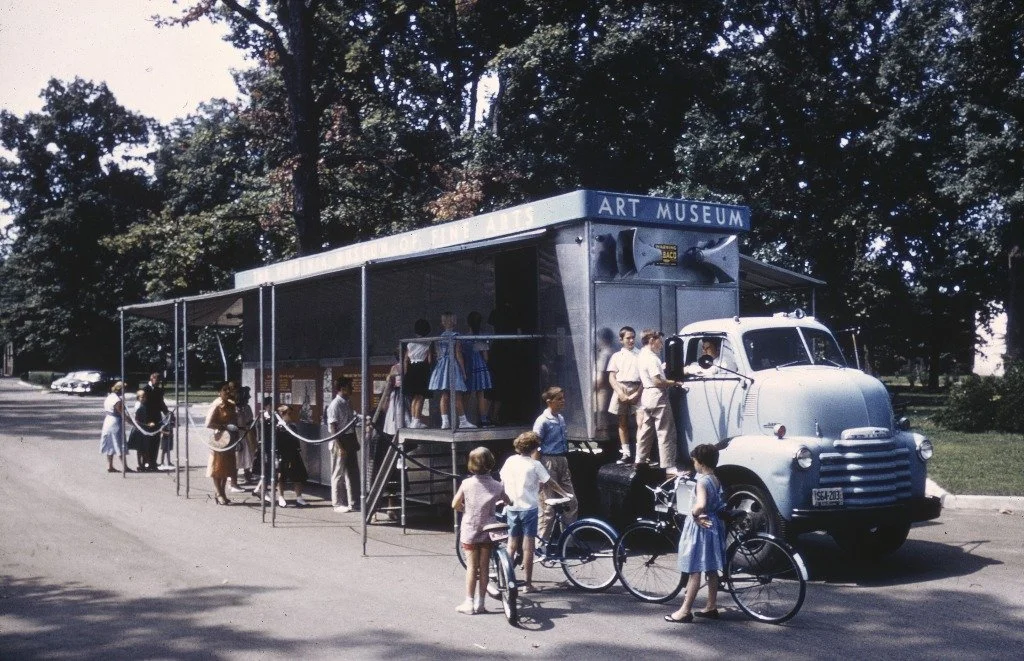
Artmobile, 1957. VMFA Photo Archives © Virginia Museum of Fine Arts
There's a version of American cultural history that most people don't know about, one that happened not in art museum halls in major cities, but in school gymnasiums, town squares, and community centers in rural corners of states most art institutions had never thought much about.
It involved tractor-trailers. And Hieronymus Bosch.
For those who don’t know him (you’re not alone, I had to look him up), Hieronymus Bosch was a Dutch painter born in 1450, famous for his surreal and nightmarish depictions of hell, sin, and the afterlife (admit it, now you want to look him up too). Here’s one of his works:

Hieronymus Bosch - Triptych of Temptation of St Anthony, 1501
Introducing…The Artmobile!
The Artmobile, the first mobile art museum in the United States, was designed by Leslie Cheek Jr., the second director of the Virginia Museum of Fine Arts in Richmond, Virginia. Its mission was to bring original works of art to residents in cities and towns throughout the state. On October 13, 1953, a tractor-trailer carrying 16 artistic masterpieces pulled into the small city of Fredericksburg, Virginia. The walls of the truck were lined with immensely valuable works by 16th and 17th-century Dutch painters, including an original triptych by Hieronymus Bosch.
Think about that for a moment. Artwork from the 1400’s, on a truck, in Fredericksburg. The kind of work you'd normally have to fly to a major city and stand in line to see, now parked outside your town and open to anyone who walked through the door.
Inside, the experience was designed to feel like a real gallery visit. Soft lighting, works mounted properly on the walls, the whole thing. It wasn't a slideshow or a reproduction. It was the actual art.
For one prominent museum scholar of the era, the Artmobile represented the most significant development in museum education in the mid-twentieth century, praising its ability to enable more people to enrich their lives through the development of a discerning eye.
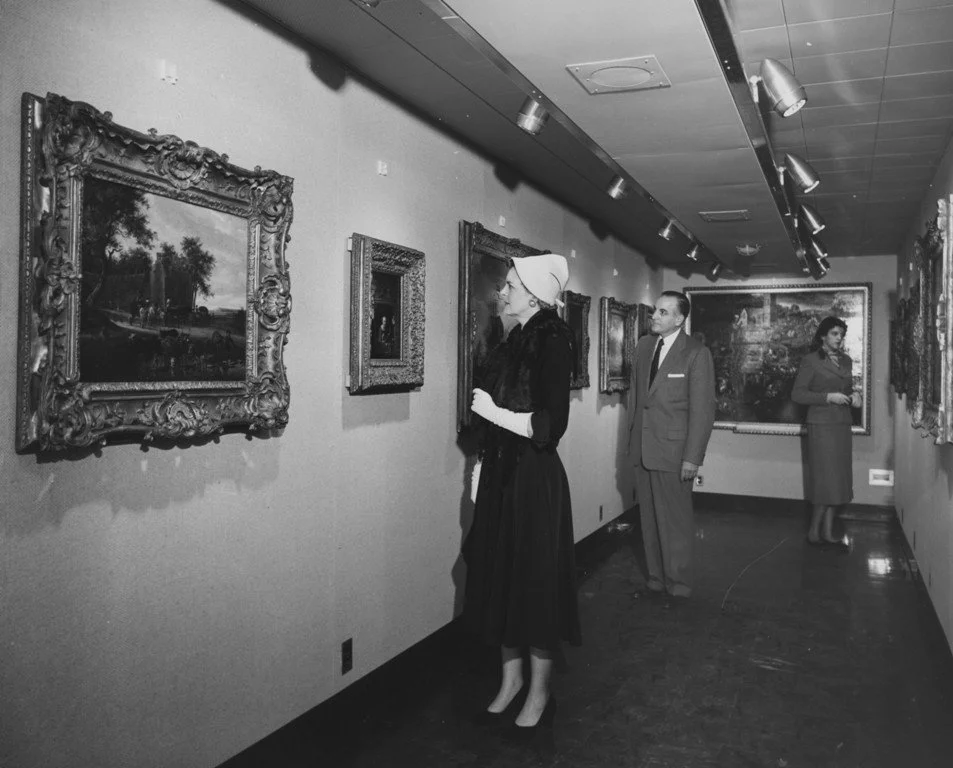
First Artmobile Exhibit: Little Dutch Masters, 1953. VMFA Photo Archives © Virginia Museum of Fine Arts
Forty Years on the Road
For four decades, as many as four Artmobiles toured 59 exhibitions and served more than 2.5 million Virginians. The program expanded over time from a single truck to a small fleet of 34-foot Chevrolet tractor-trailers, each carrying a different exhibition. Shows ranged from ancient world art to Renaissance painters to landscape painting spanning three centuries. Works by Rembrandt, Monet, and Picasso rolled through towns that had never had any reason to expect them.
The crew that traveled with the trucks became something of a legend in the state. They'd roll into a small town, set up, open the doors, and watch what happened when people who had never been inside a museum walked into one for the first time, a few miles from home.
Then in 1994, it stopped. Conservation concerns ended the program. Priceless masterworks, it turned out, were not particularly well-suited to bumpy road trips. The vibration alone was enough to cause damage over time, and the trucks couldn't adequately control temperature and humidity the way a permanent gallery could. Yeah, not shocking…they are better off.
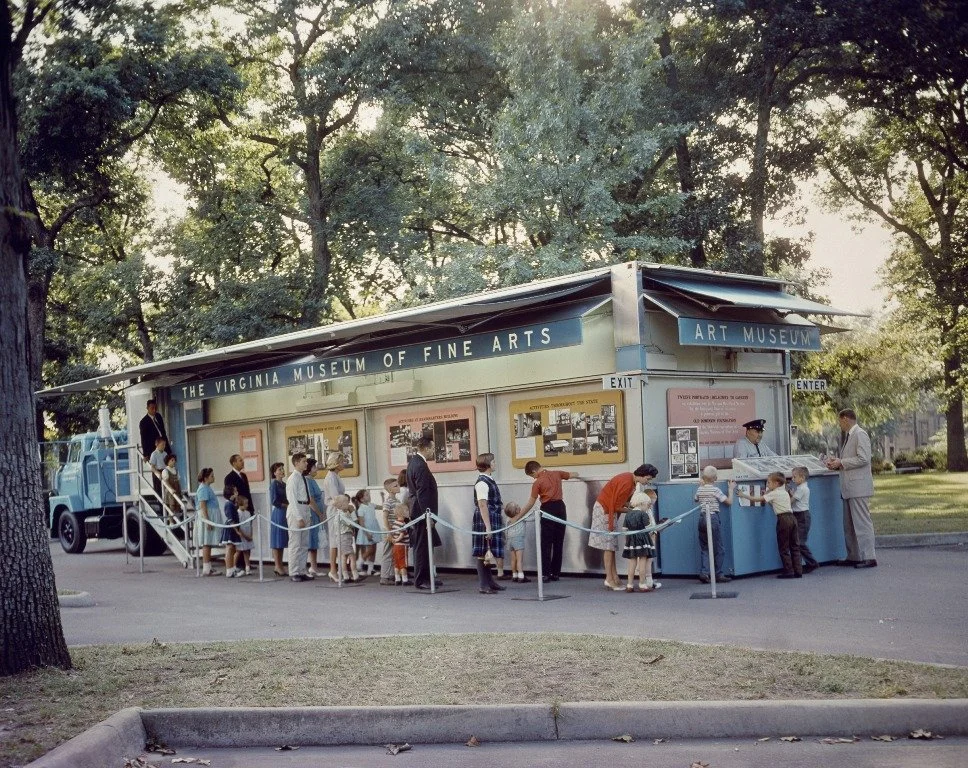
Artmobile, 1962. VMFA Photo Archives © Virginia Museum of Fine Arts
Virginia Wasn't Alone
The idea had caught on elsewhere. Museums across the country had been watching Virginia and drawing their own conclusions.
In Los Angeles, the Los Angeles County Museum of Art developed not one but two traveling museum trucks. The Maya Mobile, a 48-foot truck designed as an archaeological site, traveled to schools within the Los Angeles Unified School District, teaching students about the trade and cultural development of the Maya, Aztec, and Inka, as well as China, the Ottoman Empire, and Renaissance Italy. The Maya Mobile started in 1997, with the Ancient World Mobile following in 2003, both offered free to schools. Remarkably, both programs are still running today, serving thousands of students each year across Los Angeles County.
In Pennsylvania, the Susquehanna Art Museum launched VanGo! (whomever came up with that name deserves a prize) in 1992, bringing original works of art to schools, community festivals, businesses, and retirement centers throughout the region. In New Mexico, the "Van of Enchantment" brought cultural history to schools and public events across that vast state at no cost to visitors, reaching rural audiences in a place where the nearest museum could be hours away.
In Dallas, the Dallas Museum of Art created Go van Gogh, a school outreach program bringing art directly to students across North Texas. The name alone tells you something about what these programs were going for: art isn't a destination you have to earn, it comes to you.
Why It Could Never Fully Come Back
Here's the honest answer: the original Artmobile model, loading actual masterworks from major collections onto trucks and driving them through rural America, is gone and it's not coming back.
Insurance alone would make it nearly impossible today. Conservation standards have tightened considerably since 1953. A Rembrandt or a Monet on a tractor-trailer in 2026 would require climate control systems, vibration dampening technology, and security measures that would turn the truck into something so expensive and complicated it would defeat the purpose.
The Virginia Museum of Fine Arts tried to solve this. In October 2018 they relaunched the program as VMFA on the Road, a state-of-the-art climate-controlled trailer equipped with Wi-Fi and interactive components built for 21st-century expectations. The effort clearly had legs: as of 2026 the program is still actively touring, currently presenting Virginia as America: Navigating Life, Liberty, and the Pursuit of Happiness, bringing 14 works from the VMFA collection to communities across the state in commemoration of the 250th anniversary of American independence. It's a genuine effort and worth applauding. But it carries works from its own collection and fellowship artists rather than Rembrandts, because it has to.
The internet gets credit for giving everyone access to art, and fairly so. You can pull up the entire Met collection on your phone. You can take a virtual tour of the Louvre. High-resolution images of almost every significant work ever made are a search away.
But something was lost when the trucks stopped. The experience of standing in front of an actual object, not a screen, not a reproduction, but the real thing, is something that was probably underappreciated at the time.
The Idea That Never Dies
What the Artmobile really was, at its core, was a refusal to accept that geography should determine who gets access to culture. That a kid growing up in rural Southwest Virginia deserved the same shot at being moved by a great painting as someone born in Richmond or New York.
Jeffrey Allison, Paul Mellon Collection Educator and Director of Statewide Programs and Exhibitions at VMFA, knows that firsthand. He was six years old when his aunt picked him up and told him they were going to an art museum. Growing up in Saltville, a small town in Southwest Virginia, he assumed he was in for a long trip. His aunt drove fifteen minutes to the local school. There, painted on the side of a massive truck, were the words "Virginia Museum of Fine Arts Artmobile." The exhibition that day was paintings from the Paul Mellon Collection, many of which now hang permanently at VMFA. It literally changed his life, eventually leading him to win two VMFA fellowships and spend his career bringing that same access to other Virginians. He's now the person running the program that changed everything for him as a kid.
So that’s the story of the Artmobile. Not just a truck full of paintings, but the idea that art belongs to everyone, even if it has to be delivered in an 18-wheeler.
Special thanks to the Virginia Museum of Fine Arts for granting persmission to use these great artmobile photos.
About The Author:
Mike Meyerson is the founder of FEELING CREATIVE?, and has worked in the B2b video marketing industry for over 25 years. Currently located in NY’s Hudson Valley Region, is always looking to build the network, find a new cool trail to hike and a new place to grab a slice of pizza.
Read Mike’s other articles - HERE.